True Crime Books by Jason Lucky Morrow

Welcome to HistoricalCrimeDetective.com [Est. 2013], where you will discover forgotten crimes and forgotten criminals lost to history. You will not find high profile cases that have been rehashed and retold ad infinitum to ad nauseam. This blog is the official website for true crime writer Jason Lucky Morrow, author of four books including the popular series: Famous Crimes the World Forgot, Volume I and Volume II. If you would like to send me a comment, Contact Me Here. - Please follow this historical true crime blog on FACEBOOK.

Mug Shot Monday! Shoplifter Bertha, 68

Home | Mug Shot Monday | Mug Shot Monday! Shoplifter Bertha, 68


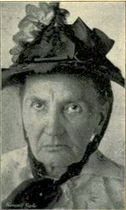
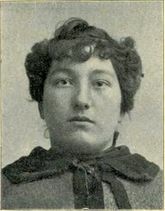
The following case has been a “repeater” for many years and is now in the penitentiary. She is sixty-eight years of age and has served sentences in the penitentiaries of Blackwell’s Island, Sing Sing, Jolie

Bertha, 68 year-old shoplifter, circa 1897, Chicago

Bertha, 68 year-old shoplifter, circa 1897, Chicago

t, and probably elsewhere. This is her third term in Joliet. She has also served several sentences in the Cook county jail. She is one of a gang of fourteen or more habitual thieves, some of whom own considerable real estate in Chicago, supposed to have been acquired from the profits of robberies. I first met Bertha while she was serving a jail sentence now more than a year ago.

When she was asked what brought her there she broke into tears and declared she couldn’t help it.” Six or eight months later she was under arrest again at the Harrison St. police station (Chicago) for her usual crime, shoplifting, and at which time I had a long talk with her in private.

“Bertha” came to America from a German village when she was sixteen years old, and on board the ocean ship she met a man whom three months later she married. He was a tinsmith by trade and only a few years older than herself. They lived sixteen years together when they separated, and he was later killed by a fall from the roof of a house he was working on.

She recalls as her first theft the stealing of a pocketful chestnuts when a young girl in her native village. It seems that a few minutes after the theft she was “conscience smitten” on passing one of the public statues of Christ, which she says are quite numerous in that part of the country. On looking at the statue’s face she felt its eyes pierce her with condemnation of her act, whereupon she threw away the nuts.

Excepting this act, she says she was a good girl while in Germany. The village she lived in in Germany was Roman Catholic, and here and there, at short intervals, were statues of Christ in the little public squares or open places.

Her mother died two years before she left Germany and her father was assassinated. She is one of a family of six sisters and three brothers.

She claims she was first introduced to systematic thieving by a female acquaintance in New York who had lots of nice things and seemed to have a “good time” by thieving in stores. Says she knows perfectly well that it is wrong to steal from anybody, but that if she didn’t “go down with the dogs she wouldn’t come in with the police,” or, in other words, the need of money and the influence of association.

She declares that she prays every night but hasn’t been to a church since her last time in the penitentiary. Says a church would fall on her because of her wickedness if she should enter one. She seemed greatly impressed with a priest who visits the jail because of his expression of sadness at seeing her return to jail. Says “his words pierced her like lightning.” She told the judge when he sentenced her that he could hang her if he chose. I have not the slightest doubt of her sincerity.

During my interview with her she frequently heaved a deep sigh and once exclaimed to herself, oh dear ! oh dear! She is a keen, robust and vigorous woman for her age, and evidently of a passionate disposition. She admits drinking freely at times, but denies having other vices.

She says that if she had her liberty and her choice she would return to her native village, where they have free homes for old people. The gang she has been operating with, range in their ages from eighteen to forty-five years, two sons of one of her sisters being engaged in selling the goods stolen. Claims she never stole from poor people. She is now in the Joliet penitentiary, and several of the other leaders of her gang have also recently been taken to the same place.

Source: Crime and Criminals, by John Sanderson Christison, Chicago Medical Book Co. 1898.
 
Check out more of our Vintage Mug Shots.
 
—###—
 

The Warden’s Wife: Kate Soffel & The Biddle Brothers, 1902

Home | Short Feature Story | The Warden’s Wife: Kate Soffel & The Biddle Brothers, 1902


The following story was made into a movie in 1984 entitled, Mrs. Soffel, 
and starred Diane Keaton and Mel Gibson.


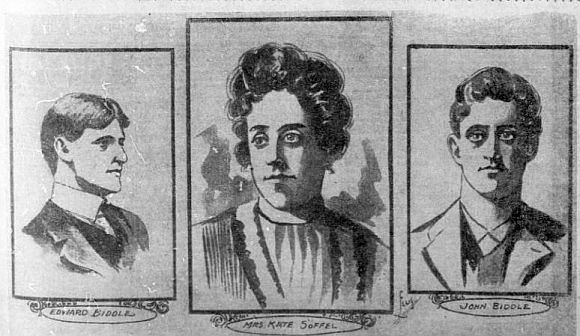
Kate Soffel & the Biddle Brothers, Ed & Jack.

Kate Soffel & the Biddle Brothers, Ed & Jack.

Story by Thomas A. Duke, for his book, Celebrated Criminal Cases of America, 1910.

.

During the early months of 1901, twenty-seven burglaries were committed in Pittsburgh, and the modus operandi of these bold thieves convinced the authorities that the crimes were all committed by the same persons.

In the early morning of April 12 an effort was made to burglarize the grocery-store conducted by Thomas Kahney, who discovered them in the act and was shot dead by one of the thieves.

On the same morning Inspector of Police Robert Gray and Detective Patrick Fitzgerald received information that the movements of a gang of men and women living at 34 Fulton Street should be investigated.

The officers proceeded to the house, and upon being refused admission they began to force an entry. As they did so, a shot was fired which killed Fitzgerald.

A posse then surrounded the house and two brothers, named Ed and Jack Biddle, Frank Dorman and two women, known as Jennie Wilcox and Jessie Wright, were arrested.

It was then learned that the men of this gang committed many and probably all of the twenty-seven burglaries above referred to and also the murder of Kahney, the grocer.

The entire gang was charged with murder, the two brothers being convicted and sentenced to be hanged on December 12, 1901.

Dorman was sentenced to life imprisonment and the two women were acquitted.

The Governor granted the Biddle brothers a respite of sixty days, during which time they were confined in the Alleghany County Jail in Pittsburgh.

At 4 a. m. January 30, 1902, Ed Biddle called from his cell to Guard James McGeary and announced that his brother had been taken suddenly ill and requested that the guard procure some cramp medicine immediately.

McGeary hastened to comply with the request, and when he returned with the medicine the Biddles broke through the bars which they had sawed almost in two. They then grappled with McGeary and threw him over a railing down to a cement floor sixteen feet below. The guard struck on his head and for some time it was believed he would die.

The desperate men then produced revolvers which had been smuggled in to them and they shot another guard named Reynolds, inflicting a serious but not fatal wound.

As only one other guard was present, they covered him with a revolver and threw him into the dungeon where his outcries could not be heard.

As these two men then became complete masters of the prison, they took the keys from McGeary’s person and walked out of the prison into Ross Street.

When Warden Peter Soffel was informed of what had transpired he almost collapsed, but when he recovered himself he stated that his wife, the mother of his four children, had disappeared and that circumstances convinced him that her infatuation for Ed Biddle, who was a handsome fellow, caused her to surreptitiously supply the brothers with the saws and weapons and that she had probably accompanied them in their flight.

At this time the ground was completely covered with snow and a posse, consisting of three Pittsburg detectives and five other officers, started in pursuit in sleighs.

On the next day, January 31st, the officers learned that the Biddle brothers and Mrs. Soffel had dinner at J. J. Stevens’ home at Mount Chestnut, five miles east of Butler, Pa.

The officers started in pursuit, and upon nearing Mc-Clure’s barn, two miles from Mount Prospect, they saw the two brothers and Mrs. Soffel attempting to escape in a sleigh. When the officers got within sixty yards of the trio they commanded them to halt, but as the order was ignored the officers opened fire with their rifles.

The brothers responded, and during the fusillade they received fatal wounds and rolled off the sleigh on to the snow. Mrs. Soffel was also wounded in the breast and fell on to the snow, but by a miracle none of the officers was injured.

The three injured persons were taken to the hospital at Butler, Pa., where Ed Biddle admitted that Mrs. Soffel had rendered the only assistance they had received.

He stated that her reason for so doing was because she believed they were innocent men about to be hanged.

John Biddle died at the Butler hospital at 7:35 p. m. on February 1 and Ed died three hours later.

Mrs. Soffel was seriously but not fatally wounded. When she realized what she had done she expressed the wish that she would also die. She added that the brothers were forced to leave the jail earlier than intended, as she had learned that the cells were to be inspected in a few days and she feared that the officials would discover where the bars had been sawed.

When Mrs. Soffel fell from the sleigh she dropped a long letter written by Ed Biddle to her, which showed that she fell in love with the desperado in November, 1901, and on December 2 she began preparations to liberate him.

It was she who purchased the saws and weapons and smuggled them in to the prisoners.

Mrs. Soffel was prosecuted for her part in the jail break and sent to State Prison for two years. After her release she tried the theatrical business, but the performance was stopped by the authorities. She then went into seclusion, changed her name and earned her living as a dressmaker, fully repentant for her mad infatuation for Biddle.

On August 30, 1909, she died at the West Pennsylvania Hospital in Pittsburg from a complication of diseases.


More Reading:

May Be The Biddles” The Washington Star, Jan. 31, 1902.

Warden Was Warned His Wife Was Infatuated,” The Salt Lake Herald, Feb. 4, 1902

—###—


Mug Shot Monday! A Jealous Husband, 1897, Chicago

Home | Mug Shot Monday | Mug Shot Monday! A Jealous Husband, 1897, Chicago


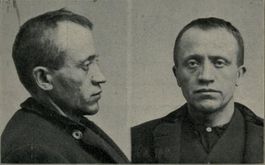
Matt Rollinger is a Luxemberger, thirty-four years of age, married, three children, and a cabinet-maker by occupation. Boarding at his house was a man whose intimacy with Mrs. Rollinger gave rise to rumors which reached his ears, and finally he became convinced of their truth.

Matt-Rollinger

Matt Rollinger, circa 1897

One morning after witnessing more than he could withstand, he sallied forth in the early twilight, partly attired in female garb, and with, pistol in hand lay in wait for the exit of his enemy. While the light was still dim he saw a form approaching which he thought was the man he wanted. He fired and the man fell dead. He had killed his friend and neighbor and not the object of his fury.

He was arrested for murder and at his trial it was shown he was in a bewildered and frenzied state of mind when found on the spot the next moment.

He is a stolid and childish creature with a harmless disposition except under great provocation. His mistake and confinement seemed to add a melancholic and demented condition. But he had the reputation of being a peaceable, industrious and skilled mechanic.

On good authority I am told that some of the jurymen remarked that if he had killed the man he intended to, he would have been acquitted. It seems they do not feel it would be safe to free him at once, and they saw no other course open but to sentence him to return the verdict of 14 years in the penitentiary.

Source: Crime and Criminals, by John Sanderson Christison, Chicago Medical Book Co. 1898.

Check out more of our Vintage Mug Shots.

—###—


The Baby Snatcher, 1924

Home | Feature Stories | The Baby Snatcher, 1924


.

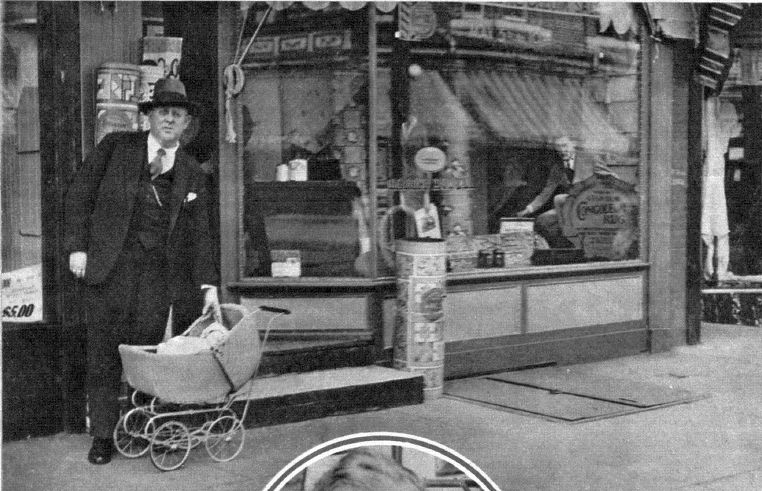
Scene of where baby Corinne Modell was kidnapped. Modell’s Upholstery Store at 116 South Sixtieth Street, Philadelphia.

Scene of where baby Corinne Modell was kidnapped. Modell’s Upholstery Store at 116 South Sixtieth Street, Philadelphia.

It was a happy mother who wheeled Baby Corinne Modell’s perambulator (baby carriage) to the front of the Modell’s Upholstery Store at 116 South Sixtieth Street, Philadelphia, the afternoon of May 5th, 1924.

Corinne, ten weeks old had easily won the blue ribbon at a neighborhood baby contest. Admiring neighbors gathered to pay tribute to the chubby little Miss who had been proclaimed queen of her neighborhood’s babyland. They laughed in delight as she gurgled approval of their caresses.

Honors rest lightly upon babies, however, as Corinne soon demonstrated.

For while a few neighbors still lingered, she closed her eye and was soon off to that land of slumber known only to babies.

“Mama,” Corinne’s father said to his wife, Eva, “It is such a nice warm day that I think we should let baby sleep out here. It will do her good. [In other words, they left her unattended in front of the store in the baby carriage.]”

Mr. and Mrs. Modell entered their store. It was then about 1:30 P.M.

A half hour later, Mrs. Modell emerged. She went to the baby carriage and peered under its hood to see if the child was still sleeping.

She gasped in horror at what she beheld. Then, realizing what had occurred, she screamed.

The baby was missing! She had vanished as though some evil spirit, jealous of the honors bestowed upon her, had spirited her away.

In the place where she had been resting lay a lifeless, was doll.

Click Here To Read The Rest of the Story


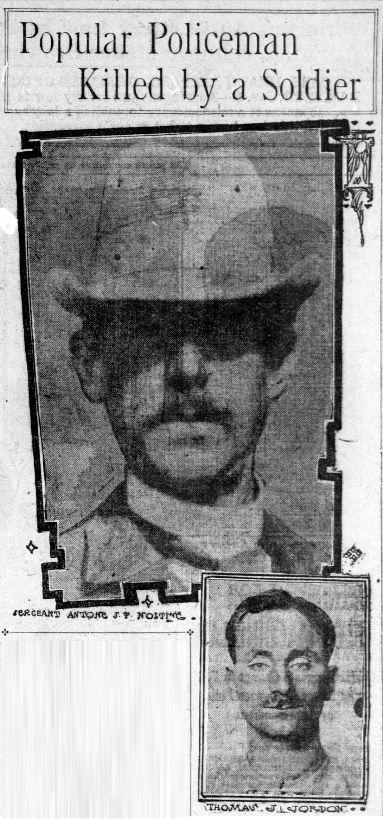
The Premonition of Sgt. Anton Nolting, 1909

Home | Short Feature Story | The Premonition of Sgt. Anton Nolting, 1909


Jan. 8, 1909, San Francisco, CA

anton-nolting

Click to open larger image in new window. Photo by The San Francisco Call, 1-9-1909

Anton J. F. Nolting was born in San Francisco on February 9, 1860. He was of a studious disposition and acquired a high education. As a young man he was in comfortable circumstances financially but meeting with reverses, he joined the San Francisco Police Force on December 2, 1895.

On March 29, 1905, he was made a Corporal and on July 9, 1907, was advanced to the rank of Sergeant.

Because of his quiet, unassuming and kindly manner, he was one of the most popular men in the department and was also generally admired because of his devotion to his invalid wife.

On October 2, 1907, he was assigned as a Patrol Sergeant to the Central Station.

He reported for duty on the watch beginning at midnight January 8, 1909, and it was noted that he was in an extremely melancholy mood. As a storm was raging, all patrol officers wore regulation rain coats throughout this watch.

About 1 a. m., Sgt. Nolting met Officer William Cavanaugh at Kearny and Bush streets. The Sergeant said that he felt that something terrible had happened or was about to happen.

After some meditation he said: “Perhaps something has happened to my poor wife.”

Nolting complained of dizziness and at Cavanaugh’s suggestion he went into the saloon at the southeast corner of Kearny and California Streets (A) and ordered a bromo-seltzer (similar to an alka-seltzer). The Sergeant then said he did not want to be alone and requested Cavanaugh to accompany him down California to Montgomery Street (B). Upon reaching that corner Nolting thought he saw the Montgomery Street officer at Sacramento Street (C) and proceeded alone in that direction, while Officer Cavanaugh was returning toward Kearny Street. [Subsequent discoveries proved that Nolting had evidently mistaken a civilian, who was also wearing a rain coat, for the officer.]

Anton-Nolting-Final-Patrol

Anton-Nolting-Map2

Click to open larger image in new window.

About the time Nolting reached Sacramento Street he heard a shot fired on Washington Street near Montgomery.

He proceeded in that direction, but when he reached Clay Street (D) he observed a soldier with a drawn pistol who was in the act of forcing two other soldiers to march ahead of him. Nolting approached the trio and began to expostulate with the soldier with the drawn revolver. At this instant the other two soldiers fled down Clay Street toward the ferry. Seeing that he could accomplish nothing by argument, the Sergeant closed in on the soldier and began grappling for the pistol. Nolting slipped and fell and while his back was partially turned, the soldier fired into his body, inflicting a wound which caused almost instant death. After firing three more shots at the officer, the soldier attempted to escape. He ran into a vacant lot which was almost immediately surrounded by Officers Brady, Teutenberg, Cavanaugh and Sheble, who were attracted to the scene by the shots. These officers closed in on the assassin shortly after he stumbled and fell and they found the empty revolver by his side.

Clay-Street

The corner of Montgomery & Clay Streets. Further up Clay Street, seen above Jordan killed Sgt. Nolting. Click to open larger image in new window.

When taken before Captains Anderson and Duke at the Central Station, he disclaimed all knowledge of the shooting and claimed that his mind was a complete blank regarding his actions during the preceding hour.

He stated that his name was Thomas Jordan and that he belonged to the Coast Artillery stationed at Fort Baker. Shortly afterward, the two other soldiers (who ran away) were apprehended at the water front.

One of the two made a statement substantially as follows:

“My name is Charles Nibarger and my companion’s name is John Kralikouski. We are soldiers stationed at Fort Baker. I had been sent out as a provost guard (Military Police) and was armed with a revolver. I was in the New Western saloon at Kearny and Washington about midnight with Jordan and Kralikouski.

“In some manner Jordan got possession of my gun and pointing it at Kralikouski and me, he ordered us to march ahead of him. When we were going down Washington Street he said we were not moving fast enough and he fired a shot in the air. When we reached Montgomery Street he ordered us to turn toward Clay Street. When we reached the last named street, the police Sergeant approached and asked who fired the shot.

LA-Herald-10-26-1909

Click to open larger image in new window.

“While he and Jordan were arguing we ran down Clay Street. We had only traveled about forty feet when we heard the shots.”

On Sunday, January 10, Sergeant Nolting’s funeral took place. The Mayor, Police Commissioners and about 300 officers attended. The largest floral piece around the casket was one sent by the soldiers from Fort Baker.

Jordan was held to answer in the Superior Court. The defendant claimed that he was in an “alcoholic trance” when the deed was done. Hiram Johnson was retained as special prosecutor.

On March 12, 1909, Jordan was found guilty and sentenced to life imprisonment.

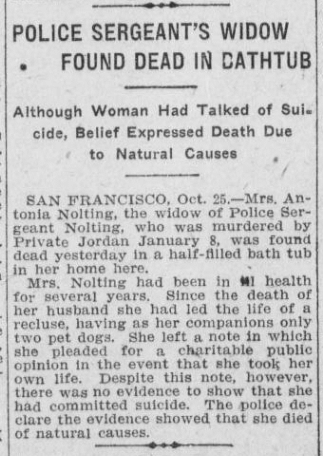
After the death of her husband, Mrs. Antonia Nolting failed rapidly and she was found dead in her bathtub on October 24 of the same year.

Story by: Thomas Samuel Duke, “Celebrated Criminal Cases of America,” The James H. Barry Company, 1910.
.
—###—

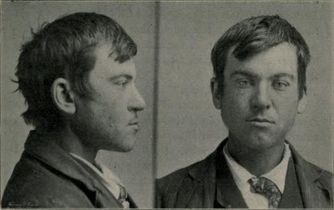
Mug Shot Monday: Arsonist George Perry

Home | Mug Shot Monday | Mug Shot Monday: Arsonist George Perry


This psychological profile was written in 1897 and I do not vouch for its 
accuracy. Source: Crime and Criminals, John Sanderson Christison, 
Chicago Medical Book Co. 1898.
 

“The first case [George Perry] considered is that of an epileptic, and arson is the crime charged. Epilepsy has many causes and many forms. Some persons have the convulsions with little, if any, apparent mental disturbance, while in others the nervous explosions, so to speak, produce a much greater effect on the mind and may even take the form of furor or insanity.

George-Perry

Arsonist George Perry, 22, Chicago. Mugshot is circa 1897.

“At the Elmira Reformatory 11 percent, of the prisoners had epilepsy or insanity quite strong in their family histories and many more had bad heredity in other respects.

“The following is a type of the most unfortunate kind of unfortunates—those who are liable to commit crime.

“They are always morbidly and excessively irritable and are quite sensitive to the fact that they have fits, and they usually hide the fact as far as they can, which is a practice not without some reason. This case has twice been a patient in an insane asylum, entering the first time at nine years of age and he has spent most of his life incarcerated.

“He is now twenty-two years old and had only left an asylum a few months before he was arrested for arson.

“When he left the asylum he had neither father, mother, nor friend to help him, and he was discharged under his protest. His mother died of consumption some months before and his father was too poor and far away to give him help. His only lot was to seek out odd jobs in the neighborhood to gain him shelter and food. He tarried in this irregular way for several months and finally tramped off in search of greener pastures.

“He had been a week with his last employer when he set fire to the barn. Just previous, the same morning, he had been to a saloon not far away, where he drank whiskey, but does not know what possessed him to commit the crime. He says his employer had treated him meanly, which is not at all unlikely, for such creatures are commonly treated without proper consideration.

“But whether this was so or not, he probably would not have committed the arson had he not been the subject of a mind perverted by the epilepsy and with all its morbid possibilities, making him not only irritable, but a dangerous person.

“He has the habit of reading the New Testament and saying prayers much of his time. In his cell almost every night he has a spell of incoherent muttering in French and Latin and of a religious composition. At times he is quite “ugly” in disposition to his cell-mates, and sometimes they are afraid of him.

“His mother died of consumption and his father, he says, is a good man, attending church, and neither smoking, chewing nor drinking, and he wishes he was like him. But it seems, as he remarked, that he cannot do better.”

Check out more of our Vintage Mug Shots.
 
—###—


Book Review: Murder in Battle Creek

Home | New Books | Book Review: Murder in Battle Creek


Review: Murder in Battle Creek, The Mysterious Death of Daisy Zick, by Blaine Lee Pardo,

One of the golden rules when it comes to writing a true crime book is to never write about a murder that hasn’t been solved. It’s a good rule to follow until it’s broken, and it produces a well written crime book in which there is an eeriness and unsettling quality about the crime NOT being solved.

One such book published in 2006 led BTK killer, Dennis Rader, to poke his head up which led to his arrest. And hopefully, Murder in Battle Creek, The Mysterious Death of Daisy Zick, by Blaine Lee Pardo, and published by History Press, is another such case.

An unsolved murder conflicts with human nature. It disturbs our psyche.  Our mind doesn’t like to leave things unfinished, unanswered and never knowing what happened or who did it. And when a book elicits those emotions, well, I argue that it is valid entertainment. Similar to a how a good ghost story makes us feel. We try to put answers to it but always fall short –and that disturbs us. It makes us think. It makes us feel.

And that’s one formula for a good book.

Book Synopsis 

On a bitterly cold morning in January 1963, Daisy Zick was brutally murdered in her Battle Creek home. No fewer than three witnesses caught a glimpse of the killer, yet today, it remains one of Michigan’s most sensational unsolved crimes. The act Murder-in-Battle-Creekof pure savagery rocked not only the community but also the Kellogg Company, where she worked. Here, Blaine Pardoe artfully takes the reader into this true crime thriller. Utilizing long-sealed police files and interviews with the surviving investigators, the true story of the investigation can finally be told. Who were the key suspects? What evidence does the police still have on this five-decades-old cold case? Just how close did this murder come to being solved? Is the killer still alive? These questions and more are masterfully brought to the forefront for true crime fans and armchair detectives.

Character development and Clarity: Pardoe does an excellent job of presenting the crime scene and secondary scene, giving depth and details to all the major characters, following a chronological timeline with clarity (a lot of writers can stray from a clear message), and unraveling all the major and minor facts and clues accordingly.

One thing a reader has to understand about a true crime book is that it can represent boxes and boxes of research, tens of thousands of pages, and it all has to be taken apart and reassembled into a 50,000 to 100,000 word book.

That’s not an easy thing to do and Pardoe does a good job of it.

Sense of Place: Some writers forget that the city or region is a character all itself. Pardoe doesn’t make that mistake and he does a masterful job of establishing “a sense of place.” I’ve never been to Battle Creek, Michigan. I never knew anything about it. But after I read Pardoe’s book, I’ve got a pretty good feel for what it was like in the 60s and how it evolved over the coming decades.

Writing: Pardoe’s writing style is solid and entertaining. He doesn’t put you “in the scene” as much as some other crime books, but I don’t think he could have with this particular story. I think his point-of-view for the writing was the right choice.

Summary: I am recommending to Historical Crime Detective readers, Murder in Battle Creek, The Mysterious Death of Daisy Zick,by Blaine Lee Pardoe. 160 pages, 45 images. (I can appreciate that many images. Wise decision from the publisher).


Mug Shot Monday: A 20 Year-Old Shoplifter

Home | Mug Shot Monday | Mug Shot Monday: A 20 Year-Old Shoplifter


With this post, we introduce a new segment on HCD called “Mug Shot Monday,” which features a mug shot or photograph and a short bio. Today’s mug shot is a 20 year-old shoplifter circa late 1890s with an interesting bio.

Twenty year-old Shoplifter from Chicago. Name unknown. Interesting Bio.

Twenty year-old Shoplifter from Chicago. Name unknown.

“Case 15 is a young woman, single, 20 years of age, and a native of Chicago. For the last three years she has adopted the life of a thief, her specialty being shoplifting. She has been in the bridewell four times and in the county jail four or five times. She has a decidedly pleasant and rather intelligent face, with a tinge of the “fly” expression, blended with caution, and even suggesting a trace of modesty. She is a trifle over average brightness, is well formed and plump, and has a frank and sociable disposition.

“She began crime early in life. When her mother sent her to buy cabbages she would steal the cabbages and keep the money, not because she never got any spending money, but because she wanted more. At 10 years of age she stole $2.60 in dimes and nickels from a cup in the pantry of a neighboring woman, who kept a candy store. At 11 years of age she stole two watches, one the day after the other, in a down-town department store. At 12 years of age she borrowed $5 in her mother’s name, but without her knowledge, from the wife of a neighboring saloon-keeper, on the plea that it was required to save a brother’s membership from lapsing in a beneficial society, her father being away from home at the time.

“Her father died in 1889 of dropsy at the age of 49, and her mother in 1892 of cancer, at the age of 52. Up to the time of her mother’s death she remained at home and attended school, being two terms short of graduating. She was now 17 years old, and says that because she could not get along with her brothers she left home and joined a girl schoolmate in systematic thieving. Her parents were strict Catholics, but her father would drink ‘a little too much” two or three times a year. She says she was always the “wild child of the family,” in which there were five bothers and three sisters, two of the brothers being older than herself.

“The others attended Sunday-school willingly, but she disliked it, and would play truant on an average of half the time. But she has never doubted as to God a future state, and rewards and punishment. She never read novels or much of anything else.

“Speedily she and her schoolmate pal became associated with a number of more experienced thieves, male and female, and for a while she lived with one of the men recently tried for the Marshall murder. She thinks she must have stolen over three hundred times, mostly from crowded stores, with an occasional chance at pocket-picking. Such articles as jewelry, ornaments, silks, dress goods, jackets, and even hats were the most common objects of attraction. She was usually accompanied by another woman or man, and would slip the articles under her cape or some other convenient garment she would wear. The stolen articles were sold to some of the many ”fences” in town.”

Source: “Crime and Criminals,” by John Sanderson Christison, Chicago Medical Book Co. 1898.

Check out more of our Vintage Mug Shots.
 
—###—

The Lazy Lothario, 1929-31

Home | Feature Stories | The Lazy Lothario, 1929-31


He boasted of his success as a ladies’ man. “Give me just two weeks with any woman in the world and she will give me the key to her heart,” he flaunted. “After all, I can’t be blamed for marrying all these women. What’s a popular man going to do? I have to please the women, and they are always chasing me.”

– George Perry, Bigamist Wife Killer

From: “Who Killed Cora Belle Hackett?” by Hyland J. Barnes, The Milwaukee Journal, The Green Sheet, Two Part Series Published on April 4 & 5, 1938, page 1 and page 1.


HARRY ST. GERMAIN prodded the misshapen bundle which lay across the deserted trail.

He had been sent to this densely wooded area of the Lac du Flambeau Indian reservation near Eagle River, Wisconsin to repair a broken telephone line and had stumbled over this mysterious object partially covered with leaves.

St. Germain dropped to his knees and began scraping away the leaves. Suddenly he drew back, shocked. He was looking at the body of a woman!

Turning from the weird spectacle, St. Germain hurried to phone Coroner Pat Gaffney. It was Sept. 30. 1930, and he had uncovered a ghastly murder that was to involve seven innocent women, a dapper Don Juan and was to send police of more than a dozen states on a nation-wide manhunt.

deserted-log-trail

The deserted logging trail where Cora Belle Hackett’s body was found near Eagle River, Wisconsin

Click Here To Read The Rest of the Story

Be Sure To Follow Us on Facebook for Weekly Updates, New Stories, Photos & More


Jesse Pomeroy: America’s Youngest Serial Killer

Home | Short Feature Story | Jesse Pomeroy: America’s Youngest Serial Killer


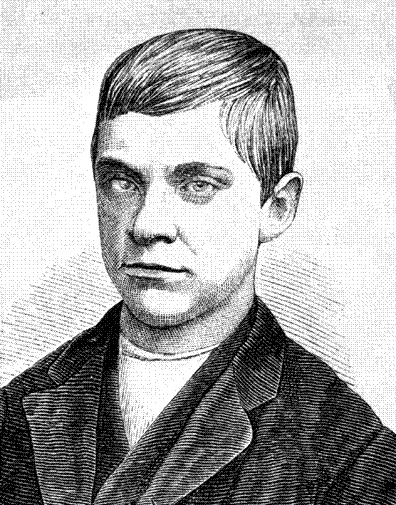
Jesse Pomeroy

Jesse Pomeroy

On December 22, 1871, the little son of Mrs. Paine, of Chelsea, a suburb of Boston, was inveigled by an unknown boy, evidently about twelve years of age, to Powder Horn Hill, near Boston, where he was stripped naked, tied to a beam and beaten with a rope until he become unconscious. The larger boy then disappeared.

On February 21, 1872, little Tracy Hayden was taken to the same place by a boy of the same description and in addition to undergoing torture similar to that inflicted upon the Paine boy, he was struck across the face with a board,  the blow breaking his nose and knocking out several of his teeth.

On July 4, 1872, this same mysterious youth enticed a boy named Johnny Balch to the same scene of torture, where he received treatment similar to that administered to the other victims, but when the child had regained enough strength to enable him to walk, his companion forced him to accompany him to a salt water creek nearby, where his wounds were washed with salt water.

In September, 1872, another child named Robert Gould was persuaded by this same boy to accompany him, to the Hartford and Erie Railroad track, where he was tied to a telegraph pole, stripped, beaten and cut about the head with a knife.

A few days after this, a little chap named Harry Austin met this mysterious young fiend at South Boston, and he was stripped, bound and punctured with pins until he became unconscious.

Within a few days after this, the sixth child, named George Pratt, was enticed into the cabin of a yacht at South Boston, and after being bound, was stripped, beaten and stabbed in the back and groin with a penknife.

Scarcely another week elapsed before little Joseph Kennedy was inveigled to a secluded spot in the Old Colony road, in South Boston, where he was maltreated in identically the same manner as was the Pratt child.

A great number of boys were arrested on suspicion, but were discharged.

Finally suspicion fell upon a boy named Jesse Pomeroy, a twelve-year-old youth who lived with his widowed mother, a poor dressmaker, on Broadway Street, between D and E streets, South Boston.

He was positively identified by several of the children he had tortured, and as it was proven beyond all doubt that he was the much-sought youths he was sentenced to serve the remainder of his minority at the West Borough Reform School. According to the custom, if the boys confined at this school were exemplary in their behavior and the authorities felt confident that the good conduct would continue after their release, they were often released on probation, providing they had a good home to go to.

Unfortunately this was done in Pomeroy’s case on February 6, 1874.

On March 8, 1874, John Curran, whose residence was in the neighborhood of the Pomeroy home, notified the police that his ten-year-old daughter had mysteriously disappeared. The only clue obtainable was the statement of a child who saw a little girl, of the same description as Curran’s daughter, enter a buggy with a strange man. As the missing girl was very pretty and well developed, it was suspected that it was a case of abduction, and the investigation was made along those lines.

On April 22, 1874, the body of a four-year-old boy named Horace Mullen was found in a marsh near Dorchester, a suburb of Boston, Mass.

The body was horribly mutilated, the head being nearly severed from the body, upon which there were thirty-one knife wounds.

Having in mind the past record of Jesse Pomeroy, the officials naturally suspected him, and he was taken into custody on the following day. A knife was found in his possession, upon the blade of which some blood was found near the handle, but the remainder of the blade was clean. Upon his shoes was found mud similar to that found only on marsh lands.

Footprints could be very easily traced through this marshy land to the spot where the body was found. Plaster casts were made and it was found that they not only fitted Pomeroy’s shoes in every respect, but it was seen that the tracks were made by a person, who in walking, planted his foot in the same manner as Pomeroy.

In addition to this, other circumstantial evidence was procured and then Pomeroy was taken into the room where the body of the child lay. The following conversation occurred between the officer and Pomeroy :

Officer: Do you know this boy?

Pomeroy: Yes, sir.

Officer : Did you kill him?

Pomeroy : I suppose I did.

Officer : How did you get the blood off the knife ?

Pomeroy: I stuck it in the mud.

An examination was then made, and it was found that the boy was perfectly sane, but was naturally a fiend and derived pleasure from torturing others.

He selected children only because he had the physical ability to force them to do his will.

In July of the same year Mrs. Pomeroy’s landlord sold the property where she resided, and the new owner proceeded at once to make extensive improvements. Laborers began to excavate the cellar and about 5 p. m. on July 18 they found the badly decomposed remains of a little girl buried under a pile of ashes and stones.

Among those who viewed the remains were Mr. and Mrs. Curran, and while the features were not recognizable, they readily identified the wearing apparel as that of their lost child. Pomeroy had been seen with the child, and he finally confessed that it was he who murdered her and buried the remains.

On December 10, 1874, Pomeroy was convicted on the charge of murdering the Mullen child and was sentenced to be hanged.

An appeal was taken to the Supreme Court, which sustained the lower court on February 12, 1875. Governor Gaston refused to sign the death warrant because of the extreme youth of the murderer.

His successor, Governor Rice, also refused for the same reason, and on August 31, 1876, Pomeroy’s sentence was commuted to solitary confinement for the remainder of his life. He has made frequent attempts to escape, but always failed. In some mysterious manner he obtained an explosive, which he placed near the door of his cell, but when the explosion occurred it did more damage to him than it did to the door.

Notwithstanding the fact that Pomeroy has been in solitary confinement for thirty-three years, he has developed into a powerful man, and in 1909 was enjoying perfect health.

As he is seldom permitted to receive visitors he devotes nearly all of his time to reading and study and has become a highly educated man.

Source: “Celebrated Criminal Cases of America,” Thomas A Duke, 1910.

From Wikipedia:

It remained for the Governor to sign the death warrant and assign a date for Pomeroy’s execution. However, Governor William Gaston refused to comply with this executive responsibility. The only legal means of sparing Pomeroy’s life was through the Massachusetts Governor’s Council, and only if a simple majority of the nine-member Council voted to commute the death penalty. Over the next year and a half, the Council voted three times: the first two votes upheld Pomeroy’s execution, and both times Governor Gaston refused to sign the death warrant. In August 1876, the Council took a third vote, anonymously, and Pomeroy’s sentence was commuted to life in prison in solitary confinement. On the evening of September 7, 1876, Pomeroy was transferred from the Suffolk County Jail to the State Prison at Charlestown, and began his life in solitary. He was 16 years and 9 months old. Pomeroy remained incarcerated at the Charlestown State Prison.

In prison, Pomeroy claimed that he taught himself to read several foreign languages, including Arabic, and one visiting psychiatrist found that he had learned German with “considerable accuracy.” He wrote poetry and argued with prison officials over his right to have it published, and he studied law books and spent decades composing legal challenges to his conviction and requests for a pardon. A psychiatric report on Pomeroy made in 1914, and quoted extensively in the Boston Globe after his death, noted that Pomeroy had made 10 or 12 “determined attempts” to escape, and that handmade tools were frequently found in his possession. A prison warden reported finding rope, steel pens and a drill that Pomeroy had concealed in his cell or on his person. According to the Globe, Pomeroy lost an eye after attempting to destroy the side of his cell by redirecting a gas pipe. The 1914 psychiatric report claimed that Pomeroy had shown the “greatest ingenuity and a persistence which is unprecedented in the history of the prison.”

In 1917, Pomeroy’s sentence was commuted to the extent of allowing him the privileges afforded to other life prisoners. At first he resisted, wanting nothing less than a pardon. He eventually adjusted to his changed circumstances and appeared in a minstrel show at the prison. In 1929, by this time an elderly man in frail health, he was transferred to Bridgewater Hospital for the Criminally Insane, where he died on September 29, 1932.

There is a book about this case written by crime historian and author, Harold Schechter. Fiend: The Shocking True Story Of America’s Youngest Serial Killer


eCover-small

Buy it today on Amazon! 372 pages, $3.95, Free with Kindle Unlimited!