True Crime Books by Jason Lucky Morrow

Welcome to HistoricalCrimeDetective.com [Est. 2013], where you will discover forgotten crimes and forgotten criminals lost to history. You will not find high profile cases that have been rehashed and retold ad infinitum to ad nauseam. This blog is the official website for true crime writer Jason Lucky Morrow, author of four books including the popular series: Famous Crimes the World Forgot, Volume I and Volume II. If you would like to send me a comment, Contact Me Here. - Please follow this historical true crime blog on FACEBOOK.

New Book: The Midnight Assassin: Panic, Scandal, and the Hunt for America’s First Serial Killer, by Skip Hollandsworth

Home | New Books | New Book: The Midnight Assassin: Panic, Scandal, and the Hunt for America’s First Serial Killer, by Skip Hollandsworth


HCD Review:

This is the best historical true crime book of 2016. Some authors crank out books, some of them write books, and an elite few craft a great book over years of unimaginable diligence and Skip Hollandsworth has produced a new American classic. I read it this weekend and I can tell you that the writing is so exquisite, that it’s like being connected to a virtual reality headset that takes you back to the panic and horror of a serial-killer whose murder spree was more daring than Jack the Ripper–before there even was a Jack the Ripper. The eBook and print version are priced about what you would expect for a book with a decade of work behind it, but that doesn’t matter. This book is an experience, not some superficial read. Do whatever you got to do to get this book. – Jason Lucky Morrow

Book Description:

A sweeping narrative history of a terrifying serial killer–America’s first–who stalked Austin, Texas in 1885

The-Midnight-AssassinIn the late 1800s, the city of Austin, Texas was on the cusp of emerging from an isolated western outpost into a truly cosmopolitan metropolis. But beginning in December 1884, Austin was terrorized by someone equally as vicious and, in some ways, far more diabolical than London’s infamous Jack the Ripper. For almost exactly one year, the Midnight Assassin crisscrossed the entire city, striking on moonlit nights, using axes, knives, and long steel rods to rip apart women from every race and class. At the time the concept of a serial killer was unthinkable, but the murders continued, the killer became more brazen, and the citizens’ panic reached a fever pitch.

Before it was all over, at least a dozen men would be arrested in connection with the murders, and the crimes would expose what a newspaper described as “the most extensive and profound scandal ever known in Austin.” And yes, when Jack the Ripper began his attacks in 1888, London police investigators did wonder if the killer from Austin had crossed the ocean to terrorize their own city.

With vivid historical detail and novelistic flair, Texas Monthly journalist Skip Hollandsworth brings this terrifying saga to life.

Praise:

“Gripping and atmospheric… This true crime page-turner is a balanced and insightful examination of one of the most stirring serial killing sprees in American history, and certainly one of the least well-known.”
—Publishers Weekly, starred review

“Through scrupulous research and a finely tuned sense of the gothic, Hollandsworth has brought this Texas-sized true-crime story, more than a century old, to vivid, chilling life on the page.”
—Hampton Sides, author of Hellhound On His Trail and In the Kingdom of Ice

“Readers who loved The Devil in the White City now have the pleasure of reading The Midnight Assassin. It paints a compelling portrait of a culture at a turning point – that is, the capitol of Texas at the end of the 19th Century, when the barbarism of the frontier was giving way to the savagery of urban life.”
—Lawrence Wright, Pulitzer Prize-winning author The Looming Tower and Thirteen Days in September

“Skip Hollandsworth, one of the great true-crime writers of our era, has brought his remarkable talent to bear on one of the most fascinating untold criminal stories in American history. The Midnight Assassin captures a time, a place, and a feeling—booming Texas in the latter 19th century—in a way no nonfiction account I have read has done. A jewel of a book.”
—S.C. Gwynne, author of Empire of the Summer Moon and Rebel Yell

—###—


Suspect Arrested in 1976 California Cold Case

Home | Recent News | Suspect Arrested in 1976 California Cold Case


SAN BERNARDINO, CBSLA.com, April 2, 2016  —   The San Bernardino County District Attorney’s Office has announced the arrest of a suspect in a murder that took place in 1976.

Cynthia-May-Hernandez

Cynthia-May-Hernandez

Larry James Allred, now 61, has been charged with the murder of then 19-year-old Cynthia May Hernandez.

The DA said that Hernandez left  her home on the evening of August 26, 1976 to catch a movie at the Fox Twin Theaters in Covina.

Hernandez, a recent graduate of Charter Oak High School, never came home.

The next morning, her family located her unoccupied vehicle in the theater parking lot. They immediately filed a missing person’s report with the Glendora Police Department.

Nearly 40 years after her disappearance, a suspect has been formally charged in connection with her murder.

Read More on this recent story:

http://losangeles.cbslocal.com/2016/04/02/san-bernardino-county-das-office-announces-arrest-in-1976-cold-case-murder/

From 2012

Woman’s disappearance still unsolved, 2012, San Gabriel Valley Tribune

Also Read:

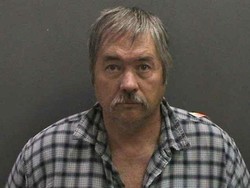
In 2011, a Larry James Allred and Robert Edward Smyrak were arrested for importing $2 million worth of knock-off Disney Pins. “In 1975, he was convicted of rape; in 1978, for kidnapping and rape,” the 2011 report

Allred’s 2011 arrest photo:

Larry_James-Allred

—-###—-


Mug Shot Monday! Bert Martin, Horse Thief, 1900

Home | Mug Shot Monday | Mug Shot Monday! Bert Martin, Horse Thief, 1900


Bert-Lena-Martin-1901

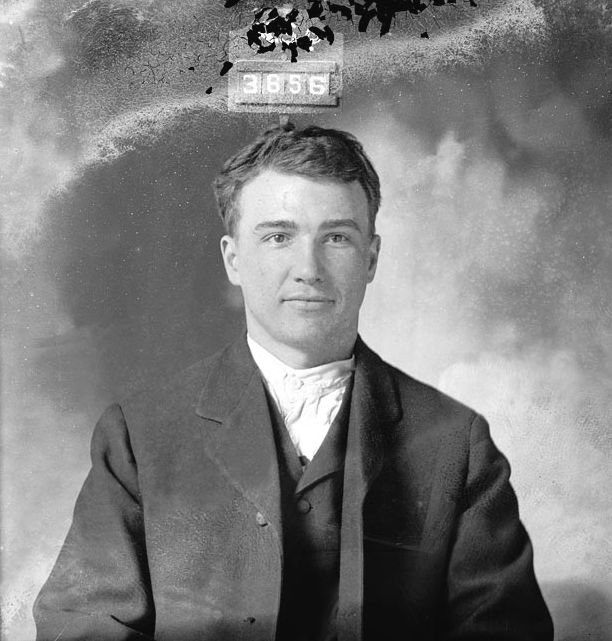
Bert Martin, Horse thief, 1900/01

In October 1900, ranch hand Bert Martin went on trial for stealing horses in Springview, Nebraska, the county seat of Keya Paha County. During his trial, he was supported by his wife and step-child, as well as his widowed-mother.

On October 13, he was found guilty and sentenced to serve two years at the state penitentiary. His conviction was probably no surprise to anyone in the county since Martin already had the reputation as “an expert ‘borrower’ of steeds.”

Due to what prison officials saw as Martin’s “ill health,” he was put on light-duty and worked in the prison’s broom factory.

“The convict Martin was always regarded as a delicate prisoner. Ill health seemed to be undermining his constitution,” read a newspaper report from 1901. “Small feet, small hands…standing five-feet four-inches, weighing but 120 pounds…Martin was employed in the prison broom factory, and performed the duties well, but was not assigned to heavy work.”

After Martin was eleven months into his sentence, he became the subject of prison gossip and an air of mystery about his identify was forged. His cellmate told prison officials that an investigation into Martin would reveal “a sensation.”

Soon, an examination by the prison physician uncovered Martin’s secret: Bert Martin was a woman.

Her real name was Lena Martin. Unable to find employment as a woman that was suitable to her liking, she ventured to a sparsely populated county in northeast Nebraska, dressed as a man, and found work as a ranch hand. She also met and married a single mother who agreed to keep her secret. Lena’s mother was also in on the deception.

On September 22, 1901, Lena Martin was transferred to the women’s prison in York, Nebraska. Before she was transported, Lena was taken to Lincoln where prison officials were forced to purchase a new dress for her because “women’s clothing is not carried in stock at the penitentiary.”

Seven months later, Governor Ezra Savage was so disgusted with Lena Martin that he commuted her sentence to time served and she was released. In his biennial address, Savage referred to Martin as “it” four times in a single sentence.

“[She is] a sexual monstrosity, unfit for association with men or women even in a penal institution, and on the solemn promise of its aged mother to care for it and guard it, and that prison morals imperatively demanded its removal, sentence was commuted to one year, six months, February 3, 1902.”

Note: I could not locate this particular Lena Martin in the US Census records from 1890 to 1940.

Similar Story posted on HCD: Handsome Jack Hill Was a Woman, 1913

—###—


New Book: In the Company of Evil:
Thirty Years of California Crime, 1950-1980

Home | New Books | New Book: In the Company of Evil:
Thirty Years of California Crime, 1950-1980


Inside Look at Serial Killers, Assassins, Bank Robbers, and More
Crime Overviews, Evidence Gathered, and Theories for Solutions

in-the-company-of-evilCalifornia’s picturesque shores have always been a magnet for outcasts and criminals. Read about 64 of the most horrifying crimes ever committed in The Golden State, from the early 1950s into the 1980s.

These accounts tell of man’s inhumanity toward his fellow man and provide an inside look at infamous serial killers, assassins, sadistic rapists, bank robbers, kidnappers, Satan worshippers, and a plethora of other notorious criminals.

Revisit “The Sex Club Slaying,” “The Chowchilla School Bus Kidnapping,” and the “Real House on Haunted Hill.” Be glad you’re not on the helpful list of “The Lonely Hearts Killer” or “Souls for Satan.”

Written in an accessible, chronological sequence and enhanced by over 60 photographs, each entry provides an overview of the crime, the parties involved, evidence gathered, and leading theories about solutions. This reference is indispensable for the study of the history of modern crime in California.

About the Author: Award-winning author and columnist Michael Thomas Barry is a graduate of the California State University Fullerton with degrees in criminal justice and history. He is a columnist for CrimeMagazine.com where he pens, “This Week in Crime History.” He is the author of six nonfiction books and has received numerous literary awards that include the 2014 Readers Favorite International Book Awards (gold medal). Barry resides with his wife Christyn and their golden retriever Jake in Orange, California. Visit Michael’s website at http://www.michaelthomasbarry.com for more information.

—###—


Mug Shot Monday! Jay Kelly Pinkerton, 1979, Texas, Executed 1986

Home | Mug Shot Monday, Short Feature Story | Mug Shot Monday! Jay Kelly Pinkerton, 1979, Texas, Executed 1986


Jay-Kelly-Pinkerton-TX

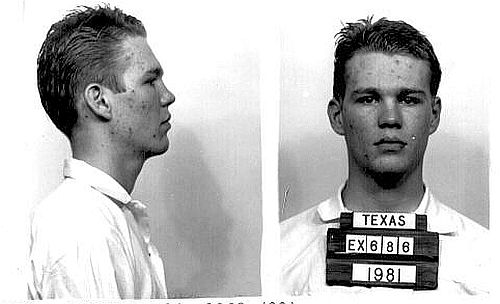
Jay Kelly Pinkerton

Warning: This story contains graphic content, near the end.

Jay Kelly Pinkerton was executed by the state of Texas on May 15, 1986, for the rape and murder of two women. On October 26, 1979, Pinkerton entered the Amarillo home of David and Sarah Lawrence between the hours of 9:30  and 11:30 p.m. where he murdered, mutilated, and raped (possibly in that order) Sarah with a large Bowie knife found in the master bedroom. While he did so, her children were asleep in another room.

Fresh footsteps outside the residence led police two blocks away to the home of a known and experienced burglar, Jay Pinkerton, who was just seventeen-years-old. Although he was wearing tennis shoes with similar tread patterns, the forensic skills of the Amarillo Police Department at that time were not at a level that could conclusively match them together and Pinkerton was released for lack of evidence. A bloody palm print at the Lawrence home was also not immediately identified as belonging to Pinkerton.

Six months later, on April 9, 1980, Pinkerton broke into an Amarillo furniture store and raped and stabbed to death twenty-five-year-old former beauty queen, Sherry Welch. The brutality and knife wounds of the Welsh and Lawrence murders were similar, with each victim being stabbed approximately thirty times. Because of his unverified connection to the Lawrence murder, police had a good idea who was responsible for murdering Welch, but it would take them a few more months to match the bloody palm print found at the Lawrence home to Pinkerton. He was eventually arrested and paraded on local television on September 26, 1980.

Due to the intense fear and anxiety of Amarillo residents had following each murder, Pinkerton’s trial for killing Sarah Lawrence was held in Corpus Christi—approximately 660 miles away. Pinkerton, who relished the media attention, was found guilty and sentenced to death on May 30, 1981.

Eleven months later, he was put on trial for the murder of Sherry Welch after bite marks found on her breasts were matched to dental impressions taken from Pinkerton. Another trial, another change of venue (El Paso), more savoring of the media attention, and another guilty verdict got him a second death sentence.

Pinkerton’s skills as a burglar, and the creepiness with which he applied that skill, were detailed in a 1999 Amarillo Globe-News article by reporter Amy Porter. [That article/link is no longer available after the Amarillo Globe moved its content behind a paywall. 11-23-2025]

Pinkerton, who converted to Islam before his execution, gave a final statement just minutes before he was declared dead at 12:25 a.m.

“Be strong for me,” Pinkerton told his father, Gene Pinkerton, as witnesses entered the execution chamber. “I want you to know I’m at peace with myself and with my God.” He recited a prayer to Allah, the supreme being of Islam. “I bear witness that there is no God but Allah. With your praise I ask for forgiveness and I return unto you,” Pinkerton said. “I love you, Dad.”

At one point, unclear when from official documents, Jay said to his father: “Say good-bye to mom. Keep your spirits up for me.”

“Good-bye Jay,” his father said.

“I love you dad,” he replied.

Pinkerton was twenty-four-years-old when he was executed. If still alive today, Sarah Lawrence would be approximately sixty-six-years-old, and Sherry Welch, sixty-years-old.

The following report comes from the prosecution’s reply to Pinkerton’s 1983 appeal and described in graphic detail the Lawrence crime scene, the evidence, her mutilation, and rape.

Warning: Graphic Content.

JAY KELLY PINKERTON v. STATE TEXAS (07/13/83),

COURT OF CRIMINAL APPEALS OF TEXAS, TRIAL TRANSCRIPT

SOURCE

…David Lawrence, husband of the deceased, testified that he called his wife at 9:30 on the night of October 26, and told her he would be home about 11:00.

Upon arriving home at 11.30 p.m., Lawrence found his wife with blood on the side of her face on the floor of their living room. His wife was lying face-up between the couch and the coffee table. The lower portion of her body was entirely nude. After examining her more closely, Lawrence noticed a large gaping hole in her throat with blood still running out of it. Her legs were spread apart and her panties had been rolled down to the bottom of her right leg.

Missing from the house was a large Bowie knife which had been displayed on a rack in the master bedroom. Lawrence had last seen the knife in its place on the rack when he left for work at 3:00 p.m. on the 26th. The deceased’s purse was also missing.

Lawrence testified that on the 27th he noticed the bottom of a window screen in the master bedroom had been pulled out somewhat and that there were red stains on the window sill underneath the screen.

Carolyn Sue Porter, an officer in the Amarillo Police Department, took several pictures at the crime scene. Porter took a photograph which revealed a palm print in blood on the inside of the deceased’s left leg. State’s Exhibit Number 17 is a latent palm print in blood which Porter lifted from the coffee table next to the deceased’s body.

Sergeant Claude Free of the Amarillo Police Department took an inked palm print of the appellant as did Raymond Thomas of the same department.

Peter Belecastro, a fingerprint expert with the Federal Bureau of Investigation, compared photographs of the palm print on the deceased’s leg with the print found on the coffee table and the palm prints of appellant taken by Free and Thomas. Belecastro testified that all of these prints were made by the same person, namely, the appellant.

Gary Chadwick, another police officer with the City of Amarillo, testified that he saw footprints in the alleyway outside the deceased’s residence and followed them to an alleyway on 45th Street in Amarillo, right across from the appellant’s residence.

Officer Everett Smith testified that he also viewed the footprints going down the alley from the Lawrence house to a point in an alleyway across from appellant’s residence and described the footprints as tennis shoe tracks with dimple patterns on them. Smith stated that he saw the appellant on October 27, at 2:30 a.m. At that time appellant was wearing a tennis shoe with a dimple pattern on the bottom which appeared to match in size and pattern the footprints seen in the alleyway. No measurements were made of the prints in the alley.

Dr. Jose Diaz-Esquivel, a pathologist who examined the deceased at the scene of the crime and later performed the autopsy, testified that the deceased suffered thirty stab wounds or more to her arms, shoulders, neck, back, left hand, face, and abdomen. The cause of death was a stab wound to the neck with transaction of the hyoid bone and larynx and associated asphyxia. With reference to the abdomen wound, Dr. Diaz-Esquivel stated that the introduction of a male penis into the wound would be compatible and consistent with the evidence he found.

The doctor also testified that the deceased’s vagina was distended and that something cylindrical in shape, possibly a penis, had been introduced into the vagina after death. Dr. Diaz-Esquivel stated that the stab wounds found on the deceased were consistent with wounds caused by a large knife and could have been caused by a Bowie knife.

Officer Ken Ten Brink (sp?) was the first to encounter appellant three and one-half hours after the murder. Ten Brink went to appellant’s home and, not finding him there, searched the surrounding neighborhood, ultimately spotting appellant running across the parking lot of a bookstore a few blocks from the deceased’s home. Though Ten Brink chased appellant through several well-lit areas yelling “police halt” and “police stop,” appellant would not stop. Ten Brink finally caught up with the appellant as he attempted to climb over a tall picket fence. Appellant had on jeans and tennis shoes and his hair was slicked back.

Investigator Dennis Hendley helped Ten Brink capture the appellant. Hendley said appellant looked as if he had just stepped out of the shower.

Officer Greg Soltis testified that the blood found in the Lawrence house was located on and in the immediate area of the victim’s body with a small amount being found on the window sill. When the body of the deceased was moved, Soltis discovered what was later determined to be the brass weight for the missing bowie knife. Soltis observed that the latent palm print lifted from the coffee table beside the deceased appeared to have been made in blood.

John Alley was a fellow inmate of appellant’s in the Randall County Jail. He testified that over a six-month period appellant made several admissions of guilt in the deceased’s murder:

Q. What did he say to you specifically, sir, do you recall?

A. The first thing that I ever heard him say was that he cut her tits off and set them on the television and he started laughing about it and that was it.

Q. Did he say he had done anything else concerning the killing of Sarah Donn Lawrence?

A. Do you want the whole gruesome details of it?

Q. Yes, sir I wish you would tell the jury.

A. Sexually assaulted her.

Q. Is that what he said in those words sir?

A. Well, I’ll get to it.

Q. All right.

“A. He cut her stomach open and f—ed her in the wound until he cum and [then] he slashed her throat and he cut her breasts off.”

https://law.justia.com/cases/texas/court-of-criminal-appeals/1983/68903-3.html

Alley chose to testify because “I have got a little three-year-old girl and pretty little wife and I’ll be damned if I’m going to sit there and see somebody like that go free after he bragged for six months that he done it and it might be my wife or my daughter next time.”

—###—


Mug Shot Monday! Sgt. John Reid, 1906

Home | Mug Shot Monday | Mug Shot Monday! Sgt. John Reid, 1906


John-Reid-4747-manslaughter

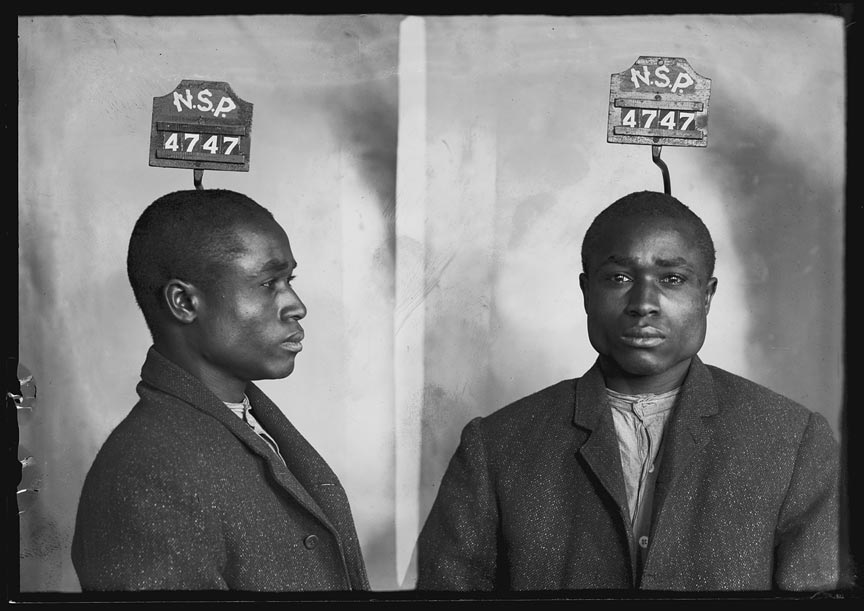
On the evening of May 13, 1906, a violent confrontation occurred between the African American members of Troop B, Tenth United States Cavalry Regiment stationed at Fort Robinson, Nebraska, and the townspeople of nearby Crawford, Nebraska.

A year before, Crawford City Marshal Arthur Moss and Sergeant John Reid of Troop B had come close to blows after the July 4, 1905, horse races. Animosity between the two men continued. On the evening of May 13, Moss was sent to break up a soldier’s beer party near the city park on the west edge of town. Moss ordered the party to quiet down or disperse. An altercation broke out between Moss, Reid, and Pvt. Jordan Taylor, also from Troop B. During the brief scuffle, Reid shot and killed Moss with a .38-caliber revolver.

Fearing for their lives over what had happened, Reid and Taylor fled into town and took refuge at the home of Edna Ewing, an elderly black resident. While making their escape, the soldiers were followed and fired upon by several civilians. Art Moss died shortly after being shot. As a crowd gathered at the Ewing house, Taylor suddenly bolted and ran towards Fort Robinson. Before getting very far, he was fatally wounded. Reid was captured and taken under guard to the city jail.

Rumors spread through Crawford that soldiers from Fort Robinson had threatened to storm the jail and free Reid. City officials feared a civilian mob might seize and lynch the prisoner. So, they decided to move Reid to the Chadron jail for safety. Before he could be transported, word came from the fort that several men and rifles from Troop B were missing. Colonel Augur quickly sent Troops I and K into town to prevent further violence. Soldier guards surrounded the jail. Tensions remained high into the next day. The seven men who were reported absent from the B Troop barracks were placed in the post guardhouse and fourteen rifles were found concealed near the town limits.

Reid was moved to the jail at Chadron, twenty-four miles away. Reid was eventually tried and convicted of manslaughter for the death of Arthur Moss and sentenced to 7 years at the Nebraska State Prison.

Story Credit: from the Nebraska State Historical Society

—###—


The Saga of Mona Wilson: Innocent Woman Serves Ten Years for Murder

Home | Short Feature Story | The Saga of Mona Wilson: Innocent Woman Serves Ten Years for Murder


Mona-M-Wilson-1927-Nebraska-complete

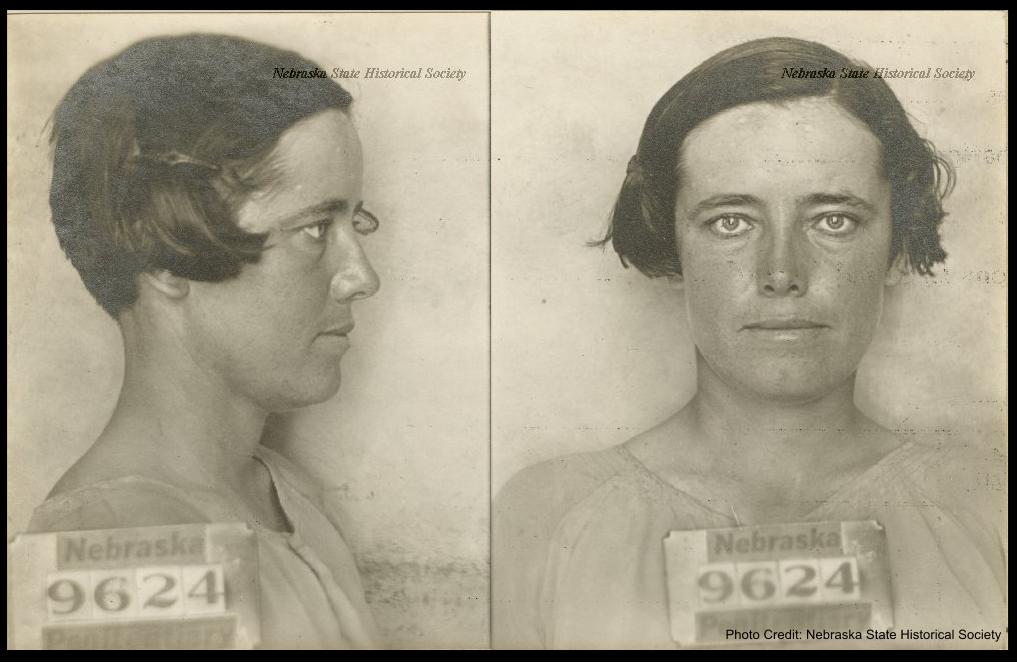
Mona Wilson’s 1927 Mug Shot for the women’s prison in York, Nebraska


In 1927, thirty-one-year-old Mona Wilson lived with her husband of two years on her parents’ farm in rural Sheridan County, Nebraska. She was a loyal daughter who helped them on their rented farm and had little interest in the outside world. Mona and her husband, Herman, lived in a small house on the property while her father and mother, William “Dan” and Olive Loomis lived in a larger home.

On July 16, 1927, Mona Wilson and her parents felt sick and her father sent her to the town doctor, Dr. Albert Molzahn, in Hay Springs, twenty-two miles away from their farm. The doctor wrote a prescription for milk of magnesia and calomel tablets, which Mona then filled at the local pharmacy. She also bought empty capsules to put the medicine in.

Calomel is Mercurous chloride and was used as a purgative and anti-bacterial medicine during the 1800s. In simple terms, it is a mercury-based poison and deadly in large or continuous doses. The deadly effects of calomel on patients were known one-hundred years before Dr. Molzahn prescribed it. Dr. Albert Molzahn was properly educated, graduating medical school from George Washington University in Washington DC circa 1910 to 1912. It is unclear why the doctor was still prescribing calomel in 1927.

Over the night, fifty-nine-year-old Olive Loomis got worse, and in the morning Mona’s father sent her to a neighbor’s house to call for help. By the time the doctor arrived, her mother had already died. Without doing an autopsy, or conducting any tests, Dr. Molzahn declared that Olive Loomis died from strychnine poisoning. A half-empty bottle of strychnine was found in the dresser drawer in Mona’s house, next to the empty capsules she had purchased the day before. This surprised Mona because a full bottle of strychnine was kept in the china cabinet in her father’s home. She claimed she never put the half-empty bottle of strychnine in her own dresser-drawer, and had never used it.

A naïve Mona was arrested and then coerced into a confession with the belief that it would help her husband who was also arrested—even though he was in another part of the county when his mother-in-law died. Her guilty plea led to a thirty year sentence which was later overturned and a new trial ordered. During that second trial, her defense attorney arguing Mona Wilson was mentally deranged because, in part, she had epileptic seizures. The jury found her guilty and sentenced her to life in prison. The state supreme court upheld this decision.

It is unclear how the doctor concluded so quickly, and without testing, that Olive Loomis died from strychnine poisoning. Her husband, “Dan,” who also said he was sick from the poisoning but managed to recover, blamed Mona’s husband, Herman, whom he loathed. He also despised his daughter for marrying him. When Dr. Molzahn arrived that morning to find Olive Loomis dead, Dan loudly accused his son-in-law. This led to a search of Mona and Herman’s home, where the strychnine tablets were conveniently located. These same strychnine tablets had been purchased years before to poison squirrels, and were kept in her parents’ china cabinet in their house.

A year or two after his wife died, William “Dan” Loomis married a twenty-year-old woman (Ida Adams) when he was sixty-years-old. He was never investigated as a possible suspect in his wife’s death. The police only considered Mona and her husband, Herman, who was not even on the farm that day. He had found work on a farm in another part of the remote, rural county.

Since no autopsy was performed, it could never be determined if Olive Loomis did die from strychnine poisoning, or if she died from the mercury chloride.

The following article was published one month before Mona Wilson’s parole hearing in 1937 which took place at the women’s prison in York, Nebraska. By then, she had served ten years for the death of her mother whom she swore she did not poison.

Tells a Complicated Story of Death by Poison – Strange Farm Killing in 1927 May Not be Woman’s Crime – February 15, 1937, edition of The Lincoln Star, page 12.

There are people who would tell you as they have told the board of pardons that Mona Loomis Wilson is not guilty of murder. They would tell you that the state has held her for ten years for a crime she did not commit.

They would tell you that Mona Loomis as a child was a good girl, that she would not have killed anyone—least of all her mother; that she was a good wife to Herman Wilson, more than faithful to admit a crime she did not do when told he had “spilled enough” to send him to the chair. She probably would tell you that herself.

Hers is one of the twenty-six women the parole board will hear when it meets March 10, 1937. It is one of those crimes which unfolds like a detective story you read for fun. But a jury sent Mona Wilson to prison for life.

Mona Wilson’s story will take you back to the summer of 1927, to a Sheridan county farm near Marple (Nebraska). There, she lived with her husband in a tiny house in the same farmyard with the larger home of her parents, Mr. and Mrs. William ‘Dan’ Loomis.

One July Day.

One July day, Don Loomis and Herman Wilson had words. Afterward Herman told his 31-year-old wife he was going to “hire out” as a “hand,” and maybe he would rent a farm and then he and Mona could move away from the home place.

Herman Wilson did hire out and Mona lived with her parents but she didn’t forsake the tiny house she and Herman had—she slept there. July 16, 1927 was a Saturday and in that night Mona and her parents were taken sick. “I felt well enough the next morning,” Mrs. Wilson relates, “to go out and milk the cows.” When she came back to the house from this task, Dan Loomis told her to go to town and have the “doc” send something out.

Events came in quick succession after that. She drove to town, saw the doctor at his house. The doctor telephoned a prescription to the drug store and Mrs. Wilson drove there to get it. “The boy who filled the prescription,” she states (in her parole application), “was not a registered pharmacist.”

She maintains she bought empty capsules from “the drug store boy,” to fill with the medicine the doctor had prescribed. Back at the farm, she and her parents all took several doses of the medicine, she says. That night Mrs. Wilson went to her house to sleep.

Mrs. Loomis Dies

“It was hot,” she declares, “and I heard father when he called—the doors were all open.” He told her to go to the nearest neighbors for help, telephone for a doctor—that her mother was worse.

She did. The neighbors returned with her. Mrs. Loomis died before the doctor arrived. When the doctor came, he wanted to see the capsules.

“Father said they were in a candy sack on the dresser.” Mrs. Wilson says. “But nothing of the kind was ever found.”

“It was decided mother died from strychnine poisoning. My father insisted my husband was to blame for it.”

“The empty capsules I had bought I took home and put in my dresser drawer. There was a full, unopened bottle of strychnine on the [property]. It was kept in the china closet in the house occupied by my father and mother. I had bought two bottles about two years before to poison ground squirrels and only used one bottle. The one in the house was the other bottle.

Strychnine Found

“When the officers searched our house they found a part of a bottle of strychnine in my dresser drawer with the empty capsules. The full bottle was gone from the china closet in my parents’ house.” Mrs. Wilson goes on to explain that her husband had written that he would be home on that eventful Sunday. When she went [to the doctor and to the pharmacy] she left a note on the table in her house telling [her husband] where she was.

“They found the note as I left it,” she states. “With what father had told them and that note, they thought he (Herman, her husband) had something to do with mother’s death so on the morning of July 19, he and I were arrested.”

Mrs. Wilson was taken to a private hospital in Hay Springs. Herman was placed in the Rushville jail. She relates how officers were to take her to her mother’s funeral, but “waited to get there just after the funeral was over.”

Later, officers told her, she declares, “my husband had told them enough to send him to the electric chair. I had always been taught to believe the officers were always fair, so I never once thought that one of them would lie to me in an effort to make me tell what they wanted me to.”

Sites A Confession

Because she thought her husband innocent, Mrs. Wilson says she ordered the county attorney to draw “any kind of a confession he wanted so long as he left my husband out of it and I would sign it.”

Pleading guilty, she was sentenced to 30 years but the state supreme court ordered that the case had to tried before a jury. It took two years for this procedure—two prison years.

Attributing her conviction to the confession, Mrs. Wilson adds “I realize all this looks very bad for me but I really don’t know how it happened. I can only say my mother was my best friend on earth, that she was always very good to me, and I loved her as well as anyone loves their mother.”

Is Trusted Inmate

During the years which have crept by, Mrs. Wilson has become one of the trusted inmates of the York reformatory. She superintends the dairy farm there. She has charge of the visitors’ gate. Officials at the reformatory recommend her (for parole). One such letter to the board said. “I have never found it in my heart to believe her guilty.”

Her closer friends are stronger than that in their letters regarding the case.

Should the board release Mrs. Wilson. Herman Wilson will take her to his Elmwood home. Reformatory attaches say he has visited her frequently during the ten years.

Epilogue

Mona M. Wilson was paroled that spring. The 1940 US Census shows that Mona, 44, was still married to her husband Herman, 57, and they lived in Lincoln, the state capital. She worked as a maid and he worked as a house painter. Herman died in 1964 and Mona died in 1980. They are buried at Ash Hollow Cemetery, (a pioneer cemetery that is one of the most famous cemeteries in the state), in Garden County near Lewellen, Nebraska.

William Loomis married a twenty-year-old woman (Ida Adams) in 1928 or 1929, when he was sixty-years-old. His father-in-law was four years younger than he was. The 1930 census shows they all lived together in Elm Grove, Kansas. In 1940, the couple were living in Box Butte County, adjacent to Sheridan County, in Nebraska. At that time, William was seventy-one-years-old, and his wife, Ida, was twenty-eight-years-old. They had a four-month old daughter, Delores Ann. William Loomis died in 1958 at the age of ninety. Ida remarried Lyle Zimmerman in South Dakota in 1977. She died in 1992.

A poem written in 1825 warning doctors about calomel.

Since Calomel’s become their boast,

How many patients have they lost,

How many thousands they make ill,

Of poison, with their calomel.


—-###—-


Mug Shot Monday! Wilburn Barton, 1921

Home | Mug Shot Monday | Mug Shot Monday! Wilburn Barton, 1921


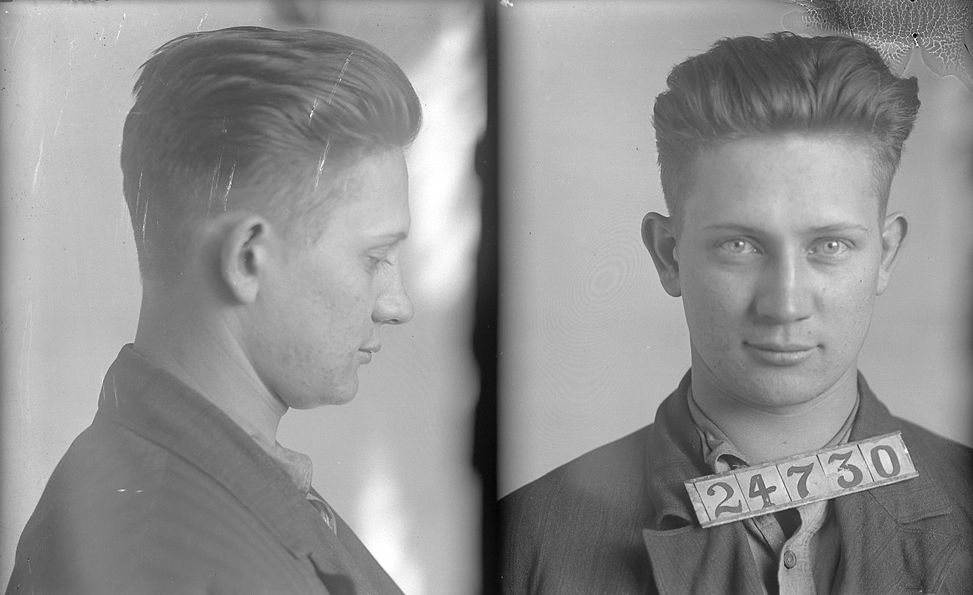
Missouri Killer Wilburn Barton

During the early morning hours of December 8, 1921, Wilburn Barton, 19, and his older brother, Milton, 22, robbed and tortured an elderly couple in their farm house in western Iron County, Missouri. The Barton brothers tied Bud Osborne to his bed with bailing wire, murdered him, and then set the house on fire. His wife, Mary Jane, was found alive but severely beaten in her yard by neighbors attracted by the flames of the burning home.

Before she was taken to the hospital in Ironton, Mrs. Osborne named Milton and Wilburn Barton as the assailants. She managed to live for a few more weeks before dying on December 25.

For some unclear reason, the local paper, the weekly Iron County Register, only devoted one or two column inches to the story during the arrest phase, then again during the pretrial and trial phases. Statewide newspapers also had no interest in what was a brutal torture slaying of an elderly couple.

Both brothers were tried, convicted, and sentenced to life in prison in April 1922. Milton Barton died in prison in 1934. The life sentence for murder was his second time in prison. In 1919, he and his brother, Enoch, were sentenced to serve two years for burglary and larceny.

In an era when convicted killers given life sentences were often paroled after serving eleven to twenty years in prison, Wilburn served twenty-eight years of his sentence by the time he was paroled in 1950. The longer than average time for patrol may indicate he was a difficult prisoner.

—###—


Link Dump: 30 HCD Rediscovered Crime News Stories Posted Between 2013-2016

Home | Rediscovered Crime News | Link Dump: 30 HCD Rediscovered Crime News Stories Posted Between 2013-2016


Categorized by year, all links open in a new window.


Workplace Violence in 1901: SOMERVILLE. MASS. July 5, 1901. With a maniacal shriek, John Murphy turned from pig-sticking to man killing in the North Packing and Provision Company’s slaughter-house today, and, driving more than a hundred of his fellow-workmen before him, slew five of them almost instantly, fatally wounding three others, and slashed several more to a lesser extent before he was overpowered.

Two Opium Dens Busted in 1901 Raids: “The two visitors were so far on their way to dreamland that they did not pay any attention to the entrance of the officer.”

The Andrea Yates Epidemic of 1901: As sad as this story is, in the course of my research for other vintage crimes I come across many similar accounts of parents murdering their children (known as filicide) due to depression, religious fervor, or other reasons. In most of these cases, poverty drives their depression. With just some light searching done of newspaper archives for 1901, I found 4 different cases.

Small Town, Vigilante Justice in Nebraska in 1907: The rope was tied to the highest beam of the bridge and after the victim made a statement he was thrown by the mob into the air and reached the end of the rope with a terrible sound, snapping his neck and producing instant death. Forty bullets were then shot into his body which was left dangling in the air for the officers to care for.

1907 Med Students use Fresh Grave for Anatomy Lab: Detectives are working on several theories today with a view to discovering the fiends who desecrated the grave of little Margaret Kuhlewind, eight years old, in the cemetery at Bernardsville, New Jersey and mutilated the body. A few hours after the burial the grave was opened, the coffin forced out and the body taken out and horribly mutilated. Thrown back into the casket without even smoothing the shroud over the mutilated body, the coffin was lowered into the grave and the dirt hastily piled back.

Female Colorado Farm Hand Marries Girlfriend in 1913: “Well, when Anna and I met we liked each other from the start. We got to going together. Of course, I knew I was a woman and she knew I was a woman but other people didn’t. We got to going to each other’s rooms a good deal. Of course, with us it didn’t make any difference but other people didn’t know and they talked. We knew they were talking a lot and gossiping about us, so we just decided to end the whole thing by getting married. And that’s what we did. We couldn’t very well do anything else. You see, I’d worn men’s clothes around here all the time and I couldn’t come out and say I was a woman. That would cause more talk than ever. So we just got married.”

The Genesis of the Lie-Detector Test 1913: The most unique and scientific “third degree’ ever administered to a criminal in this country is to be given Charles Kopf, arrested in Vallejo, Cal, and charged with having committed a murder In Nebraska fourteen years ago, when he is brought back to this State for trial. Arrangements for the examination are now being made by the Omaha police and scientists connected with the medical school, University of Nebraska.

Kardashian Murdered in 1916: It is alleged that Tamerian, who is little more than 21 years of age, attacked Kardashian with a pair of scissors in a dispute over the proper way to press trousers. Kardashian died at the Newton Hospital nine days later from a wound in his abdomen. 

One of the first college fraternity hazing deaths in America, 1918: Robert Wellons, roommate of Rand, was also forced to dance and sing, and in a fall received slight injuries. Rand dropped from the barrel, fell upon the broken bottle, which pierced the jugular vein and carotid artery, and bled to death in ten minutes.

The Crazy-Ass Blackburn Cult of California in the 1920s: Two of the cult’s followers, a married couple, preserve the dead body of their foster daughter for almost five years. During the first year of preservation, they moved around a lot with the cult and were naturally obliged to take their daughter’s body with them. In order to transport her from one residence to the next, they propped her up in the back seat of their automobile. “The remains were so well preserved that passers-by thought they saw a living girl.”

The Botched Execution of Eva Dugan in Arizona in 1930: Mrs. Eva Dugan, the first woman to be legally executed in Arizona, paid with her life on the gallows shortly before dawn today for the slaying in 1927 of A. P. Mathis, Tucson rancher. The trap was sprung at 5:02 a. m. As the trap clanged and she dropped more than six feet, the noose tightened, severing her head, and the body catapulted to the floor. Dr. L. A. Love, prison physician, pronounced her dead immediately.

The Witch Craft Murder of Clothilde Marchand, 1930: “What came out of that trial is a bizarre tale with the following ingredients: A Ouija board, witchcraft, an Indian faith healer, manipulation and coercion to kill, and a philandering sculptor who claimed it was necessary for him to “make love”  with his models out of “professional necessity.”

The Story of a ‘Gangster Queen,’ Cecil Valore, 1931: She accused her husband of the following crimes:

  • Murder of Dr. Scully [on March 3, 1930]: She said that Valore and a relative went to Scully’s office and that the doctor was slain when he resisted robbery.
  • Killing in the county jail of Anthony Colletto who was being held on charge of murder for the killing of his wife. The coroner said lie hanged himself although his attorneys insisted it was a murder.
  • Slaying of a guard at Mansfield. Another man was convicted and died in the electric chair.
  • Killing of a man in the robbery of the Blue Pig Inn here. The killing was attributed to policemen.
  • Killing of another man, in a crime the details of which she had forgotten.
  • Bombing of the homes of two Loraiu county attorneys who failed to get Valore out of trouble after accepting a fee.

Innocent Man Freed After 15 Years in Missouri Prison & Asylum, 1932-1947: The account of a miscarriage of justice in the Frank Werther case, in which an innocent man was kicked around for 15 long years, reads like something out of a fiction magazine.

Father Poisons Family, 1934, Oklahoma: A father who said he “could not bear to see my family starve” was held without bond here tonight on a murder charge after three of his small children had died from poison he allegedly administered. Sebe Christian, Creek County Attorney, said the father, Chester Barrett, 32 years old, signed a full confession after several hours questioning today. A murder charge was filed immediately. The father’s excuse for the act, which not only killed the three little girls, but endangered the lives of his wife and four of his five other children, was that he was ill and had no money.

1935 The False Confession of a “Mercy Killer” Nurse Reveal Harsh Police Tactics: “Apparently proceeding on a premise that there was no question about Miss Sevigny’s guilt, they did not bother to find out whether or not there was any testimony other than that used to build up their own case. — We deplore the fact that the young woman, whom we all believed to be innocent of any criminal action, has been branded by sensation-seeking newspapers and a careless police department as a murderer. — We believe that, the methods to gain her ‘confession’ should be not part of the procedure of a civilized police department in these days and we hope that our long and carefully considered action in thus freeing Miss Sevigny from the stigma attached to her, may, in part, at least, bring about a favorable reaction from the public.

Alcide (Frenchy) Benoit Murders Michigan State Policeman Richards F. Hammond in 1935: County Prosecutor Francis Ready announced the confession of the 24 year-old black-haired gunman shortly after Benoit’s desperate game of hide-and-seek over sleet-covered country areas with officers or three states and the federal government ended In Monroe—a short distance from the spot where he abducted Trooper Hammond.

Prince Yogi of Tulsa, 1935: In jail Tuesday night, Yogi told of having used his hypnotic powers to put two fellow prisoners to sleep. He said he predicted future events by consulting the stars. Then he was inspired by sudden concern.

“Say,” he addressed a jailer, “what do you suppose the judge will do with me tomorrow?”

The jailer considered with some disdain before replying: “Well, it is a cloudy night and I’ll admit you can’t see the stars, but if you see all and know all, why should you wonder?”

Rented Husband Loses Lawsuit for His Share in 1941: In blasé, nonchalant tones, Samuel Brummel, 56-year-old insurance salesman, testified Thursday that his wife rented him out to another woman for a year for S10,000, promising him half of the money. Brummel, a dark, cigar-chewing little man, told the story as trial of his suit to divorce Mrs. Lillian Brummel, 55, and to collect his half of the “fee.”

Oklahoma Executioner Rich Owens Discusses His Long Career in 1948 Article. During his life, he killed a total of 75 men: sixty-six of those were by execution, and the other nine were men he killed under various circumstances.

The Amazing, Multi-State Crime Spree of a 14 year-old boy in 1949: Since then, officers say he has: 1. Stolen a long string of automobiles, motorcycles and even a motor-scooter. 2. Burglarized an ex-police commissioner’s home of $580. 3. Escaped from officers three times. Once was a thrilling getaway from a 50-man posse when he jumped from a car handcuffed.

Leon Turner and the Whitt Brothers, 1950, Missippippi: Leon Turner had suffered the shame of being convicted for molesting a black girl and his drunken rage gave him the courage to get revenge seven days later. Grabbing their guns, the three men headed toward the dilapidated house of the girl’s step-father, Tom Harris. 

Army Wife Acquitted for Murder of Horrible Husband in 1955, Japan: On his last night he bragged of his love life. “There isn’t a man around who’s had as many women as I’ve had.” Then he told her how he’d seduced her best friend, as well as the wife of a colonel, a New York TV actress, numerous army nurses, and once, a Japanese airline hostess “on one of the plane’s seats, in front of a general.” — Then he told her, “You haven’t had a beating in a long time,” and started whacking her. He choked her, kicked her, flung her across the room. At breakfast he stabbed her with a fork, and threatened to have her killed.

Arizona Student with Poor Grades Gets Revenge in 1964: A bitter argument over his poor marks in English triggered a wild rampage early today by an enraged 16-year-old Tucson High School student which ended in the death of a woman and beatings of two other persons.

The Girls Scout Murders of 1977, Locust Grove, Oklahoma: The story of what happened on the night of June 12, 1977, is what fiction horror movies are made of — if a horror movie ever dared to depict female victims between the ages of 8 and 10.

DNA Evidence in 1984 Murder Leads to Suicide by Criminologist: Two gruesome murders from 1978 and 1984 are seemingly related and lead police to three good suspects who all go on to commit suicide. There are about five or six left turns in this article and at the end, you will have to make a decision about an unlikely suspect on your own.

The Foss Lake Mystery in Oklahoma–Two Cars, 6 People Missing 43 & 44 years Found at Bottom of Lake in Oklahoma:

Feature Story Comes to Life With Video – This story related to the 1924 Philadelphia kidnapping of Corrine Modell in which her granddaughter contacted me. There is a short video with this post.


—###—


New Book: Gitchie Girl

Home | New Books | New Book: Gitchie Girl


[The following information was provided by the authors.]

Gitchie Girl coverGitchie Girl is a fast-paced, quick read at 164 pages that has been on several #1 true crime national bestseller lists since its January 2016 release. It profiles one of the most heinous mass murders in the Midwest. What happened at Gitchie Manitou State Park over a span of several hours was a true life nightmare for five teenagers. Only one survived. Find out why her life was spared and the challenges she faced being the lone survivor of a mass murder. Below is the back cover summary of Gitchie Girl. A portion of the proceeds benefits the lone survivor as well as the Council on Sexual Assault & Domestic Violence. Order from Amazon at: http://amzn.to/1mSk9rP

A TERRIFIED VOICE CRIED OUT IN THE NIGHT.

“Who are you? What do you want?”

            The sound of snapping twigs closed in on the five teenagers enjoying an evening around a glowing campfire at Gitchie Manitou State Park. The night of music and laughter had taken a dark turn. Evil loomed just beyond the tree line, and before the night was over, one of the Midwest’s most horrific mass murders had left its bloodstains spewed across the campsite. One managed to survive and would come to be known as the “Gitchie Girl.” Harrowing memories of the terrifying crime sent her spiraling out of control, and she grasped at every avenue to rebuild her life. Can one man, a rescue dog, and a glimmer of faith salvage a broken soul? This true story will touch your heart and leave you cheering that good can prevail over the depravity of mankind.

            Through extensive research, interviews, and personal insight the authors bring a riveting look at the heinous crime that shook the Midwest in the early 1970s. Written from rare, inside interviews with the lone survivor who broke nearly four decades of silence, this story brings the reader a shocking yet moving story that will not soon be forgotten.