
True Crime Books by Jason Lucky Morrow

Welcome to HistoricalCrimeDetective.com [Est. 2013], where you will discover forgotten crimes and forgotten criminals lost to history. You will not find high profile cases that have been rehashed and retold ad infinitum to ad nauseam. This blog is the official website for true crime writer Jason Lucky Morrow, author of four books including the popular series: Famous Crimes the World Forgot, Volume I and Volume II. If you would like to send me a comment, Contact Me Here. - Please follow this historical true crime blog on FACEBOOK.

Charleston’s Most Inhospitable Hosts: The Story of John and Lavinia Fisher

Home | Short Feature Story | Charleston’s Most Inhospitable Hosts: The Story of John and Lavinia Fisher



Guest Post by Harry Parsons,
Content Manager, Arcadia Publishing

We all know the horror film trope: the motel, the inn, the guesthouse at the side of the road that is, for some reason, curiously empty. The friendly, welcoming, eager proprietors who usher you in and tell you to make yourself at home, but somehow seem a little too keen, too forceful about the questions they ask you.

Hundreds of horror films and books use this same setting to thrill and unnerve their audience. It’s not surprising that these themes retain their power to shock and terrify us, especially when they are inspired by real events.

Movies and stories often have a basis in fact. The story of John and Lavinia Fisher exemplifies a perfect made-for-film, true horror story that happened long ago. At the beginning of the 19th century, the Fishers lived just outside Charleston, SC. They split their time between running an inn for travelers and heading up a gang of highwaymen who made a living by trapping and killing unwary visitors and then stripping the corpses of valuables.

The Legend of John and Lavinia Fisher

Operating in the early 1800s, the Six Mile Wayfarer House — so named because it was six miles outside of Charleston, South Carolina — developed a local reputation as a popular place for travelers to rest on their way to Charleston. However, the local authorities began to catch a whiff of something untoward when people noticed a few too many of the patrons of the inn checked in, but never seemed to check out.

According to the legend, Lavinia greeted travelers at the door and ushered them into a living area, where she would begin to question them about themselves, their lives, and their business. Based on the answers, she and her husband determined which guests had enough valuables to make robbing them worthwhile.

For the chosen victims, Lavinia provided them with a cup of tea containing a poison or sleeping agent strong enough to force them to quickly retire to bed. Unfortunately, the Fishers had customized the bed in that room to fall through the floor, dropping its occupant onto a specially-crafted spiked room lying underneath the house. To add to the macabre, John finished off anyone who survived the poison and the fall.

Subsequent investigations revealed that the Fishers dispatched of hundreds of people in this gruesome manner.

David Ross

Several versions of the infamous couple’s downfall exist in popular folklore.

One version asserts that the town fathers decided to investigate the disappearances and formed a posse to search the road. When most of the exploratory group returned to Charleston, the posse left one man –David Ross – to stand watch along the road.

That night, two people in Fisher’s gang ambushed Ross, beating him and dragging him to where the gang had gathered. As the story goes, Ross recognized Lavinia and begged her to help him. Instead, she started choking him and putting his head through a window. During the struggle, he managed to escape and made it back to Charleston to alert the authorities.

John Peeples

Another version of the legend focuses on a man named John Peeples. On his way to Charleston from Georgia, he decided to stop at the Six Mile House. Lavinia and John Fisher set the usual trap, with Lavinia telling him a room wasn’t quite ready while offering him a meal and chance to rest. She asked Peeples the standard questions about his life and work.

Peeples did not enjoy tea, but he didn’t want to seem rude to his hosts. When Lavinia offered him a cup, he accepted and poured it out when she wasn’t looking. The questions continued, and Peeples evidently began to feel uncomfortable with the line of questioning. He also heard people moving around in other rooms, despite his hosts assurance that they were alone.

After a while, Lavinia informed Peeples that a room had become available. Already suspicious, he accepted the room, but he elected to sit in a chair by the door instead of sleeping in the bed. In the middle of the night, he woke to see the bed falling through the floor right in front of him. He leapt out the window and ran to the authorities rather than sticking around to see what else they had planned for him!

Separating Legend from Reality

The tales of David Ross and John Peeples both have kernels of truth. Unfortunately, their horrifying stories about the falling bed and hundreds of human bones found on the property remain either unverifiable or stand in contradiction to official records.

Local newspapers from the period focused more on theft than murders or disappearances, and while investigators did discover some bodies on the property, the notion of hundreds of corpses under the Six Mile is almost certainly an invention.

There is no concrete link between the Fishers and the bodies, either. The court eventually convicted John and Lavinia of highway robbery, which was recognized as a capital crime just like murder.

The Conclusion of the Story

The record indicates the court sentenced John and Lavinia to an execution by hanging.

On the day of their scheduled execution, John Fisher accepted the counsel of a local Reverend and attempted to repent in hopes of a last-minute commutation. He told the gathered crowd that as a Christian man, he should not be put to death.

Terrifying to very end, Lavinia arrived at the gallows in her wedding dress, clinging to the hope that as a married woman, she could not be hanged. Neither ploy worked; the judge presiding over the executions simply stated John would hang first. Though the law forbid the execution of married women, the law had no rules against hanging widows.

Press reports at the time recorded Lavinia’s uttered chilling last words before she leapt from the scaffold on her own rather than allow the hangman to do his job. Before she jumped, she yelled “If you have a message you want to send to hell, give it to me – I’ll carry it.”

It’s the perfect end to a spine-tingling tale of true crime!

Related Book: Six Miles to Charleston: The True Story of John and Lavinia Fisher, by Bruce Orr, Foreword by John Laverne

—###—


Vintage Detective Story: The Stackhouse Case, 1916

Home | Short Feature Story | Vintage Detective Story: The Stackhouse Case, 1916


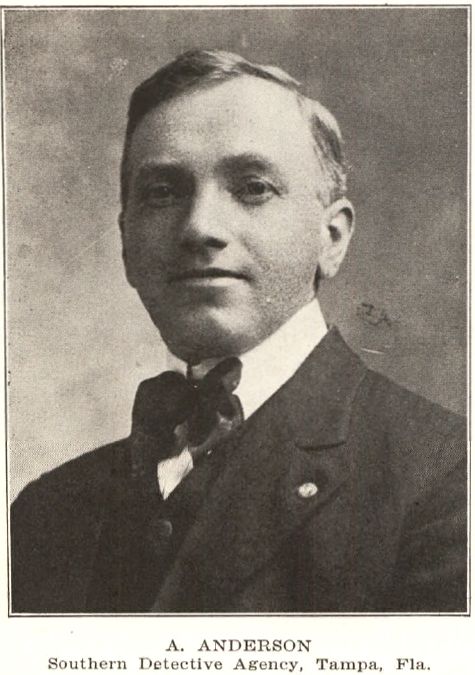
Story by A. ANDERSON (Private Detective), Principal Southern Detective Agency, Tampa, Florida, (formerly with Scotland Yard, London, England), and, Dalton O’Sullivan, Detective and Author of Enemies of the Underworld, 1917.


Early in April of the year 1916, I was summoned to Boca Grande by the president of the C. H. & N. railroad. The little town being only twenty miles from Tampa, I drove down in my car and went at once to call on him. I gave my card to the office boy and he ushered me into the president’s private office. The president received me cordially.

Private Detective A. Anderson, Southern Detective Agency, Tampa, Florida

“I received your wire this morning,” I said, “and decided to come immediately.”

“I am glad you are here,” he replied. “I am anxious to have you get to work on this case at once.”

I asked for the details.

“Harry Stackhouse, one of the contractors employed by this railroad, obtained about $12,000 from the company under false pretenses and he has disappeared,” the president told me. “In handling this case, great secrecy will be required, because I suspect his friends and relatives here in Boca Grande will keep him posted on our movements as much as possible.”

“How long has he been missing?”

“Fully two weeks. He was in league with Lankford, our chief clerk, who had the power to approve all vouchers for work performed. The vouchers were passed and cashed by the First National Bank, and these two men evidently divided the spoils. The deficit was discovered the first of March. Lankford, unable to bear the disgrace which he had brought upon his wife and children, committed suicide.”

“Has a picture of Stackhouse appeared in the newspaper?” I asked.

“Yes,” the president answered, and taking a newspaper from a drawer of his desk, he handed it to me. “We furnished the editor with a cut of Stackhouse, which was used in our ‘Railroad Men’s magazine,’ he explained. “I believe it is the only picture available.”

“I don’t know whether I can locate this man or not from this picture,” I frankly told the president. “This picture might pass for Bill Jones or Sam Smith, or a hundred other men. But it is better than nothing. Fortunately this is a profile and it may be of some help.”

Tearing out the picture, I placed it in my vest pocket, and left Boca Grande to begin work on the case.

I went first to the clubrooms in Tampa where Stackhouse had formerly visited. It was impossible to get any information there, but I did learn that his son, who was a traveling salesman in the northern part of the state, had headquarters in Jacksonville.

With this information to begin work on, I left at once for Jacksonville. On arrival, I went to the Seminole Hotel. Entering, I left my traveling bag near the entrance. I went to the cigar stand and bought a couple of cigars and an evening paper. I remained near the cigar stand looking over the headlines in the paper until the other persons who had entered the hotel with me had registered and were shown to their rooms. Then I examined the register to see what room Stackhouse occupied. Noting that he had checked out the day before, I asked the clerk if he could give me room No. 354, the same one Stackhouse had previously occupied.

 “Yes,” the clerk answered, and turning to the bellboy, he said: “Show this gentleman up to room No. 354.”

The room was in the front of the house on the third floor with connecting bath. A thorough search of the room revealed no clue of any kind worthy of consideration. The bath was the thing that appealed to me just then. After a brisk rub and fresh linen, I went out to have a look at the city.

About 11 o’clock, I returned to the hotel and went to bed. I lay awake studying the best way to proceed, but could not see anything to be gained by remaining in Jacksonville. The next morning, I was preparing to shave, and began looking for a piece of paper to use for the lather when I caught sight of something white protruding from beneath the dresser scarf. It was a small piece of paper torn from a telegram. The words “Harry Stackhouse, New Orleans, La.,” were plainly visible. I decided to take the next train for that city.

The morning after my arrival in New Orleans, I visited telegraph offices until I obtained a copy of the telegram I had found in the room at the Seminole Hotel. I made a note of the address at which it was delivered. Then, through the city detective department, I met an inspector, whose services I enlisted. We prepared a decoy special delivery letter, and I delivered it, impersonating a special delivery messenger. When my knock at the boarding house door was answered by the proprietor, I inquired if Mr. Harry S. Stackhouse roomed there.

“He roomed here until ten days ago,” the man answered.

I gave him the special delivery letter, but he refused to sign for it, saying he did not know where to forward it. I departed somewhat disappointed in being again just a little too late.

At the corner drug store, I searched the city directory, jotting down the address of every person by the name of Stackhouse. I began with the first name listed and went the rounds, finding only one family with whom I was able to obtain an interview admitting relationship to Harry Stackhouse.

“Are you the only kinsman he has here?” I inquired.

“Yes, I think so, and I am his third cousin,” this man said.

“Do you know if he has any relatives anywhere else?”

“He had a sister in Shreveport, La. She may have moved. It has been about eighteen years since I heard from her.”

From this man, I learned the name of the sister was Mrs. Weatherford, and that she had resided at No. 515 Kings Highway.

When I arrived in Shreveport, I went immediately to the Kings Highway address. As I drew near No. 515 in my automobile, I purposely “killed” the engine. I then went to the house and asked permission to telephone to a garage.

A young man about 18 years of age opened the door, and he invited me into the living room where the telephone was located. After I had telephoned to the garage, the young man offered me a chair, saying I could wait until the repairer arrived.

I had made such a thorough study of the picture given to me by the president of the railroad, that I thought I saw a striking resemblance between it and this young man. The assistance I telephoned for came in a few minutes, and I arose, saying: “To whom am I indebted for this favor?”

“Harry Weatherford is my name and I am glad to have been of some service to you, Mister—”

“Wright,” I substituted. “Are your parents living?”

“My mother is living,” he replied, “but she is out shopping today.”

Thanking him again, I left. I drove to the post-office and saw the inspector. I asked him if I could have a look at Mrs. Weatherford’s mail. We selected a letter with typewritten address, which had been mailed on a train running through Texas to New Orleans. I waited patiently for several days in the hope of seeing a reply from the same source, but none came. I requested the inspector to issue orders to the railway mail clerks working on the southbound Texas-Pacific railroad to find out where this letter had been posted.

The following day I was called to the postmaster’s office He handed me a letter, which had been mailed in Galveston, and addressed to Mrs. Weatherford. Holding the letter to the light, I could see another envelope enclosed, and by careful tracing, I made out the name Stackhouse. I watched the Weatherford home and at 12 o’clock that night. I followed young Harry Weatherford to the Union Station and saw him drop the usual mysterious letter in the mail car of train No. 22. With a feeling of victory in sight, I journeyed to Galveston.

In Galveston, as usual, I made my arrangements with the postmaster and inspector, regarding all mail addressed to Stackhouse. Several weeks watching brought no new developments, and I confess I was beginning to feel somewhat discouraged, as I had now been at work on the case nearly ten weeks.

One afternoon I was caught in a thunderstorm, and I took shelter under an awning in front of a grocery store. While there, I observed an elderly man crossing the street at an-angle.

His hat blew off and came circling in my direction. I stepped forward, and picking up the hat, handed it to the owner. To my great astonishment, I was face to face with Harry Stackhouse. He thanked me and passed on. I followed him at a safe distance.

He went to the post-office. I stood behind him at the general delivery window, and heard him ask for mail addressed to Harry S. Brooks. He received a letter and went out. I kept a few paces behind him and saw him enter the Tremont Hotel.

I went at once to my room at the Galvez Hotel, packed my bag hastily, and with an air of “just arrived,” I entered the Tremont, went to the register, and checking over the guests, found the name “Harry S. Brooks.”

I walked through the lobby to where he was sitting reading a letter, and I addressed him in a low voice as “Mr. Stackhkouse.”

He looked up suddenly, hesitated, and then replied: “No, my name is Brooks.”

“That’s strange,” I said quickly, and drawing the picture from my pocket, I held it before him.

He laughed a little nervously.

“If that is intended for me, it is a mighty poor specimen,” he said.

He began looking first in one direction and then in another, as if contemplating escape, but he evidently realized that I was a secret service man and ready for an emergency.

 “I have been scouring the country for you,” I said, “and it’s time you turned up or I would have lost my reputation.”

He grinned and replied: “Well, chief, if you’ve got me, I suppose I might as well get ready and go along with you.”

That night we left for Boca Grande, where I turned him over to the sheriff.

Editor’s Note: I could find no further information regarding Harry Stackhouse. For embezzling during that time period, I’m guessing he was sentenced to somewhere between five and ten years to a state prison, and was probably out in three years if he behaved well.


—###—


Mug Shot Monday! FBI’s Second Longest Most Wanted Fugitive Found Buried in Wife’s Backyard, Died of Natural Causes in 1999

Home | Mug Shot Monday, Recent News | Mug Shot Monday! FBI’s Second Longest Most Wanted Fugitive Found Buried in Wife’s Backyard, Died of Natural Causes in 1999


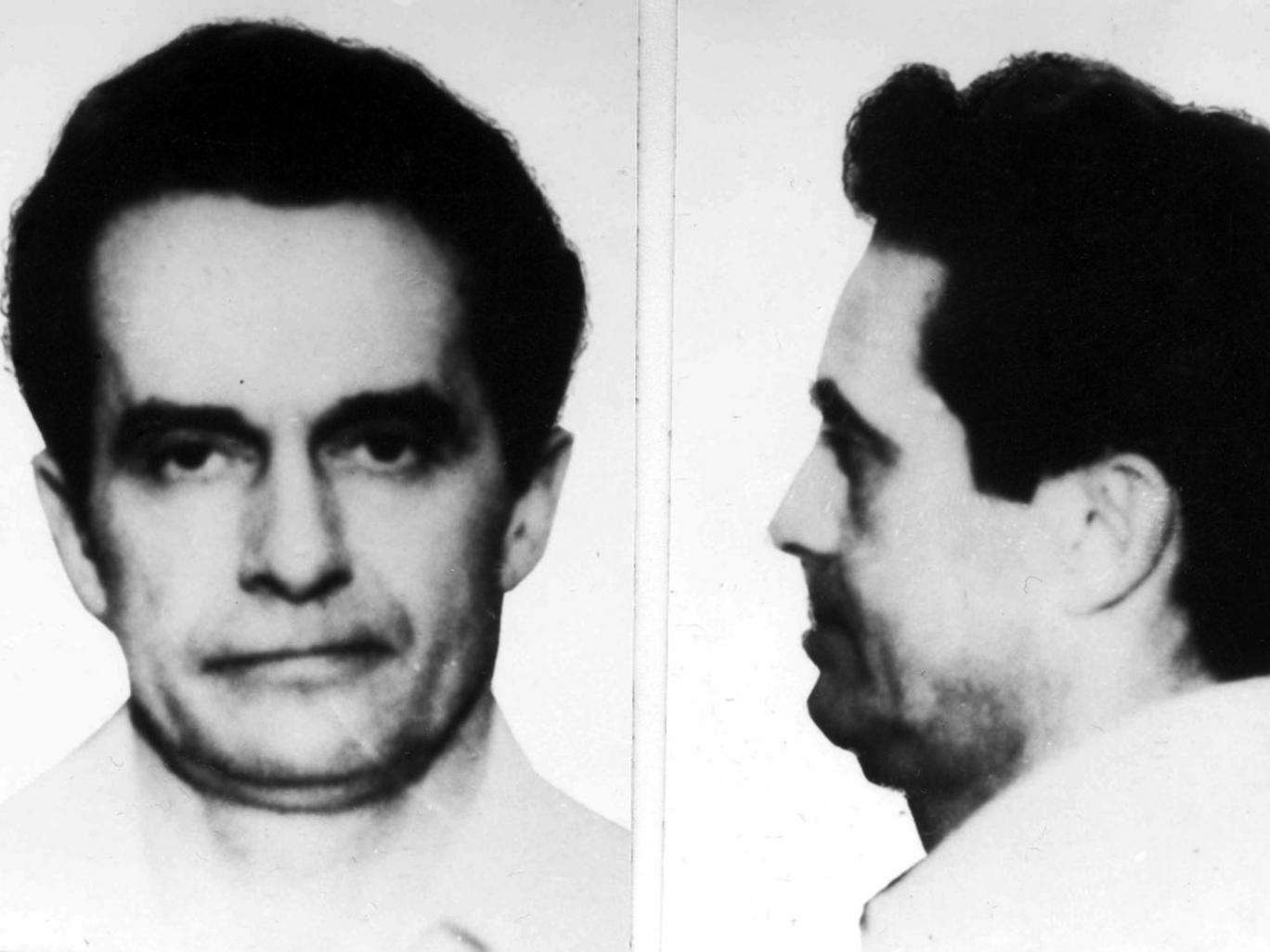
Donald Eugene Webb Mugshot, died in 1999

Donald Eugene Webb, FBI Most Wanted List, 1981-2007, body recently discovered


On August 4, 1980, forty-nine-year-old Donald Eugene Webb, a career criminal and associate of the Patriarca Crime Family was in Saxonburg, Pennsylvania, preparing to rob a jewelry store when he was stopped by the local police chief during a routine traffic stop.

Summary of Webb’s crime from Wikipedia.org

Gregory B. Adams, a 31-year-old police chief and nine-year veteran of law enforcement, made a routine traffic stop in the parking lot of Agway Feed Store on Butler Street in Saxonburg, Pennsylvania at about 2:50 p.m. or 3:10 p.m. on December 4, 1980. Adams used his patrol car to stop the suspect by blocking the exit of the parking lot. When he asked the suspect for his driver’s license, the suspect gave fraudulent identity documents and shot Adams. He returned fire, but the shots were not fatal.

The man believed to be Donald Eugene Webb got out of the car and fought with him. Adams was disarmed and pistol-whipped with his own revolver, being struck several times causing deep wounds to his face and head.

Witnesses heard fired shots; four “pop” noises, presumably from a semiautomatic .25-caliber Colt pistol and a “boom” from Adams’ revolver. He was shot once in the arm and once in the chest at close range. By another account, Adams was shot twice in the chest, one bullet collapsing a lung and another ripping the bottom of his heart. Adams was not wearing his bulletproof vest at the time as he had lent it to another officer. The killer took Adams’ gun, ran to his patrol car, ripped out its microphone and took the keys before driving away in his own car.

A nearby resident found the mortally wounded Adams, who told her that he did not know his attacker and that he thought he was not going to live. Adams was so badly beaten he was almost unrecognizable. Adams lost consciousness on the way to the hospital and died of his injuries. Adams was survived by his wife Mary Ann Adams (later Mary Ann Jones), and their two sons, Benjamin and Gregory, Jr. Adams is buried in St. Mary’s Cemetery in Herman, Pennsylvania.

Webb’s blood type (O) and a New Jersey driver’s license bearing the name of an alias connected to Webb were found at the scene of the shooting. Two weeks later, the rented car he had driven was found at a Howard Johnson’s motel. On the seat and floorboard were bloodstains that matched Webb’s type. Webb was placed on the FBI’s Most wanted list in 1981, and he remained there for 25 years, 10 months and 27 days. He was removed from the list on March 31, 2007 to make room for more contemporary and dangerous fugitives.

On June 15, 2017, the FBI released never before seen photographs as well as a press release detailing Donald Webb’s crime, descriptive features, and list of known aliases. Read Press Release.

Never before seen photographs of Donald Eugene Webb, later found buried in his wife's backyard.

Never before seen photographs of Donald Eugene Webb, later found buried in his wife’s backyard. Click to open larger in new window.

This press release out-of-nowhere was the result of an April 2017 FBI search of the Dartmouth, Massachusetts home of Webb’s wife (ex-wife?) where they found a door inside a closet that led to a secret room. Inside the room, they found a cane. Since Webb was shot in the leg by Chief Adams, it was assumed it belonged to him. A check of local building permits proved that this addition to the house was done without a proper building permit.

Also in June, Chief Adam’s Widow, now Mary Ann Jones, filed a lawsuit against Donald Eugene Webb, his wife, Lillian, and her son, charging wrongful death and conspiracy in the 1980 murder of her first husband. Read article.

Earlier this month (July 2017), FBI agents returned to his Webb’s home in Dartmouth, Massachusetts. After promising his wife, Lillian, immunity from prosecution, she showed them the area in the backyard where he was buried. Tests confirmed it was Donald Eugene Webb, and that he had died in 1999.

Donald Eugene Webb was the second longest fugitive on the FBI’s Most Wanted List. Still evading capture, is Victor Gerena, who robbed an armored truck in 1982 and escaped to Cuba.

VIDEOS:
Discovery

Death

Widow Speaks Out

—###—


Famous Crimes the World Forgot Vol II Reviewed by Defrosting Cold Cases

Home | Recent News | Famous Crimes the World Forgot Vol II Reviewed by Defrosting Cold Cases


Special thanks to cold case blogger Alice de Sturler for the nice write-up and review of Famous Crimes the World Forgot Volume II on her fantastic website, DefrostingColdCases.com

You can read her review here.

“My blog (DCC) is a resource blog about old unsolved homicides and wrongful convictions. Many cases have no web presence or a very limited one. With the Internet as a primary source for information gathering it is crucial that those developing new technologies can find these old cold cases.”

Lots of important and great stories can be found on her website, and the testimonials she has received are tributes to her devotion to seeking justice, victim advocacy, shining a light on injustice, and helping others in the field.

Thank You Alice.

—###—


Vintage Detective Story: The Conviction of ‘Omaha Billy,’ 1903

Home | Short Feature Story | Vintage Detective Story: The Conviction of ‘Omaha Billy,’ 1903


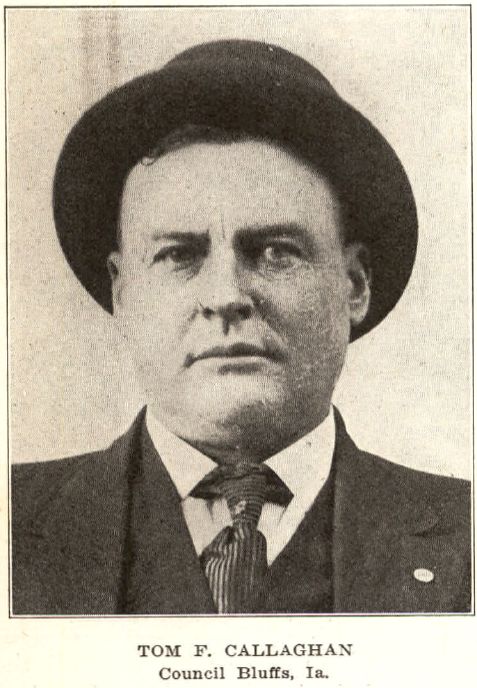
Story by Tom F. Callaghan, Chief of Detectives, Council Bluffs, Iowa, and
Dalton O’Sullivan, Detective and Author of Enemies of the Underworld, 1917

Bert Forney was proprietor of a saloon, 1028 West Broadway, Council Bluffs, Iowa. He was not a quarrelsome man, but was a man of more than ordinary nerve, and one who would fight to the death before letting anyone hold him up and rob him.

Chief of Detectives, Council Bluffs, Iowa, Tom Callaghan, 1903

.

On the night of April 3, 1903, he was sitting at a table playing cards with a friend, James Chaney, when the back door of the place opened and a loud command, ‘HANDS UP!’ was given by a man wearing a mask and pointing a six-inch barrel revolver at Bert Forney. Forney sprang from his chair and ran behind the stove. The robber fired, shooting through the drum of the stove. Then Forney ran toward the door of a little side hallway hoping thus to secure a vantage point from which he might return the fire of the robber.

Reaching the little hallway, Forney turned with the intention of shooting at his assailant and had his right arm raised with his revolver pointing at the man, when the third bullet from the robber’s revolver struck him just under the right shoulder and plowed its way clear through his body and Forney dropped to the floor dead.

One bullet went through the drum of the stove, the second lodged in Forney’s hip while he was running and the third as described. When I arrived at the scene of the shooting, I saw that the only living witness to the murder was James Chaney. He gave me a description of the man that had done the shooting and stated if he ever should see the man again, he could identify him by his build and particularly by his piercing eyes.

The next day, at approximately 10 a.m., I received a phone call from someone that refused to give his or her name, but stated that the man that killed Bert Forney had a package of laundry at the Evans’ Laundry and that he was to call for it at 4 p.m. The caller also said he was registered at the Kiel Hotel but could not tell under what name. Two officers were sent there to watch for the man that was to call at 4 p.m., but 6 p.m. came and yet no call for the package. I went to the laundry at six o’clock. I was the only plainclothes officer working nights. I hid back of the entrance behind a rack where I could see him but he could not see me.

After waiting one hour, he called for the package, said he was Frank Parsons, and received it. Then, as he left the door going across the street, I followed on tiptoes, caught a firm grip on the lapel of his coat, pointed my revolver that I held above my hip at his stomach, and told him he was under arrest. Gritting his teeth, he reached for his gun, which he carried beneath the left band of his trousers, and as he grasped the handle again and again I threatened I would kill him if he did not throw up his hands. He did as commanded but for some time he tried to break loose. With a lot difficulty, I finally got him to the police station.

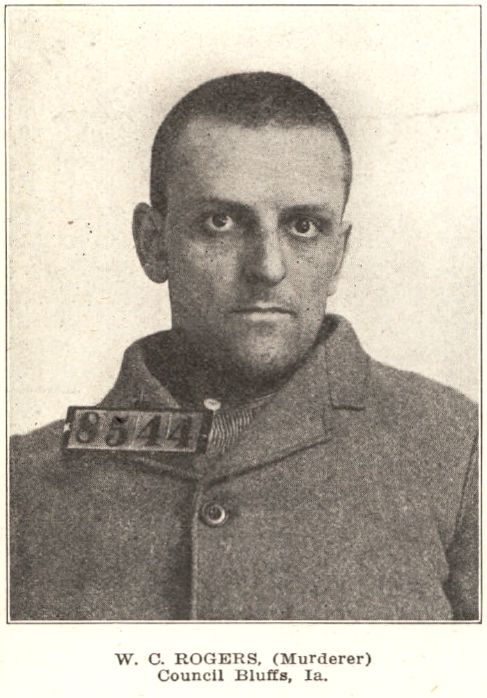
William C. Rogers, "Omaha Billy" - 1903

William C. Rogers, “Omaha Billy” – 1903

I recognized him as William. C. Rogers, a member of the notorious Burrier-Rogers-Dolan-Tucker-Stevenson gang that made their headquarters at Lake Manawa, Iowa, the year before. I had seen him in the Jarvis Saloon two nights before when I sent A. A. Kirk, a patrolman, in the saloon to look at him so if anything came off that night we would know he was here. This fact was very important as Rogers claimed he was not in town for almost a year until the day he was arrested.

The revolver Rogers carried was a six inch blue steel, .41 caliber Colt. Three new shells had been recently put in the gun; three other shells were evidently in the gun for some time; three shots had been fired in the Forney saloon. To see if the rest of the tip was correct, I went to the Kiel Hotel where I found his personal effects in a room where he was registered under the name of Frank Parsons.

Dr. V. L. Treynor, Coroner and Dr. M. A. Tinley, held a post mortem on the body of Forney. One bullet that hit the hipbone was almost split in two, but the bullet that struck under the arm and was found in the fleshy part of the victim’s other arm, was perfect, having missed hitting any bone whatsoever. Dr. M. A. Tinley fired two bullets out of Rogers gun—the ones that were found in the gun—into loose clay. Both bullets showed the rifling imprints, imperfect, yet both alike. The gun had rusted on the inside of the barrel causing the rifling to produce a different imprint on the bullets all the way around.

We took the perfect bullet that was taken from Forney’s body and one fired from Rogers’ gun into the soft clay and with the points in opposite directions we placed them together. We turned them to match the markings and each and every mark was twin for twin all the way around. One rifling imprint would be deep in the center, one real shallow and some of them barely seen. The formation was there to stay and was as solid as the steel trust itself. We also weighed the bullets; they were the same in weight. We compared them with bullets fired from another .41 Caliber Colt revolver but no rifling imprint matched those from Rogers’ gun. This bullet evidence, we found after the trial, was the most convincing of any or all other evidence.

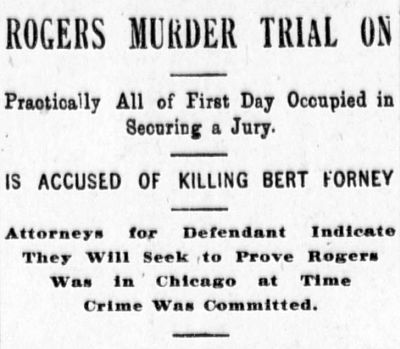
Headline from the Omaha Daily Bee, February 16, 1904

Headline from the Omaha Daily Bee, February 16, 1904

The Grand Jury indicted W. C. Rogers for murder in the first degree. He was defended by able counsel, W. A. Mynster and John Lindt. W. H. Killpack was the county and prosecuting attorney, J. J. Hess, assistant. The case was continued from two terms of court on account of the defense but finally went to trial, February 9, 1904. We secured two witnesses who saw Rogers the day before the murder, and two who saw him on the day of the murder. The defense had sixteen witnesses; the State had thirty-two.

 To “prove” that Rogers was in Chicago the day of the murder, they brought a man who claimed to be the clerk in a certain hotel in Chicago that saw W. C. Rogers write his name on his hotel register the day of the murder and identified him as the man. Mr. D. Holst of the Kiel Hotel, Council Bluffs, testified he saw W. C. Rogers write his name on his hotel register the day before the murder and produced the book signed ‘Frank Parsons.’ We put experts on the stand that testified the name from Chicago and the Kiel signature were written by two different men. We also, with several witnesses, identified the man from Chicago as one of the gang that was here the previous year. James Chaney testified that Rogers was and in every way, a man resembling the murderer of Forney. The trial lasted eleven days. He was found guilty of murder in the second degree, receiving a sentence of twenty-five years at hard labor at Ft. Madison.

In 1906, his case was taken to the Supreme Court of Iowa and the lower court upheld. He has since tried several times to be paroled. He is wanted for other crimes at Minneapolis, Minnesota, and Clinton, Iowa.

From what I can learn of him, he was arrested in Denver as far back as 1890 at which time he had already secured a reputation and was known as “Omaha Billy.” He was next, as far as I can learn, incarcerated in the Ft. Madison Penitentiary under the name of “Billy Miller” along about 1891, for a short term. He is credited with serving terms in the penitentiaries in Minnesota and Wisconsin and finally drifted over to Ohio where he received a three-year sentence from which he was released in March 1902.

Owing to the fact that he had powerful friends in Omaha backing him—rich fences that had been receiving his plunder—furnishing money and counsel and the great effort that was put forth to clear him, I consider this one of the greatest cases ever tried in this locality and the fact of the convincing bullet evidence was original  here [the first time ever used in that courtroom] as far as I can ascertain. It was at least the most complete and convincing that I ever heard of.

—###—


Criminal Slang Dictionary for 1890 to 1919
890 Words & Phrases used by Criminals

Home | Uncategorized | Criminal Slang Dictionary for 1890 to 1919
890 Words & Phrases used by Criminals


In 1910, if someone said they were “blowing the peter,” — it’s not what you’re thinking. From approximately 1890 to 1919, that term meant they were going to the door off a safe to rob it, and the person doing it was called “a yeggman,” slang for safe robber.

If someone said they wanted to buy some “happy dust,” it meant that he or she wanted to purchase some cocaine.

An inmate, pig, trader, hustler, and moll were all slang terms for prostitute. If she was “on the turf,” it meant she was a streetwalker. If “she got jugged by a peeler, and thrown in the Irish club house,” it was slang for “she got arrested by an Irish cop and was taken to jail.”

“Jail arithmetic” was a slang term for ‘cooking the books’ by an accountant, bookkeeper, or bank employee who was embezzling, and was falsifying records in the company’s ledger . In other words, his bogus arithmetic would get him sent to jail.

They also had “rappers” back then, but it was slang for a civilian who informs to police, or files a complaint with law enforcement.

Just completed and now posted on HCD is the Criminal Slang Dictionary of 890 words and phrases used by underworld figures from 1890 to 1919 (approximately). Check it out for yourself and don’t get nipped tanking the white mule while driving your sneeze wagon.

Criminal Slang Dictionary of Words & Phrases
in use from 1890 to 1919

—###—


The Chinatown Trunk Murder: Christian Missionary’s Love Triangle has Fatal Consequence, 1909

Home | Short Feature Story | The Chinatown Trunk Murder: Christian Missionary’s Love Triangle has Fatal Consequence, 1909


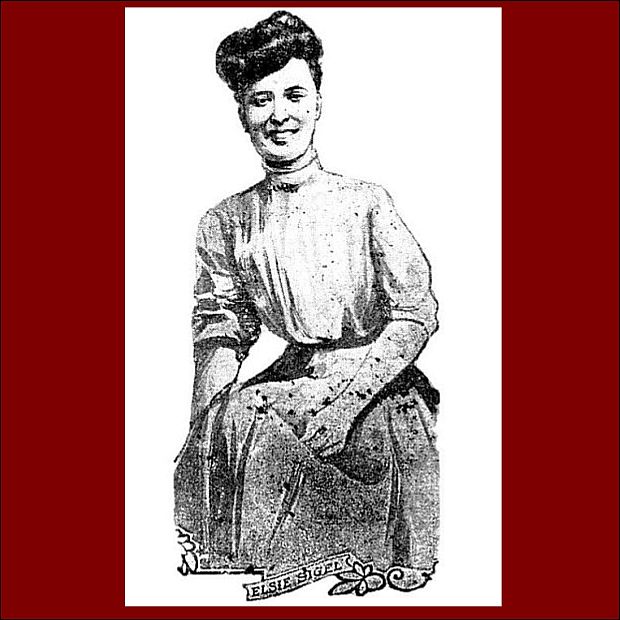
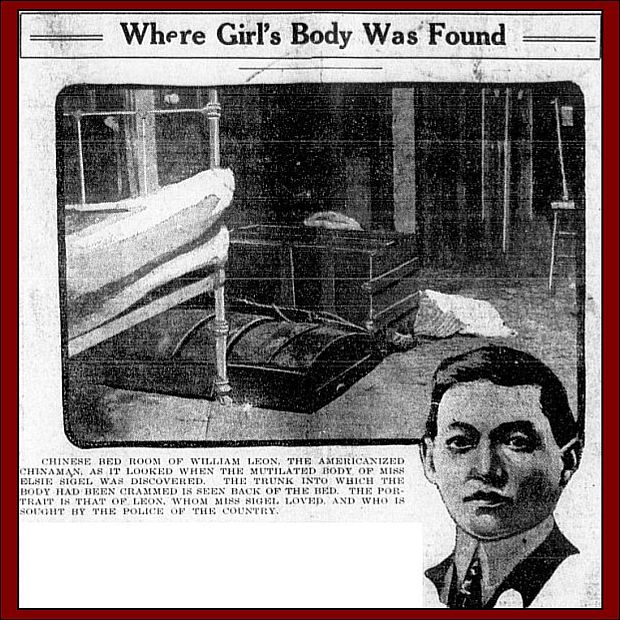
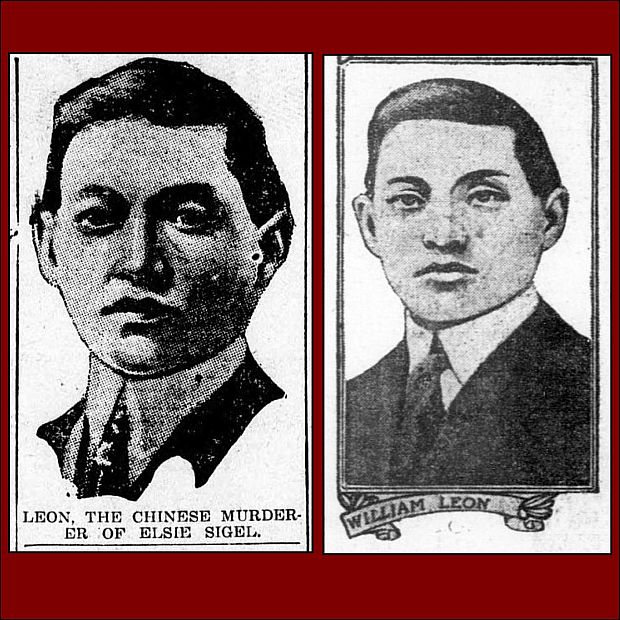
Elsie Sigel was the nineteen-year-old granddaughter of famed and respected Civil War General Franz Sigel. In 1909, she was working with her mother as a Christian missionary in the Chinatown district of New York City. While helping her mother, she began love affairs with two Chinese men, Leong Lung, alias William Leon, and Chu Gain.
On June 9, 1909, Elsie went missing. Knowing of her affair with Leon, her family did not report her disappearance to police. This would have attracted the attention of newspaper reporters who might have uncovered her relationships, and brought shame to the family.
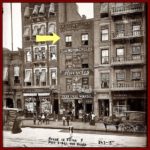
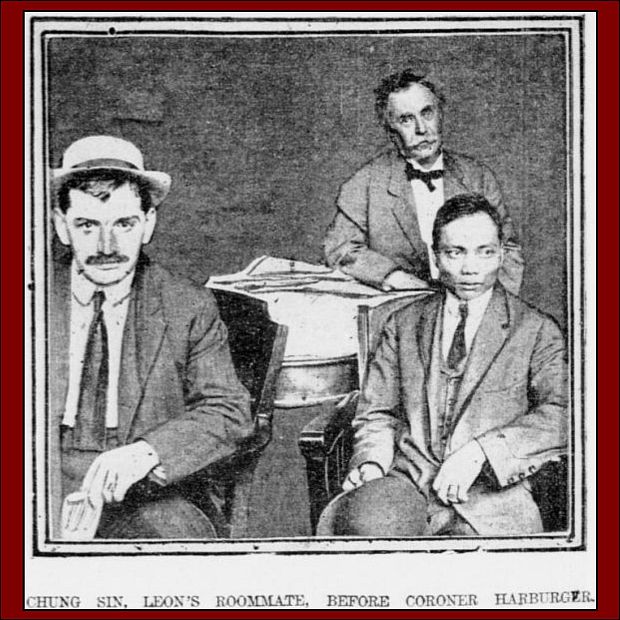
On approximately June 15, Leon's uncle, who owned a 'Chop Suey' restaurant on the third floor of a four-story building at 782 8th Avenue, reported to police that his nephew, William, had not been seen in six days. When he attempted to enter the boy's apartment, one floor above the restaurant, the door was locked and no one answered his repeated attempts at knocking. Also missing was Leon's roommate, Chong Sin. A police officer was dispatched to the scene to investigate and he was able to force the door open.
With the exception of a bed and a trunk bound with rope (evidently prepared for shipping), the room was vacant. After removing the rope, the officer opened the trunk and found the almost nude body of a well-formed young woman soon identified as Elsie Sigel, Leon's girlfriend. The body was doubled up, wrapped in a sheet, and inside the trunk for seven days.
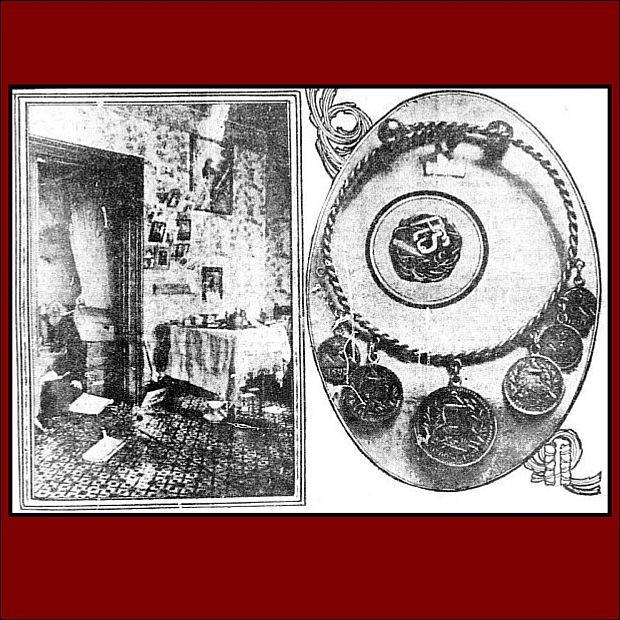
Elsie Sigel's killer had strangled her to death with a cord from a window shade. At the time of her death, Elsie was wearing a gold necklace and pendant inscribed with the letters "P. C. S."-an item that may have once belonged to her father, Paul Sigel. Investigators found another piece of her jewelry in the room, a bracelet bearing the initials "E. L. S." Her mother later identified the jewelry as those worn by her daughter.
Police soon located roommate Chong Sin and held him as a material witness. He gave them a statement claiming he witnessed William Leon murder Elsie Sigel in his apartment on the morning of June 9. William Leon, Sin explained, was insanely jealous of Elsie's new relationship with Chu Gain, who feared Leon. Meanwhile, news of Elsie's murder and the manhunt for William Leon was published in newspapers coast-to-coast. This fed the public's disdain for Chinese, and "set off a wave of anti-Chinese hysteria, as well as suggestions that the murder was Sigel's own fault." (Wikipedia).
Despite the nationwide manhunt for William Leon, and reported sightings of him in Cuba, Texas, and other places, he was never captured. His disappearance remains a mystery.

Read the Entire Story


—###—


New Book: Ugly Prey, by Emilie Le Beau Lucchesi

Home | New Books | New Book: Ugly Prey, by Emilie Le Beau Lucchesi


Book Synopsis

An Italian immigrant who spoke little English and struggled to scrape together a living on her primitive family farm outside Chicago, Sabella Nitti was arrested in 1923 for the murder of her missing husband. Within two months, she was found guilty and became the first woman ever sentenced to hang in Chicago. Journalist Emilie Le Beau Lucchesi leads readers through Sabella’s sensational case, showing how, with no evidence and no witnesses, she was the target of an obsessed deputy sheriff and the victim of a faulty legal system. She was also—to the men who convicted her and the reporters fixated on her—ugly. For that unforgiveable crime, the media painted her as a hideous, dirty, and unpredictable immigrant, almost an animal.

Lucchesi brings to life the sights and sounds of 1920s Chicago—its then-rural outskirts, downtown halls of power, and headline-making crimes and trials, including those of two other women (who would inspire the musical and film Chicago) also accused of killing the men in their lives. But Sabella’s fellow inmates Beulah and Belva were beautiful, charmed the all-male juries, and were quickly acquitted, raising doubts among many Chicagoans about the fairness of the “poor ugly immigrant’s” conviction.

Featuring an ambitious and ruthless journalist who helped demonize Sabella through her reports, and the brilliant, beautiful, twenty-three-year-old lawyer who helped humanize her with a jailhouse makeover, Ugly Prey is not just a page-turning courtroom drama but also a thought-provoking look at the intersection of gender, ethnicity, class, and the American justice system.

Reviews

“Emilie Le Beau Lucchesi’s riveting and creepy tale of violence, betrayal, and injustice is an uncomfortable yet all-too-familiar story of anxious Americans’ willingness to believe that illiterate, poor immigrants can be guilty of a crime because of who they were, not what they did.” —Kate Clifford Larson, author of The Assassin’s Accomplice: Mary Surratt and the Plot to Kill Abraham Lincoln

“An elegantly researched and beautifully written example of investigative journalism. Sabella Nitti’s story is a cracking-good mystery. It’s a monument to Jazz-era misogyny, true crime, women’s rights, immigrant prejudice, and the brutal inequities in the system of jurisprudence in 1920s Chicago.”—Jeffrey Gusfield, author of Deadly Valentines: The Story of Capone’s Henchman “Machine Gun” Jack McGurn and Louise Rolfe, His Blonde Alibi

“Emilie Le Beau Lucchesi has told a long-neglected story that needed telling—a story about class, fear of the Other, and justice denied. Her rigorous history is shocking and moving. It has a lot to tell us about both who we were then and who we are today.” —Douglas Perry, author of The Girls of Murder City: Fame, Lust, and the Beautiful Killers Who Inspired Chicago

“The author’s inclusion of contemporary sensational Chicago trials helps readers place the importance of the case. VERDICT For lovers of historical true crime.” —Library Journal


About the Author: Emilie Le Beau Lucchesi

Emilie Le Beau Lucchesi has contributed to the country’s largest newspapers, including the Chicago Tribune, New York Times, and Los Angeles Times. Her work has also appeared in CountryLiving.com, MarieClaire.com, and GoodHousekeeping.com. She frequently speaks to universities and professional organizations on topics related to women in history, media, and Jazz Age Chicago. She lives in Oak Park, Illinois.


—###—


CrimeCon 2017, June 9-11, Indianapolis

Home | Recent News | CrimeCon 2017, June 9-11, Indianapolis


CrimeCon 2017 – http://www.crimecon.com

A friendly reminder that CrimeCon 2017 will take place in Indianapolis June 9-11. Day passes are now available and they have put together quite a line-up of “true crime” stars including Nancy Grace, Josh Mankiewicz, Aphrodite Jones, Kelly Siegler, Carl Marino (the young Lt. Joe Kenda), and over 30 True Crime Podcasters.

Here’s the update I just received from the event organizer.

We announced Oxygen as our presenting sponsor
* We just started selling day tickets last week
* The cutoff to book the hotel is 5/24
* Podcasts- We have over 30 of the top true crime podcasters attending! They are setting up on “podcast row” during Friday and Saturday of the convention. We also have an onsite podcast studio that select shows are doing live recordings from.
* Ken Kratz is hosting a super small and in depth session on the Avery case Friday morning before the convention starts

Schedule details — http://www.crimecon.com

—###—


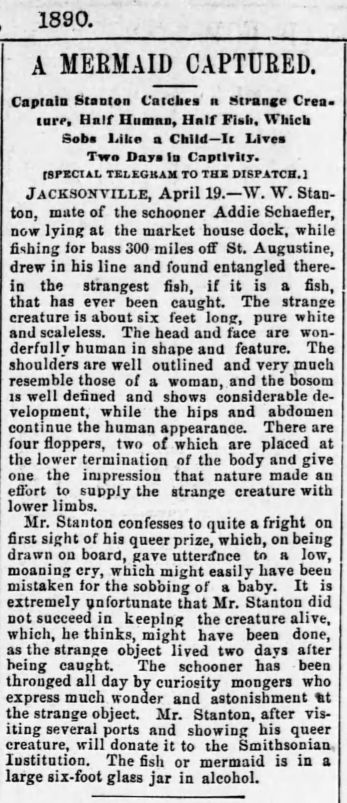
Was a Mermaid Captured in 1890?

Home | Rediscovered Crime News | Was a Mermaid Captured in 1890?


Okay, this isn’t crime related, but it is mysterious. And weird. A short news story published in 1890 about a captured mermaid–with a well-developed bosom, apparently. I find all kinds of weird stories when digging around in old newspapers and this is just one example. — JLM

Mermaid Captured

—###—