A Tribute for my Mother
Home | Recent News | A Tribute for my MotherA Tribute for my Mother

A Tribute to my Mother
Posted: Jason Lucky Morrow - Writer/Founder/Editor, December 2nd, 2018 under Recent News.
Comments: none
Where old crime does new time: A Research Site Dedicated to Forgotten Crimes & Forgotten Criminals

Welcome to HistoricalCrimeDetective.com [Est. 2013], where you will discover forgotten crimes and forgotten criminals lost to history. You will not find high profile cases that have been rehashed and retold ad infinitum to ad nauseam. This blog is the official website for true crime writer Jason Lucky Morrow, author of four books including the popular series: Famous Crimes the World Forgot, Volume I and Volume II. If you would like to send me a comment, Contact Me Here. - Please follow this historical true crime blog on FACEBOOK.
A Tribute for my Mother
A Tribute to my Mother
Posted: Jason Lucky Morrow - Writer/Founder/Editor, December 2nd, 2018 under Recent News.
Comments: none
[September 7, 2018] Posted below for your consideration is Chapter 17 from the first volume of a new anthology series presented by HCD Publishing entitled, Vintage True Crime Stories: An Illustrated Anthology of Forgotten Cases of Murder & Mayhem, Volume I, 314 pages.
The book will be released on Amazon Kindle this coming Monday, September 10. A hard copy of the book is already available on Amazon for $14.99. Distribution of the digital book through other venues will continue over the next several weeks.
All the books in this series, including Volume I, will have a corresponding companion webpage where readers can browse through additional images, illustrations, maps, genealogy files, court documents, relevant excerpts from vintage magazines and books, and pdf files of old newspaper stories that were published during the many stages of each criminal case.
The link to the companion webpage for volume one is at the end of this story.
—–
Story by Thomas Furlong, Fifty Years a Detective, 1912
NO CRIME COMMITTED IN THE West in recent years was surrounded with more mystery than was the murder of James S. Collins which occurred in Topeka, Kansas, in the spring of 1898 (May 13). Mister Collins was slain while asleep beside his wife in their home. The weapon used was a shotgun, and one or two of the shot struck the wife’s shoulder, making slight, though painful wounds.
The murdered man had been a prominent insurance and real estate man of the Kansas capitol, where he had lived for many years and was well known to most citizens of that city, as well as throughout the entire state. In fact, he was considered one of the state’s most prominent citizens. At the time of his murder, he was about fifty-five years of age, had a wife, one daughter, and a son, John.
The Collins family occupied a comfortable home in Topeka. John, the only son, was a student at the state university at Lawrence, Kansas, where he was being prepared for the ministry. He had been a student at Lawrence for two or three years before his father’s murder. He boarded at the school and occasionally visited his home in Topeka, usually on Sundays and holidays.
The Collins home, which was one of the best on the state capitol’s most prominent residential thoroughfares, was disturbed early one morning by the discharge of a gun in the sleeping room occupied by Mr. Collins and his wife, which was situated on the ground floor. Mr. Collins had been shot and died instantly, and his wife, as stated above, received one or two grains of coarse shot in her shoulder. Other occupants of the house that morning were Miss Collins, a young lady of about eighteen years of age, and John Collins Jr. Both of them occupied rooms on the second floor of the house. There was also a servant girl in the house. It was in the early part of the summer, and the windows were all screened with wire. John, apparently aroused by the shot that killed his father, dressed hastily and aroused the nearest neighbors. It was at an early hour in the morning but after daylight.
The police were sent for and, on their arrival, ascertained that the doors of the house were all intact and carefully locked; however, a window screen in the rear of the house on the second floor was found to have been cut, leaving a hole large enough for the passage of a human body. This window was directly above a one-story addition to the main building in the rear.
After the police finished their investigation of the premises, they arrived at the conclusion that the murderer must have entered the house with a key. After he shot Mr. Collins, he escaped by going up the main stairs to the second floor, down the hall to where the wire screen to the window had been cut and jumped out of the window onto the roof of the one-story addition. He then jumped down to the ground, a distance of about ten or twelve feet, and in that way made his escape.
The murder created a great sensation because of Mr. Collins’ high standing in the community. A number of the more influential citizens of Topeka, who were friends of his, formed a committee for the purpose of locating the murderer and having him brought to justice. These gentlemen wired me at my St. Louis office, asking me to come to Topeka to investigate the case. I went to Topeka at once, arriving there, if I remember right, the third day after the murder had been committed.
I reported to the gentleman who was chairman of the committee and at once began my investigation by examining the premises where the murder occurred. I interviewed the widow, who was Mr. Collins’s second wife, her stepdaughter, and her stepson, John Collins. Mrs. Collins was a woman between thirty-six and forty years of age, of the brunette type, rather above the medium height and inclined to be slender. She was very attractive and considered a good-looking woman, intelligent, and refined.
Miss Collins was also above the medium height, nice-looking, well educated, and intelligent.
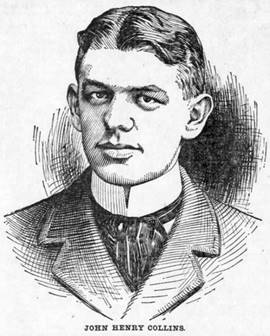
John Collins had just passed his twenty-first birthday, was about five-feet-eight- or nine-inches tall, light brown hair, fair complexioned, well built, pleasing in manner and a very fine-looking young man.
After I had consumed about four days in my investigation, I became satisfied in my own mind that the murder had been committed by some person who belonged in the house and that the house had not been entered by an outsider. I had discovered that Mr. Collins had been killed with his own shotgun, a high-priced firearm, which he always kept in a leather case, usually placed on the upper shelf of a clothes closet in his bedroom. This closet was unusually large and extended from the floor to the ceiling. The ceiling being very high, an ordinary-sized man could not reach the shelf where the gun was kept without the aid of a stepladder, or possibly, it could have been reached by a tall person while standing on a high table.
Mr. Collins had not used his gun for months before the murder, and it had always been his custom after using the weapon to clean it thoroughly, take it apart, and pack it in the case. It was, therefore, necessary for the murderer to take this gun case from the shelf, put it together and load it with the ammunition, which was also kept on the high shelf. None of this could have been accomplished by any outside person without having been discovered by one of the residents of the house.
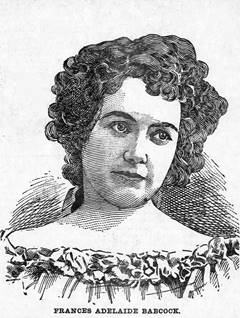
I also learned that John Collins had left his lodgings at Lawrence on the evening preceding the murder, going to Topeka and directly to his home, where, he claimed, he retired for the night at an early hour. He also claimed that he remained there until aroused by the shot that killed his father. I also learned that the young man had formed the acquaintance of a very estimable and wealthy young lady (Frances Adelaide Babcock) at Lawrence, with whom he had become infatuated. He had paid a lot of attention to her for months, and finally, she had informed him that her mother had decided to purchase or lease a cottage at Long Branch in which to spend the summer months.
 I surmised that when he learned that she intended to accompany her mother to Long Branch for the summer, young Collins feared his sweetheart would meet one of the many fortune hunters who frequent the resort during the summer months, thus endangering his chances of winning her. Since that was unacceptable to him, Collins made up his mind to do all he could to spend the summer at Long Branch to guard his young lady friend from the unwanted, indecent, lecherous, salaciously sinful flirtations of other young men, who, of course, might possibly be taller, more handsome, and more clever.
The elder Mr. Collins had been considered to be wealthier than he really was at the time of his death. He had met with financial reverses and really had but little more than his home in Topeka when he was murdered, but he was carrying thirty-thousand-dollars insurance on his life, ten thousand to his wife and ten thousand to each of his children.
Having secured the above information, I sent one of my operatives, J.S. Manning, to Lawrence, Kansas, with instructions to quietly ascertain all that he could as to the habits of the young man Collins and his associates. Mr. Manning’s investigation there developed that young Collins had been spending considerable money on buying flowers, carriage hires, and entertainment. He had no means of defraying these expenses other than twenty-five dollars a month allowed him by his father for that purpose. Mr. Manning also learned there were a couple of black hack drivers (a horse and carriage taxi) in Lawrence who had been patronized by the younger Collins.
 Upon receipt of this information from Mr. Manning, I sent Dell F. Harbaugh, who was then in my employ, to Lawrence. Mr. Harbaugh had lived in Lawrence, Kansas, for a number of years before he entered my service. He had been in the livery business there and had been a hack driver. He was personally acquainted with the black drivers mentioned before, but these men did not know that he was now in the secret service work. For this reason, Mr. Harbaugh saw it was easy to find out everything that the hack drivers knew about John Collins.
After renewing their acquaintance, Harbaugh learned from them that Collins had approached them and entered into a verbal contract to kill his father for a certain sum of money, part of which he had paid at the time the agreement was made, he agrees to pay the balance after the murder had been committed.
They told Harbaugh that they had no intention of attempting to murder Mr. Collins but had promised John they would do so to work him for what money they could get out of him, knowing, as they did, that he dare not expose them when they failed to carry out their agreement.
The murder was to have been committed on or before a certain date. The date passed and Mr. Collins still lived, whereupon John became anxious and admonished the hack drivers who had hustled him. They told him that they were entitled to more money than what he had agreed to pay them, and he gave them an additional one-hundred dollars, as well as a gold watch his father had presented to him on his twenty-first birthday.
This money young Collins had secured by borrowing from his friends, and through bank drafts he had drawn on his father’s account, as we later learned. There was then another date set for the murder to be committed by the hack drivers. When that day arrived and passed, young Collins again yelled at the drivers for not having carried out their agreement. They coolly informed him that they had concluded that if his father had to be killed, that he had better do the killing himself. They positively would not commit the crime and, in fact, they had never intended to do so.
Upon hearing this, young Collins became desperate and left Lawrence and went to Topeka. There, he killed his father in his sleep with his own shotgun.
When this evidence was obtained, I reported it to the gentlemen who had employed me, and they then decided to hand my report over to the prosecuting attorney at Lawrence. At the request of the prosecuting attorney, the county commissioners at Topeka employed me to complete the evidence so that Collins could be arrested and prosecuted for the murder of his father.
John Collins was immediately arrested, placed in jail without bond, and in due time the case came to trial. The trial caused a great deal of interest in the community because the elder Mr. Collins was so well known, and the killing had been done in a mysterious manner.
The trial attracted great attention throughout the entire country. All of the leading western papers had special reporters present, and all the sensational features were “played up” (as newspapermen call it) as they developed. The courtroom was crowded, and many noted lawyers were also in attendance to watch the legal battle, which at times waxed very warm as all the counsel on both sides were very able men. Prosecuting Attorney Aaron P. Jetmore was at his best, making one of the greatest fights I ever saw to get his evidence before the jury.
Among the spectators for almost the entire trial was the late Justice David Josiah Brewer of the United States Supreme Court at Washington. He was visiting his daughter, who was the wife of the prosecuting attorney, Mr. Jetmore. At the close of the case, Mr. Justice Brewer complimented me (private detective Thomas Furlong) very highly for my work in solving the mystery.
During the trial, a great many people got the idea that I had been employed by the insurance companies, believing that the companies were trying to avoid payment of the thirty-thousand-dollars insurance by proving that the son had killed his father. This opinion was erroneous. The people who employed me in this case were citizens of Topeka and lodge friends of the murdered man. They were not connected with the insurance companies relevant to the case, and they were only good and law-abiding citizens seeking justice. As soon as I had satisfied them that young John Collins was the murderer, they immediately turned the evidence over to the proper state authorities.
The trial lasted more than a week. Collins was defended by two of the most prominent attorneys at that bar. They labored earnestly and to the best of their ability to clear him, but he was found guilty of murder and sent to the state prison to await the governor’s action in fixing the date of his execution. However, it has always been the custom in Kansas for the governor to never set the date for execution of one found guilty of murder. The prisoners are usually kept in prison, and a sentence of death in Kansas usually means a life term in the penitentiary.
There has been an effort made by friends of young Collins and the family to obtain a pardon for him, but up to this time, I understand they have not made progress.
I will say here that the black hack drivers from Lawrence took the witness stand for the state against John Collins and produced the watch that he had given them, which had been presented to him by the elder Mr. Collins upon the 21st anniversary of John’s birthday. This watch, with the testimony of the hack drivers, in which they detailed the contract they had made with the younger Collins, all of which was corroborated by circumstances that were not, or could not be, contradicted, led to the conviction of the son for the murder of his father.
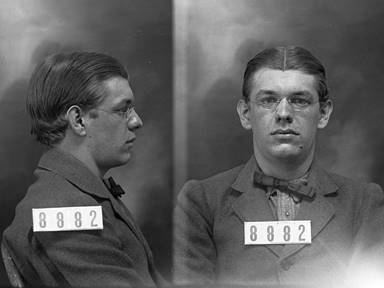
Above, a Kansas State Prison mugshot of John Henry Collins taken in 1901. Despite being sentenced to death, Collins served less than ten years for the murder of his father. Following his release, he moved to California. Photo Credit: Kansas State Historical Society, Item Number: 311265.
—–
Epilogue: John Collins was released from prison a year or two before 1910 when the US Federal Census reports him as living on South Flower Street in a Los Angeles, California, rooming house. The census reports that the thirty-two-year-old was living alone and employed as a hotel clerk. By 1920, he had married Grace Fowler, a twenty-eight-year-old stenographer who worked in a machine shop. He also returned to his first calling, the church, where he worked for the next twenty-five years as a “Practitioner” in Santa Monica, employed on his own account. The couple had one son, William, born in 1921.
John Collins died on February 1, 1945. He was sixty-seven years old. Grace died more than eight years later, on September 6, 1953.
Click here to visit the companion webpage for Vintage True Crime Stories Volume I.
—###—
Posted: Jason Lucky Morrow - Writer/Founder/Editor, September 7th, 2018 under Feature Stories, New Books.
Tags: 1800s, Kansas, Patricide
Comments: none
The infographic below communicates in a clear and simple way the tedious process of putting an anthology of true crime stories together.

—###—
Posted: Jason Lucky Morrow - Writer/Founder/Editor, September 7th, 2018 under New Books.
Comments: none
Vintage True Crime Stories: An Illustrated Anthology of Forgotten Cases of Murder & Mayhem, Volume I, is a new book from HistoricalCrimeDetective.com that will be released Monday, September 10.
All this week leading up to the Monday launch date I will be posting more information about the book including a sample chapter or two, images, and information about free digital advance copies with a chance for reviewers to win one of two $50 Amazon gift cards.
—–
 When it comes to committing murder, nothing has changed in the last 100 years.
One of the questions I hear the most from those who read vintage true crime stories goes like this: “Is crime worse today than it was back then?” I know it may seem like capital crimes and the deprivations of society are the worst they have ever been in American history, but the upcoming release of a new anthology series surmises that—when it comes to murderers, they haven’t changed much in the last one-hundred years. Catching them, yes. The motive, means, and opportunity, no. The cold-blooded killers of today are the same as they were long ago.
To prove this theory, consider the cases below that appear in our new book, Vintage True Crime Stories, Volume I scheduled for release this Friday, September 7, by Historical Crime Detective Publishing.
Chapter One: Twenty years before the 1932 kidnapping and murder of Charles Lindbergh Jr., there was the Marie Smith case of 1910. The nine-year-old went missing while walking home from school. Her killer was German, spoke with a thick German accent, and his last name was even similar to Hauptmann’s. Both men were entrapped by scientific advancements that were landmarks for future cases. And, in the end, both men were executed in the same electric chair.
Chapter Two: Like a scene in a contemporary action movie, two hitmen on a motorcycle roar down a Rhode Island road late at night. At the designated location, they come to a stop beside the chauffeur driven automobile of a wealthy doctor who was accompanied by his mistress. At point blank range, the assassins emptied their pistols into the two figures in the backseat. They ignored the driver and sped away, disappearing into the darkness. That event led to a one-of-a-kind murder trial with an outcome that reinforced the duality of American justice for the next one-hundred years.
Chapter Seven: During the late hours of January 10, 1895, two burglars break into the parsonage of Rev. William Hinshaw and his wife Thurza. A fight breaks out; Thurza is shot in the head and dies on the steps leading up to the back door. Bravely, William fights back in a desperate struggle with the man holding the gun. His partner, a smaller but ‘wirey’ man, slashes him a dozen times with a razor, forcing Hinshaw to release his hold on the taller one who then fires one round into the reverend’s left shoulder. Fearing others may have heard the shots, the robbers flee through the backdoor and disappeared down a snow-covered lane.
Neighbors, friends, and newspaper editors declared Rev. William Hinshaw a hero. One needed only to look at his many wounds to see that that he fought as hard as any man could against the two robbers—the ones who never left footprints on the snow covered lanes of Belleville, Indiana.
Chapter Eleven: On January 1, 1914, the cabin of a local photographer burns to the ground. Inside, they find his body. Three days later, it happens again to another man. Autopsies prove the men were killed before the fires were set. The evidence leads investigators to an elderly Civil War veteran with a dark past filled with dead bodies.
These four stories were recently discovered in one of the rarest true crime books known to exist, Enemies of the Underworld: Embracing Sixty-Eight Stories by America’s foremost Detectives, by Frank Dalton O’Sullivan.
His 700-page tome is a combination manual for new detectives, and true crime book featuring true stories co-authored by senior detectives and police chiefs from across the United States. Self-published in 1917, the book sold for five-dollars, the 2018 equivalent of $108–which might explain why it’s nearly impossible to find a copy of it today.
With this artifact, Historical Crime Detective Publishing saw it as the perfect foundation to structure a new anthology series simply titled: Vintage True Crime Stories: An Illustrated Anthology of Forgotten Cases of Murder & Mayhem.
Volume I contains fifteen stories from O’Sullivan’s book, while the remaining five chapters were selected from Fifty Years a Detective by Thomas Furlong, published in 1912.
Mixed in with these twenty stories are sixty-five images, fifty-two footnotes, a dozen epilogues, and ten annotations.
But wait, there’s more! – Volume I of this series comes with a companion webpage where readers can find more information including fifty more images, and more than 130 pages of newspaper coverage about the cases covered in this book.
Editor: Jason Lucky Morrow
Posted: Jason Lucky Morrow - Writer/Founder/Editor, September 4th, 2018 under New Books.
Comments: none
Editor’s Note: The Bloody Benders were a family of serial killers who lived and operated in Labette County, Kansas, between 1871 and 1873. Nearly a dozen travelers who stopped at their small inn were murdered, and their bodies later found buried on the Benders’ property. The family of four disappeared before they could be arrested. Over the years, a dozen different accounts of their fate were theorized or told. The story below—that they were killed soon after they were suspected in the disappearances of eleven people—is just one of those accounts, but this one comes from one anonymous source, and two deathbed confessions by individuals who said they were involved in the interrogation and execution of all four Bender family members. It was written and published in an obscure true crime magazine in 1951.
—###—
by Manly Wade Wellman, 1951
WHEN Osage Township began seriously to worry, about March 1, 1873, over vanishing travelers on the road from Fort Scott on the Missouri line to Independence deep toward the Indian nations, those travelers had been vanishing for about two years. One more was still to vanish, before Kansas and the world would know how these disappearances had come to pass.
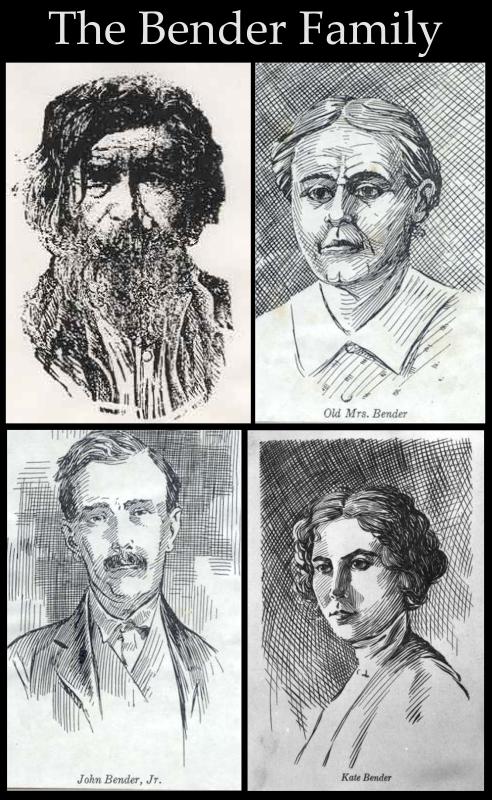 In those days news did not travel fast or far, especially news about lost strangers nobody expected to meet, anyway. People were too busy settling.
First there was only a trail leading southwest into Kansas, bitten through the buffalo grass by heavy-rimmed, ox-drawn wheels. As the Civil War spent itself and a new impulse of settlement strove that way, the trail was hardened and widened by much travel into a highway. Wagonloads of settlers trundled in. Here and there on the treeless plain sprang up farmsteads, relieving a monotony hitherto broken only by occasional meager creeks, small knolls, or willow and cottonwood scrub. Osage Township in Labette County, just east of the new village of Cherryvale, was distinguished from the rest of the developing country only by the faint color and flavor of mystery.
Many of the sunburnt farmers had served in the Union Army. Their women were plain and industrious, their children shock-headed, barelegged, shrill. These people built their own houses, butchered and smoked their own meat, ground their own flour from their own grain, sewed their own clothing and cobbled their own shoes. They had no theaters, no libraries. Occasionally there was a barn-raising, a revival meeting, a spelling school. Neighbors made much of every trifle of entertainment and sociability.
Leroy Dick was Osage Township Trustee. Among his neighbors were Rudolph Brockman, bluff, jovial and Teutonic; Silas Toles, of shrewd Yankee stock; George Frye and Thomas Jeans, modest and laconic farmers; Maurice Sparks, whose quick temper sometimes fulfilled the implication of his name; and the Bender family, whose roadside home did duty as store, restaurant, and hotel.
Posted: Jason Lucky Morrow - Writer/Founder/Editor, August 10th, 2018 under Feature Stories.
Comments: none
Some good news to share…
But first, let me apologize for my long absence from the blog and Fb page. I am taking a long mental health vacation. Or, creative health vacation. Something like that. When I come back, I have some great stories to present including “The Case of the Missing Chocolate Pudding!” Just kidding. I’ve been putting in a lot of Mr. Mom hours.
The good news is that I found out twenty-four hours ago that my last book, Famous Crimes the World Forgot Volume II, received the Gold Medal in the True Crime Category of the 2018 Independent Publisher Book Awards.
Gold Medal. True Crime. I still can’t wrap my head around it. I did not see that coming.
Here’s how IndependentPublisher.com describes their book awards – in two sentences.
The “IPPY” Awards, also known as the “World’s Largest Book Awards Contest,” are open to English-language authors and publishers worldwide and conducted annually to recognize the year’s best independently published books. Launched in 1996, the awards have grown from 325 entries in 28 categories, to over 5,000 entries in 125 categories.
After looking at the books and authors, who won the Silver and Bronze Medals, I can say I am impressed by their work. One is a professor of law at the University of Kentucky, and the other is a former prosecutor. Yikes.
But seriously, recognition is awkward because validation of one’s work is a tender thing. Mostly, it never happens. When it does, the words that once came so easily slip away and I can only say “from my heart, thank you very much,” and I have no better words than those.

—###—
Posted: Jason Lucky Morrow - Writer/Founder/Editor, April 13th, 2018 under Recent News.
Comments: none
From HCD: The biography of Native American Bobby BlueJacket, a safecracker & killer who redeemed himself inside and out of prison, will go on sale in February, 2018. The book, Bobby BlueJacket: The Tribe, The Joint, The Tulsa Underworld, is available for preorder from the publisher, First to Knock. Author Michael P. Daley, was kind enough to share with Historical Crime Detective a short story excerpt titled, “Always Take a Limousine to a Safe Burglary.” The story is just one of the fascinating episodes in the life of this forgotten criminal considered “a legend amongst Tulsans who considered themselves outsiders.”
The Book Trailer:
“…I had such a hatred inside of me
that I was as dangerous as
any son-of-a-bitch that ever lived.”
—Bobby BlueJacket
Watch this book trailer on Vimeo.
About the Book:
 Bobby BlueJacket is the extraordinary true story of a career thief who first gained notoriety as a convicted teenaged killer. Based on over 5 years of research, the book draws from BlueJacket’s own memories, long-buried law enforcement and trial records, prison archives, news accounts, as well as interviews with others such as photographer Larry Clark and veteran reporters of Tulsa’s mid-century crime beat.
Born in 1930, BlueJacket came of age as a Native American in white Oklahoma—passing through teenage rumbles, scheming pool halls, and Midwest safecracker crews. While incarcerated, he remade himself as a celebrated prison journalist. By the 1970s, he would act as a political impresario, used tire salesman, and prison rodeo emcee—ultimately becoming an Eastern Shawnee activist and respected tribal elder. At each turn, BlueJacket sought out success and self-definition by any means necessary. More than just an underworld tale—Bobby BlueJacket is an in-depth exploration of one man’s experience in a brutal post-war world.
Bobby BlueJacket is illustrated with almost 90 photographs from never-before-seen personal archives, as well as images from prison publications and newspaper clippings.
Softcover / 6 x 9 / 752 pgs. (Includes 87 pgs. of b&w photography and 106 pgs. of source notes)
by Michael P. Daley
The following piece is excerpted from Bobby BlueJacket: The Tribe, The Joint, The Tulsa Underworld by Michael P. Daley. Publisher: First To Knock, 2018. This piece was adapted for Historical Crime Detective.
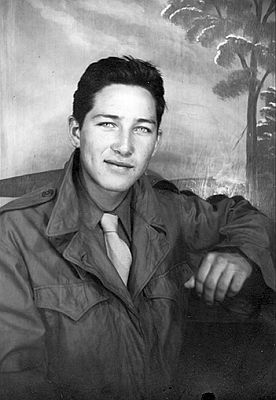 The years following World War II are often seen as a jubilee and a time of growth. But it wasn’t all tickertape parades back home. The hard reentry into civilian life led many veterans to booze, narcotics, crime, and violence. It was a troubling time even for those, like 18-year-old Bobby BlueJacket, who hadn’t seen any traumatic fighting overseas. Tulsa’s wartime boom had come to an end and the job market shrank, leaving few openings for the newly expanded applicant pool of returning soldiers. It seemed to BlueJacket like his whole city desperately needed a paycheck. The unskilled, of course, had it the worst.
Job prospects were grim. But the bonds between BlueJacket and his buddies only cemented. All back from the War, the teenage boys joined together to form a Golden Gloves boxing team. Their manager was a Sapulpa man nicknamed “Knobby,” due to his likeness to the bald-headed manager of funny paper heavyweight Joe Palooka. Knobby and the boys toured the Midwest, going as far as New York—fighting in social halls, gymnasiums, Masonic lodges, and even at the Tulsa Coliseum. The boys were carted around in an old stretch limousine that BlueJacket and Lewis had bought, likely with stolen dough.
It would have been nice to train at the local YMCA with the rest of Tulsa’s boxers, but BlueJacket’s crew was barred from the place. “The old boy that was the head of the boxing club up there, for some reason, he didn’t like us,” BlueJacket said in a 2014 interview with the author. “I guess he thought we was a bunch of thugs.” Instead, the boys trained in the basement of the Tulsa police station. The police basement was also ground zero for professional wrestling run-throughs in the late 1940s. And police, pro wrestlers, and teenage boxers were an even more dramatic juxtaposition than it appeared, because BlueJacket’s boxing squad also doubled as a safe burglary crew in the afterhours.
The young boxers had been stealing for a few years now. Such early capers included the jacking of a Wurlitzer jukebox at Capshaw’s 24-hour restaurant. But safecracking is a technical expertise and so the boys needed a little education before moving up the ranks. Luckily Tulsa, in the mid to late 1940s, was probably the best place to get a schooling on burglary. The city was uniquely positioned, geographically, forming a bottom third of an underworld triangle that included Omaha and Chicago. These cities, according to BlueJacket, produced some of the finest safe burglars that ever lived. “Tulsa was quite a town in those days, kind of crossroads,” he remembered while driving through the city in 2013. “And it just seemed like everybody congregated around Tulsa.” Each city’s crews did jobs on their own, but the big ones required merging. Through crew mergers, tips and skills circulated. “Tulsa was a real safecracking institute,” BlueJacket continued. “Some of the biggest and best safecrackers in the country come out of Tulsa, and that’s where we all learned the business.”
Perhaps Tulsa’s most notable safecracking professors were the Wilson brothers: Ted, Paul, and Ray. Ted Wilson had come back from World War II and used his G.I. Bill opportunities to attend safe and lock school. “Before [Ted] died he showed everybody how to open them safes,” BlueJacket noted. “These guys were big time.”
Many of Tulsa’s burglars came from the neighborhood around Pine and Utica, an intersection marked by the Rightway Skating Rink and Morris Pastry. “Everybody out there went to prison, was in reformatories and things. It’s where they all come from in Tulsa. It was a real hard neighborhood. If a kid got out of the neighborhood, he could get out but he was still scarred,” BlueJacket described. “Most people didn’t come down here unless they was goin’ to go skatin’.” The area was also where out-of-town thieves and bank robbers rested their heads.
BlueJacket utilized a number of safecracking methods while apprenticing with older crews, but punching safes was most common in those days. “Most of us around this country, you know, was punch n’ hammer, you see?” BlueJacket said, “We got into peeling ’em at the end, but I started out with the old punch.”
BlueJacket, with his young boxing squad, also took part in a less technical style of safe burglary—taking the entire safe with you instead of trying to crack it on location. This was where that old stretch limousine came into play. Besides its inherent flashiness, the automobile happened to have a wide enough passenger door to fit a large safe through. “We had snatched a couple of safes around town, where you couldn’t really beat ’em open there because there’s traffic and people livin’ above ’em in apartments and things,” BlueJacket explained. “So we’d snatch ’em out of there and throw ’em in the back seat of that car and drive off.” They would take the safes out to empty fields in rural areas, “and beat ’em open.”
Targets were identified based on the potential for cash-flow. In the first months of 1948, BlueJacket’s crew hit the Osage School Gymnasium, the East Admiral Boulevard Bar, Hamburger King on West Third Street, and the Kid Cola plant at Third and Guthrie. The Cozy Theater was hit three times. The boys also got $120 from the Triple J Café, whereas a burglary of the Little Mayo Café reportedly yielded only 15 cents.
Towards the end of March, BlueJacket had a line on some gambling money. “If anybody was gambling, I usually knew about it,” he said. This job involved two different Greek diners across the street from one another on Boulder between 4th and 5th. One side of the street had a small, six-stool café called Purity Lunch. Across the street was the Boulder Café at 415 S. Boulder. Between these two places a lot of gambling was going on. Because gambling money can’t go in a bank, the Boulder Café had a mighty safe underneath the counter, stuffed full of cash and built into concrete.
On March 24th, BlueJacket, Rafael, and Chub made out for the Boulder Café. They didn’t have the limousine that night, but had access to a ’48 Plymouth four-door thanks to a boy named Griffin who would drive. The plan was to chip and pry the safe out of the concrete with bars, and then use Griffin’s Plymouth to cart the thing off. Punching or peeling on site would be too loud.
Griffin parked across the street. The others approached from the alleyway, where a big, inactive ventilation fan was. “We bent the blades on that fan and went on in,” BlueJacket described. “Took pry bars and beat that safe out of the ground. Pried it enough to where we weren’t making a lot of noise.”
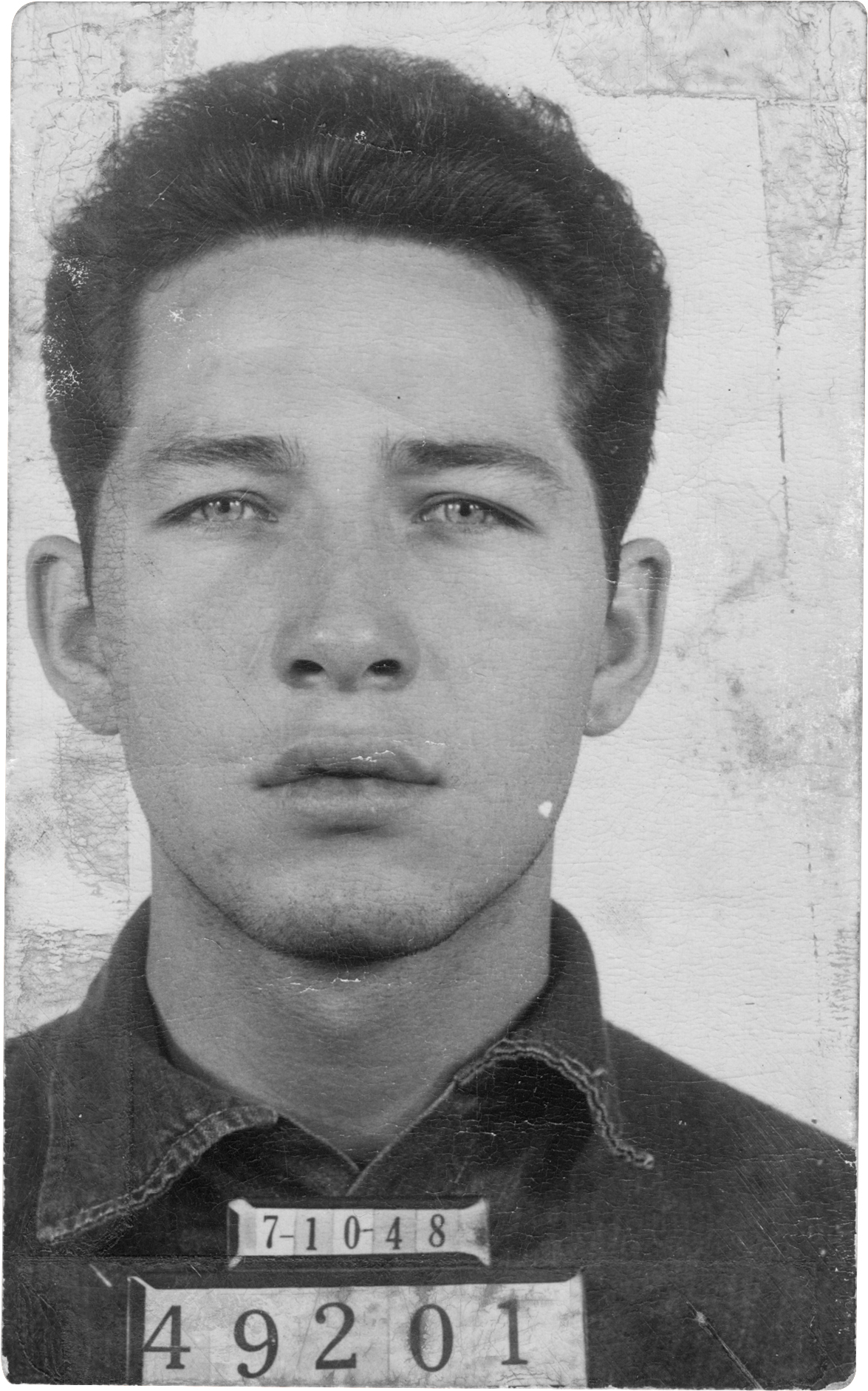
Bobby BlueJacket seen here in a mugshot dated three and one-half months after the Boulder Cafe safe robbery.
When the chipping and prying was done, Rafael flashed a lighter in the window. That was the signal. Griffin pulled his Plymouth around. The boys came plowing through the front door with the safe in their arms. The plan was to throw the thing in the Plymouth’s back seat, like they usually did with the limousine. The quicker the better as it was heavy as hell. But there was a problem. The safe wouldn’t fit in the Plymouth’s backseat. BlueJacket said, “The reason the son of a bitch won’t fit is we was goin’ by that big Buick seven or nine passenger limousine we had with the big wide door.” They were confused, now stuck out on the sidewalk holding the Boulder Café’s safe. Their arms were growing real weary. A cruiser could roll by any second.
The boys decided to set the safe down in BlueJacket’s lap and figure out a backup plan. “There on the curb, I’m holding the safe in my goddamn lap and I’m pinned to the ground, can’t move,” he said. “It pinned me to the ground.”
After further consternation, they dropped the safe into the trunk, bringing the back of the car down low, nearly scraping the pavement. Now it was time to move. The boys jumped in. Griffin hit the gas. The Plymouth peeled out, porpoising like a speeding motorboat through the empty streets.
In 2014, BlueJacket revisited the location of the Boulder Café, which is now a parking garage. Thinking back on his times as a safe burglar, BlueJacket said there was a lesson to be learned: “The moral of the story is don’t try to put a goddamn safe in the back seat of your car ’til you measure the door.”

415 South Boulder, Tulsa, OK, former site of the Boulder Cafe which was burglarized on March 24, 1948 by Bobby BlueJacket and associates. Click to open larger image in new window.
About the Author:
Michael P. Daley writes about crime and cultural history. His previous books include Enjoy The Experience: Homemade Records 1958–1992, which was featured in BBC, NPR, Vice, Book Forum, Rolling Stone, and was called the greatest music book of the year by Los Angeles Magazine. He was founder/Editor of Parallax News, a digital news service for the 2016 U.S. Election. Michael was also a founding member of Boo-Hooray and Sinecure Books. He has worked on productions for Rizzoli, Four Corners, Zero Books, Brookings, and Warner Brothers.
—###—
Posted: Jason Lucky Morrow - Writer/Founder/Editor, December 15th, 2017 under New Books.
Tags: 1940s, 1950s, 1960s, Criminal Biography, Oklahoma
Comments: none
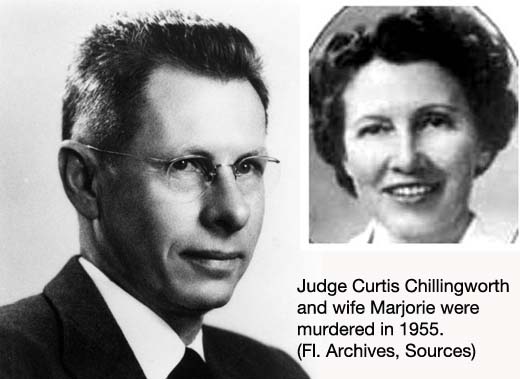 In the early morning hours of June 15, 1955, Judge Curtis Chillingworth and his wife Marjorie were snatched from their beachfront home in Palm Beach County, Florida and were never seen again.
Curtis E. Chillingworth was born to an upper-class family in 1896. His grandfather had moved down from New York and served as sheriff. His father, Charles had acquired over 12,000 acres of land and served as the first city attorney. Curtis was more than a rich, white boy, he was local royalty. He graduated from the University of Florida in 1917 and was admitted to the Florida Bar a few months later. He joined the United States Naval Academy and served in two world wars. Between his stints in war, Chillingworth married the love of his life Marjorie McKinley and had three daughters.
In 1921, Chillingworth became the youngest person to ever hold the circuit judge position. He was only 24. This title he would hold for 32 years until his disappearance in 1955.
Chillingworth was known as a truly honest judge. He was a stickler for the law and punctuality. He was the type to stand outside the courtroom and stare at his watch waiting for the hand to move. So, when Judge Chillingworth missed an appointment to meet two repairmen at 8 a.m., everyone knew something was terribly wrong.
The two carpenters waited at Chillingworth’s beachfront cottage in Manalapan, Florida hoping the judge would return shortly. Growing tired of waiting the pair decided to take a swim. They took the footpath around the home and down to the beach. There they noticed what looked like blood. Alarmed they began to take stock of the area. The floodlight had been shattered. Something was wrong.
By noon, police officers were swarming the area. Evidence was slim at best. All that was left were the shards of glass, an empty spool of tape, blood on the porch steps, and signs of a scuffle in the sand. It would be five long years before the community would learn the truth. Unfortunately, the truth would be even more shocking. A young judge who grew up down the street from the Chillingworth girls would eventually become the mastermind behind Florida’s Crime of the Century.
Joseph A. Peel was the polar opposite of the honorable Judge Chillingworth. While the elder was a stern upholder of the law, the younger was a rowdy playboy who loved to manipulate it. Peel was all about making money and living a flashy lifestyle.
 In 1953, Peel represented both the wife and the husband in a divorce case. This unethical manipulation of the law earned him a hearing with the higher-ranking Judge Curtis Chillingworth. Considering his youth, Chillingworth gave Peel a warning but declared it would be the final one. This would be enough to scare any honest person onto the straight and narrow path, but not Joseph Peel.
A judge’s salary was only $3,000/year, but somehow Peel could afford all the top luxuries of life. No one ever questioned him, but Joe Peel was playing both sides of the law. With two cohorts, Floyd Holzapfel and Bobby Lincoln, Judge Peel ran a protection racket in Palm Beach County. It was a simple scam. If the police needed a warrant, they had to see Judge Peel. Peel would issue the legal documentation, and then call his cohorts and warn them of the coming raid. Criminals paid big money to have this protection and soon Peel was making a year’s salary in a week. This scheme probably wouldn’t have been discovered if Peel had done his legal work properly. But in 1955, Peel was again set to face Judge Chillingworth for unethical conduct. This time he would be disbarred.
Judge Peel was still acting as an attorney during his judgeship and again he chose to handle a divorce case deceitfully. This time he told a woman that she was divorced and never filed the final paperwork. When she remarried and tried to adopt a child she discovered that she was a bigamist.
In a panic, Peel called in Floyd Holzapfel and hatched a plan for murder. The details wouldn’t come out for five years and the bodies would never be found. You can read more about this story in Synova Cantrell’s latest book Grim Justice available for pre-order on Amazon now.
—###—
Posted: Jason Lucky Morrow - Writer/Founder/Editor, November 23rd, 2017 under New Books.
Tags: 1950s, Florida, Murder, Workplace Violence
Comments: none
Story Summary:
The high-society wife of a millionaire trunk manufacturer undergoes an unspecified operation, which alters her personality (or so it is claimed). In 1907 she runs away to Chicago where she falls in love with a black man. To keep him happy, she works as a maid for a string of wealthy Chicago families. While in their employ, she steals expensive items from their homes and brings the goods back to her beau who fences them. She is eventually caught, sent to prison, her husband divorces her, and takes their child. In a later incident, she is proclaimed “Queen of the Vampire Women” of Chicago.
Story written by Lieutenant James V. Larkin, Detective Bureau, Chicago Police Department, and Dalton O’Sullivan, Private Detective, and Author of Enemies of the Underworld, 1917.
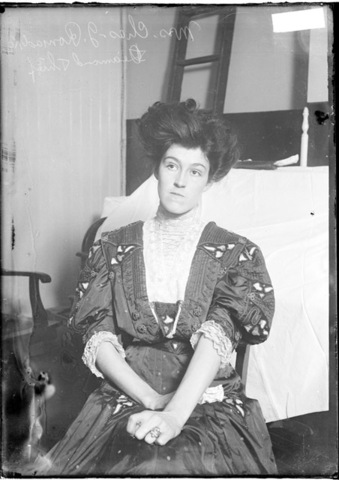
Evelyn Romadka after her arrest in 1907
A most remarkable case of dual personality was revealed in the arrest and confession of Mrs. Evelyn Caine Romadka, beautiful wife of Charles Romadka, millionaire trunk manufacturer of Milwaukee, Wis.
Her arrest and conviction was the result of a clever bit of detective work on the part of Lieut. James V. Larkin, of the Chicago detective bureau. Many startling revelations were made at the trial and it developed, that this amazing woman, despite the fact that she possessed an abundance of wealth, had actually burglarized a number of homes in Chicago and had stolen more than $25,000 worth of jewelry.
The Romadka case became notorious in police annals. It revealed the existence of one of those peculiar cases where a person steals, whose only motive, perhaps, for committing theft, is the excitement attendant upon the experience itself; habits developing in a person of abnormal mental faculties.
Prior to her marriage Mrs. Romadka was Miss Evelyn Caine, a pretty school teacher in a small town in the northern woods of Wisconsin. One day Romadka, while on a hunting expedition, happened to meet the little country schoolteacher on her way to school. An innocent little flirtation finally resulted in a love match.
Romadka returned to Milwaukee to inform his parents of his decision to marry the girl. There was much parental objection, principally because of a difference in religious views. Young Romadka finally prevailed upon his family to accept the woman of his choice, and a short time later, he returned home with his bride.
The young couple lived happily for a short time. About a year later a child was born. The young wife fell dangerously ill. An operation was necessary. The best physicians and specialists in the country were summoned. Mrs. Romadka survived but she apparently did not recover fully from the shock of the operation.
One day, she disappeared, and was next heard of in Chicago, where she stopped at the Victoria Hotel. It was learned later that she devoted much time to the meetings of a secret organization.
She studied the ad columns in the newspapers and in this manner obtained positions as a maid in the homes of wealthy Chicago families. She would remain in one place long enough to ascertain where the family jewels were kept and then make away with them.
After continuing these operations for some time, her arrest and conviction followed a robbery at the home of C. E. Beck, 5520 South Park Avenue, Chicago. Mr. and Mrs. Beck were absent from home on Labor Day, and had neglected to lock the front door. It so happened that in leaving the house, the couple was seen by Mrs. Romadka.
She boldly entered the house shortly after the couple disappeared and ransacked every room in the place. In one of the bedrooms, she found a large alligator skin pocketbook, which contained more than a thousand dollars’ worth of jewels.
When Mr. and Mrs. Beck returned home later, they discovered the robbery and immediately notified the police. Lieutenant Larkin was furnished with a complete description of the stolen pocketbook and the jewelry it contained.
A short time after that Lieutenant Larkin stepped into the Baltimore Inn, one of the fashionable cafes in Chicago, and while dining there, he happened to notice a well-dressed woman at a nearby table, in company with a prominent Chicago businessman.
It was not the woman that attracted Lieutenant Larkin’s attention so much as it was the leather pocketbook the woman carried and which she had placed in full view on the table. Its description tallied exactly with the one Mrs. Beck reported had been stolen.
Lieutenant Larkin immediately began an investigation. When the woman left the café, the officer followed. He made some rather sensational discoveries. He learned that the woman, whom he suspected was a Mrs. Romadka, prominent member of society of Milwaukee, and reputed to be quite wealthy.
The police officer learned, somewhat to his consternation at first, that Mrs. Romadka was much given to strange whims and fancies. Among other things, she apparently delighted in posing as a poor maid and seeking employment in the homes of the wealthy, only to remain at a place a few days and then disappear.
All these deductions only strengthened his first impression that in this woman he had discovered one responsible for a number of mysterious robberies in Chicago. She was finally arrested (October 16, 1907) and taken to police headquarters where she was questioned.
Her husband was notified and he hastened to Chicago. No one appeared to be more surprised than the husband to learn that his wife had been working as a maid in the homes of several Chicago people, and his surprise knew no bounds when he was told his wife had been accused of burglary.
At first, the woman declared the leather pocketbook and jewels, found in her possession and identified as having been stolen from the Beck home, were given to her by her husband. Later, she confessed having committed the robbery, together with many other thefts in Chicago.
Her confession involved William Jones, a black man in Chicago, with whom the Milwaukee millionaire’s wife had evidently become infatuated. She admitted having stolen jewels and articles of value in order that she could make presents to this lover of hers.
Another piece of clever detective work was necessary to effect the capture of her lover, whom the pretty young wife of the millionaire trunk manufacturer frankly declared she loved and preferred to the man she had lawfully wed.
In making her confession, Mrs. Romadka’s love for William Jones (another source lists his name as Albert Jones) proved even greater than her desire to prevent the shame and humiliation, which her arrest brought upon her husband and his family in Milwaukee.
She told the police she could not recall the name of her African-American lover. At all events, she refused to divulge any information concerning this man that would aid the police in bringing about his arrest.
The police were anxious to capture him, for in his arrest the police hoped to be able to recover some of the jewelry the woman admitted having stolen. Mrs. Romadka was ordered locked up.
Lieutenant Larkin then visited the apartment Mrs. Romadka had occupied and made a thorough search in every room. He found nothing there that appeared to be an aid in determining the name and address of the colored man whom he sought.
The police officer did find, however, tucked in a desk drawer in the living room, a small slip of paper containing several telephone numbers. He traced each of these numbers and finally discovered that one telephone number brought him to the home of her paramour.
When the officer called, he was told by a white woman, who said she was the black man’s wife, and that the man he sought was absent. The wife said she did not know where he had gone or when he would return.
Lieutenant Larkin managed to find quarters near this house and succeeded in rigging up an extension telephone connecting directly with the wire leading to the man’s home. He waited for results and in a short time a call came.
He heard the woman at one end of the wire advise the man at the other end of the wire that detectives had called at the house and that he had better remain away for a time. Lieutenant Larkin also heard the man instruct the woman to destroy a certain trunk in a bedroom in the second floor, and to secrete the contents.
This was enough. The detectives hastened to the man’s home and confiscated the trunk. It was taken immediately to police headquarters and opened. Many of the articles Mrs. Romadka admitted stealing from the homes of wealthy Chicago people were found in the trunk.
Lieutenant Larkin also learned from whence the man had telephoned and located the man at this address. His arrest followed immediately. Later, the man admitted he had taught Mrs. Romadka to rob homes and turn the loot over to him. He converted all the stolen articles into cash whenever possible.
He boasted of having an evil influence over the woman, and told the police she had been but a tool in his hands to do with as he pleased. When confronted with her “negro master,” the woman fainted. Mrs. Romadka was convicted of burglary and the man was found guilty of receiving stolen property.
They were both sentenced to long terms in prison. This ended one of the most sensational cases ever brought to the attention of the police and at the time it attracted nation-wide publicity in the press.
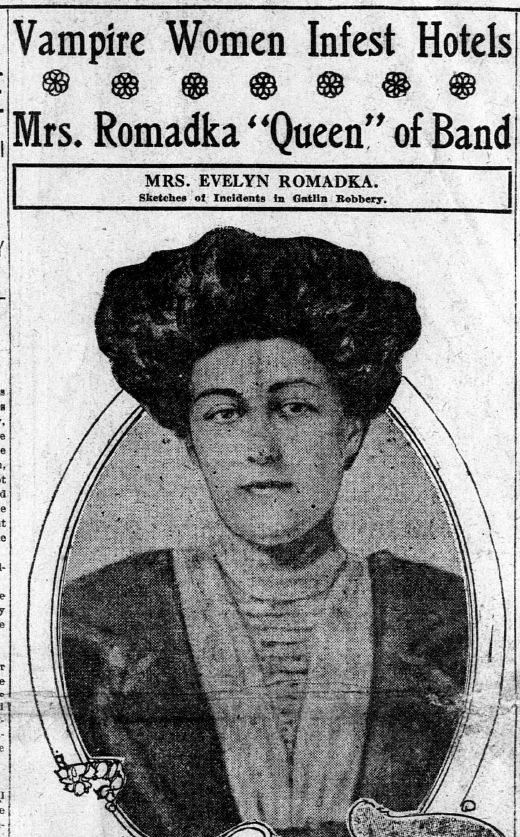 Epilogue: Charles Romadka divorced his wife in 1908 and gained sole custody of their daughter. Because of the scandal caused by his wife, his family shut-off all contact with him and tried to oust him from the company.
Evelyn Romadka was released from Joliet Prison on January 5, 1910. In July 1911, police in Chicago were searching for Evelyn in connection with the theft of nearly $1,000 from several bar hopping companions. Two of them, a Kansas City millionaire in town for business and pleasure, along with his date—a local good-time girl, told police that a woman they had partied, “Mrs. Graves,” with slipped “sleeping powder” into their drinks several hours into the festivities.
After they passed out, the woman stole $860 in cash and a diamond stickpin from the Kansas City millionaire, and $80 from his female companion, a woman once known in Denver as the “Pink Pajama girl.”
Police learned her true identity after Evelyn’s photograph was identified by the victims from a police mugshot book.
In a sensational new story published the day after the theft was reported, the Chicago Examiner proclaimed Evelyn was actually the leader of a gang of eight “Vampire Women,” who preyed on wealthy male travelers to Chicago. It was her idea, they said, to use sleeping powders to drug the unsuspecting men and steal their money.
The Kansas City millionaire left town before he could swear out a warrant against Evelyn. Although he promised to return to do so, he never did.
Evelyn Romadka apparently left Chicago after this incident. At this time, I could not find any further information about her life or death.
In 1912, The Romadka Brothers Trunk Manufacturing Company of Milwaukee filed for bankruptcy. Her ex-husband had remarried by then, and was working as a turnstile operator at a summer park for $10 a week.
1911 theft story from the Chicago Examiner
1911 theft story from the Chicago Inter-Ocean
—###—
Posted: Jason Lucky Morrow - Writer/Founder/Editor, September 22nd, 2017 under Short Feature Story.
Tags: 1900-1919, Love Triangle, Petty Crimes, Vintage Detective Stories, Women
Comments: none
Lenient Sentences for Serial-Rapist and Molester Lead to More Crimes
DNA Connected Stansbury to 1974 Murder Seven Years After He Died in Prison
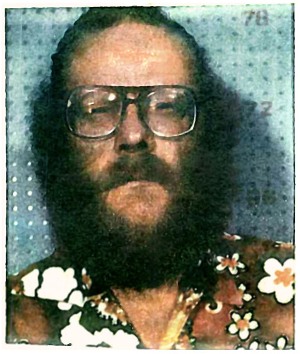

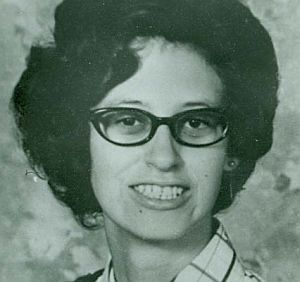


In the summer of 1974, twenty-nine-year old Barbara Hall was found dead near a horse trail in the San Dimas/Claremont area near Pomona, California. Her life was tragically ended at the hands of a murderer who had kidnapped her from Pomona, sexually assaulted her, and took her life.
Her murder remained unsolved until December 2010 when the Cold Case Unit of L.A. County Sheriff’s Homicide, working with the Sheriff’s Crime Lab, was able to use more advanced DNA testing capabilities to solve the case.
Through their analysis of DNA found on Hall in 1974, a Pomona man who drove an ice cream truck throughout the San Gabriel Valley during the 1970’s was proven to be the murderer.
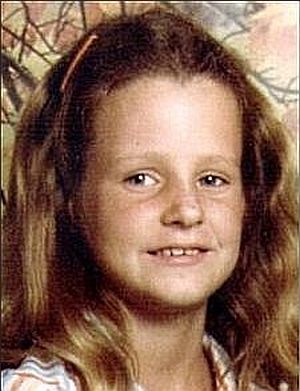
Robert Edward Stansbury died in 2003 in San Quentin prison at age 60. He was serving time on death row for the 1982 rape and murder of a ten-year-old girl whose body was found in Pasadena, after being abducted from Baldwin Park in Los Angeles County.
Sheriff’s Cold Case Homicide investigators re-opened Hall’s case in 2010 and found there was sufficient DNA that in past years, would have been in sufficient to identify the murderer of Barbara Hall. Sheriff’s Crime Lab (Scientific Services Bureau) technicians soon got a DNA match, and proved the killer was Stansbury.
The story of this horrible crime began on August 13, 1974, when Barbara was found strangled to death on a trail near Mills Avenue and Mount Baldy Road, in an area bordering unincorporated San Dimas and Claremont. At the time, homicide investigators learned that Barbara, who was developmentally disabled, had been abducted from Pomona on August 12, 1974. The case lingered for decades until it was re-opened by Los Angeles County Sheriff’s Cold Case Unit Sgt. Richard Longshore in 2005.
In re-tracing the suspect’s steps back over forty-one-years ago, Cold Case detectives learned that Stansbury drove an ice cream truck in the San Gabriel Valley and the unincorporated areas of East Los Angeles. Stansbury used the truck as a ruse to commit his criminal acts.
His criminal history included sexual assaults on adults and minors of both genders, dating back to 1963.
In November 1963, Stansbury was convicted of lewd and lascivious conduct for oral copulation on two ten-year-old boys in the San Joaquin Valley. He was sentenced to ten years in prison but was released early in January 1969.
From California, Stansbury went to Oklahoma City where he raped a woman in December 1970, but only received a two-year sentence. He was released in November 1973.
On November 24, 1974, a few months after Barbara Hall was murdered, Stansbury forced a fourteen-year-old girl into his car at gunpoint, raped her twice, and then released her in Pomona. Five days later, Stansbury abducted a twenty-one-year-old Montclair woman outside a bar and raped her twice before letting her go. He was convicted in a single trial on both counts and only served six and one-half years in prison. He was released on October 10, 1981.
To get closer to children, Stansbury began driving an ice-cream truck during the summer of 1982. His strategy seemed to have worked for him. On September 28 of that year, Stansbury kidnapped, raped, and beat ten-year-old Robyn Jackson from Baldwin Park in Los Angeles County. When he was finished, he stuffed her into the ice cream truck’s freezer, between the Fudgsicles and Sno-Kones, while she was still alive. He then drove to Pasadena where he threw her like a ragdoll into a concrete-lined ditch. The force of the landing cracked her skull and killed her.
An arrogant, egotistical Stansbury chose to represent himself at his trial which began in 1984 and ended eleven-months later after he filed 160 motions. His conduct not only annoyed the judge and prosecutor, but his own defense attorney who sat on the sidelines. He was sentenced to death in on July 16, 1985.
He died in 2003 at the age of sixty before he could be linked to the 1974 murder of Barbara Hall in 2010.
—###—
Posted: Jason Lucky Morrow - Writer/Founder/Editor, August 21st, 2017 under Mug Shot Monday, Short Feature Story.
Tags: 1960s, 1970s, California, Murder, Oklahoma, Sex Crimes
Comments: none
 All Rights Reserved. Privacy Policy | Terms | Contact | Sitemap