True Crime Books by Jason Lucky Morrow

Welcome to HistoricalCrimeDetective.com [Est. 2013], where you will discover forgotten crimes and forgotten criminals lost to history. You will not find high profile cases that have been rehashed and retold ad infinitum to ad nauseam. This blog is the official website for true crime writer Jason Lucky Morrow, author of four books including the popular series: Famous Crimes the World Forgot, Volume I and Volume II. If you would like to send me a comment, Contact Me Here. - Please follow this historical true crime blog on FACEBOOK.

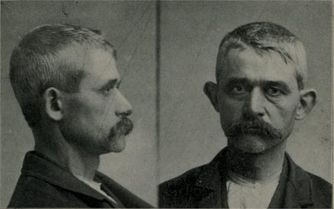
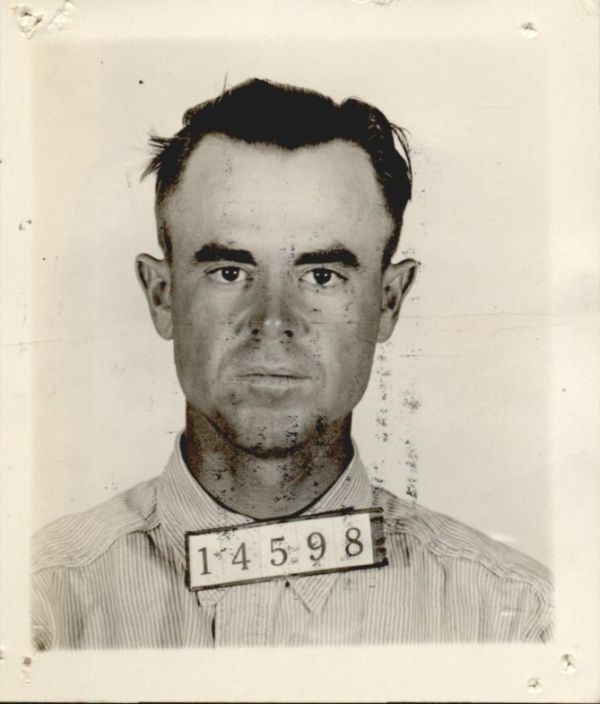
Mug Shot Monday! John Wolker, 1897

Home | Mug Shot Monday | Mug Shot Monday! John Wolker, 1897


This is what happens to people who have poor impulse control.

John Wolker, Chicago, 1897, accidentally shot his favorite daughter while aiming toward his wife.

John Wolker, Chicago, 1897, accidentally shot his favorite daughter while aiming at his wife.

John Wolker is a German, fifty-two years of age, and a carpenter by occupation. He is of medium height and rather lean in form. By his first wife he had two children, whom he boarded out in care of a sister prior to his second marriage. He had been boarding with his second wife for some time before he married her, and it seems the union was not born of any sacred spark, but was rather a matter of mutual convenience. During the three or four years they lived together, many quarrels arose, with jealousy and distrust growing stronger, chiefly, it appears, on the part of the wife, who, unlike Wolker, is a robust person.

Finally, one evening, while he was partly under the influence of whiskey and beer and frenzied by his wife’s conduct toward him at the time, he took an old pistol he had kept for a long time and discharged it in the direction of his wife and her two little girls, mortally wounding the one who had been his favorite.

When he told me his story he had frequent spells of hysterical sobbing, suddenly breaking down and as suddenly resuming, but evidently intense in his feeling. He declared he would gladly die for the child’s sake and that he did not realize what he was doing at the time.

He pleaded guilty, and the judge sentenced him to life imprisonment instead of execution, owing to his evident mental weakness. As the testimony in court was one-sided, I am precluded from here discussing the case fully.

But I am perfectly satisfied he is naturally a harmless individual in the absence of great provocation. This was the first charge of a criminal offense against him.

Originally Published: “Crime and Criminals,” by John Sanderson Christison, Chicago Medical Book Co. 1898.

Check out more of our Vintage Mug Shots.

—###—


Adolph Luetgert and His Dissolving Wife, 1897

Home | Short Feature Story | Adolph Luetgert and His Dissolving Wife, 1897


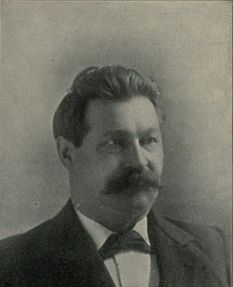
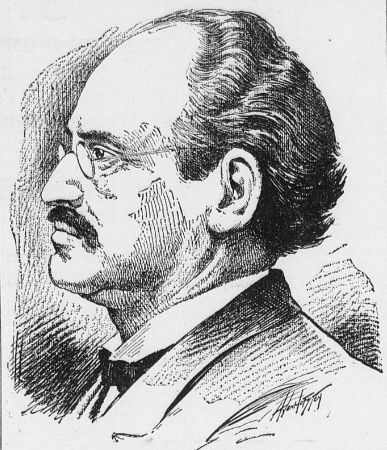
Chicago sausage maker Adolph Luetgert

Chicago sausage maker Adolph Luetgert In the latter part of April, 1897, Adolph Luetgert, a powerfully built, coarse appearing man, who conducted a sausage factory at the corner of Hermitage Avenue and Diversey Boulevard, in Chicago, failed in business. He had been married twice. By his first wife he had a grown son named Arnold, and by his second wife, Louise, he had two boys named Elmer and Louis. The family lived on Hermitage Avenue, next door to the factory, and a young woman named Mary Seimmering was employed as a servant in their house.

On May 1, Mrs. Luetgert suddenly disappeared, but her husband was apparently unconcerned regarding her absence and advanced the theory that she had committed suicide because of his failure in business.

On May 4, Deidrich Bicknesse, Mrs. Luetgert’s brother, called to see her, and Luetgert informed him that she had been missing for three days, but admitted that he had not notified the police of the singular incident nor had he taken any steps to locate her.

Bicknesse, observing Luetgert’s utter indifference, had the police notified and Captain Herman Schuettler instituted an investigation.

The press gave much publicity to the mysterious disappearance and the police began a general search, even going to the extent of dragging the river for a considerable distance, but nothing was discovered.

Finally Captain Schuettler decided to confine his investigation to the factory in general but to a large vat therein in particular, and a rapid solution of the mystery followed.

In the sediment in the bottom of the vat, two gold rings, one having the initials “L. L.” engraved inside, a tooth, and two corset steels were found.

The rings were positively identified as the property of Mrs. Louise Luetgert, and in the yard where the bones from the animals were thrown, a part of a skull and other pieces of human bones were found.

It was learned that during the period between May 2 and May 17 Luetgert made many efforts to gain an entrance to the factory, but was always refused admission by the sheriff’s deputies who were in charge.

On May 18, Luetgert was arrested and four days later was indicted by the grand jury.

He attempted to gain his freedom on a writ of habeas corpus but failed.

On August 7, the prosecution obtained a corpse, and placing it in the identical vat where Mrs. Luetgert’s body was destroyed, boiled it in caustic potash for two hours. At the expiration of that time, nothing remained of the fleshy parts of the body but a fluid and all of the bones, except the larger ones, were completely destroyed.

This proved that their theory was correct.

On August 24, Luetgert’s trial began before Judge Tuthill. The attorney for Luetgert claimed that he had also made a test with a corpse, but that the boiling process did not dissolve it. The contention of the defense was that no crime had been committed and that Mrs. Luetgert was not dead, but was remaining in seclusion. A letter was received by Alderman Schlake signed by “Loisa Luetgert,” in which the missing woman was represented as saying that she was then living with friends in Chicago, but it was shown that the handwriting in no manner resembled that of the missing woman and the missive was evidently sent for the purpose of con¬fusing the authorities.

Nicholas Faber and Emma and Gottliebe Schimpke testified that they saw Luetgert enter his factory about 10 p. m. on the night of May 1 with a woman about the size of Mrs. Luetgert.

Frank Bialk, a watchman in the factory, which had been shut down since the failure, testified that on this night, Luetgert instructed him to bring down two barrels of caustic potash and place them in the boiler room, and that Luetgert then poured the contents of both barrels in one of the vats. The watchman was instructed to keep up steam all night and at 10 p. m. he was sent by Luetgert to the drug store after some nerve medicine.

When he returned, Luetgert was in the room where the vats were located and had the door locked.

Bialk furthermore testified that he resided at the home of Police Officer Klinger and that on May 6 Luetgert called on him. After concealing the officer under the bed in Bialk’s room, Luetgert was admitted to the room and in suppressed excitement asked if the officers had discovered anything at the factory. Bialk answered “No,” and Luetgert, with a show of relief, remarked: “That’s good.”

He then admonished the watchman to tell the police nothing and promised that when the factory re-opened, good positions would be provided for Bialk and his son.

Frank Odorfsky, an employee of the factory, who assisted Luetgert to put the caustic potash in the vat; testified that in all his experience in the factory he had never seen caustic potash used there before.

Mrs. Agatha Tosch, whose husband conducted a saloon opposite the factory, testified that she saw smoke coming from the factory chimney on the night of May 1, although the factory was supposed to have been shut down at the time.

She also stated that Luetgert visited her on the following day and requested her to say nothing about the smoke as it would get him in trouble.

Chas. Hengst stated that he was passing the factory about 10 p. m. on May 1, and heard a noise similar to that made by a person screaming.

Chemist Carl Voelker testified that there was no occasion for caustic potash in a sausage factory.

Mrs. Christina Feldt, a widow with whom the defendant had at one time been infatuated, testified that Luetgert often expressed his hatred for his wife and intimated that he would get rid of her.

Dr. Chas. Gibson and Professor De la Fontaine testified that the masses of soft substance which had presumably boiled over the vat was flesh that had undergone burning by potash.

Particles removed from the drain pipes leading from the vat were then produced and proven to be portions of human bones.

Luetgert handled these exhibits in the most cold-blooded manner, and demonstrated that he was devoid of all feeling.

Professor George Dorsey of the Field Columbian Museum, testified that one of the bones found in the pile of animal bones was the upper portion of the left thigh bone of a woman.

During the trial, Chas. Winthers of 250 Orleans Street, was arrested for attempting to intimidate Mrs. Tosch, the witness who saw the smoke coming from the chimney in the sausage factory on the night of May 1.

Captain Schuettler testified regarding the indifference exhibited by Luetgert as to the fate of his wife, and as to the result of his official investigations.

The defense began on September 24, and several persons testified that since May 1 they had at different places seen a woman who resembled Mrs. Luetgert.

It was the theory of the prosecution that Luetgert, tiring of his second wife, was anxious to get her out of the way so that he might marry Mary Seimmering, the family servant. On September 25, this girl testified for the defense and described Luetgert’s “kind treatment” toward his wife.

She denied having been on intimate terms with Luetgert, although members of the grand jury were subsequently produced who swore that she had told them of her improper relations with the defendant.

The defense then produced a number of experts for the purpose of offsetting the testimony given by experts for the prosecution.

William Charles, Luetgert’s business partner, testified that the caustic potash was bought for the purpose of making soft soap, as they intended to clean the factory prior to turning it over to an English syndicate.

To rebut this testimony, Deputy Sheriff Frank Moan swore that when he took possession of the place there were over 100 boxes of soap in stock, thus showing that there was sufficient on hand for cleaning purposes.

On October 18, the case was submitted to the jury and after deliberating for sixty-six hours they failed to agree, nine favoring a conviction and three voting in favor of an acquittal.

On November 29, 1897, the second trial began and Luetgert made an appeal to the public for financial assistance, but few people responded.

On January 19, 1898, the defendant took the stand in his own behalf for the first time and the police experienced great difficulty in handling the crowd.

The trial resulted in a conviction and on May 5 Luetgert was sent to the Joliet State prison for life.

At 6 a. m. on the morning of July 27, 1899, Luetgert left his cell and returned shortly afterward with his breakfast in a pail, but just as he was about to eat it, he dropped dead from heart disease.

After his death, Frank Pratt, a member of the Chicago bar, stated that he visited Joliet in February, 1898, to consult a client named Chris Merry, and being somewhat of a palmist he asked Luetgert if he wanted his “hand read.”

The latter consented and Pratt told Luetgert that he possessed a violent temper and at times was not responsible for his actions. Pratt stated that Luetgert then virtually admitted that he killed his wife when he was possessed of the devil. Pratt is quoted as saying that he regarded this admission as a professional secret and therefore did not feel at liberty to divulge it until after the death of Luetgert.

It is said that Luetgert also made similar admissions to a fellow prisoner.


This story comes from the book: “Celebrated Criminal Cases of America,” by Thomas Samuel Duke, The James H. Barry Company, 1910.

—###—


New Book Claims to Identify Zodiac Killer

Home | New Books | New Book Claims to Identify Zodiac Killer


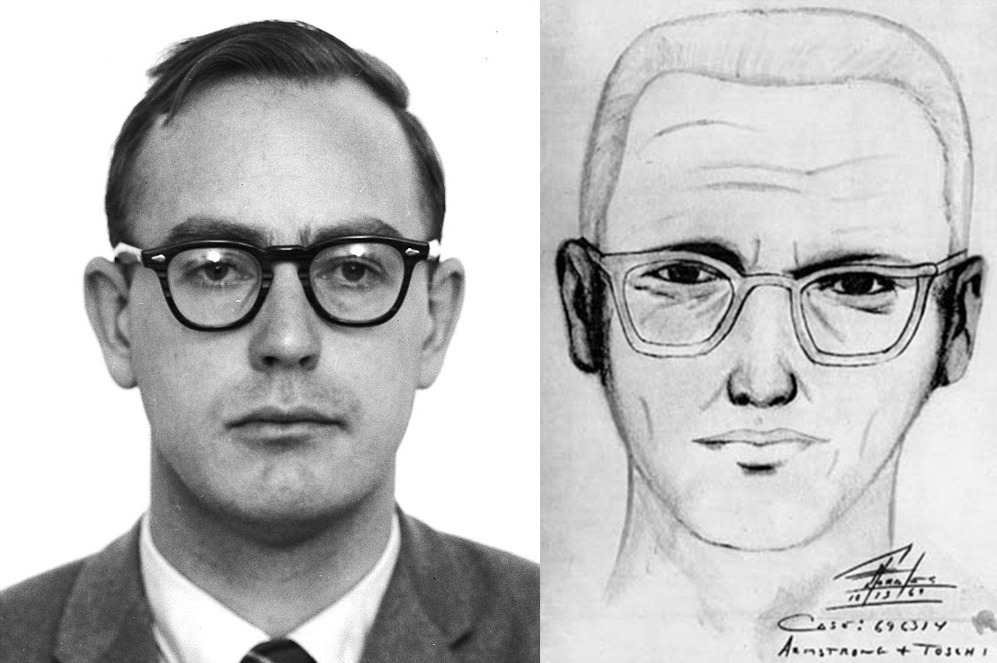
Left, Earl Van Best. Right, artist sketch of Zodiac Killer

Left, Earl Van Best Jr. Right, artist sketch of Zodiac Killer


Follow HistoricalCrimeDetective.com on Facebook

The Zodiac Killer, whose serial murders terrorized northern California in the late ’60s, was a man named Earl Van Best Jr., according to a new book by Gary L. Stewart, who happens to be his biological son. Stewart’s The Most Dangerous Animal of All, as we reported Monday, is for sale now from HarperCollins after a top-secret rollout. “I’m really hoping this will bring some closure to the families of my father’s victims,” Stewart tells People magazine.

Although many others have claimed to know the killer’s identity over the years, Stewart’s publisher calls his book’s case “legally sound” — here’s some of the evidence within. Read More at New York Magazine or purchase via Amazon

I want to caution HCD readers to maintain a healthy bit of skepticism and a scientific viewpoint, and not get caught up in the hype surrounding the book. The reviews on Amazon are unimpressive. I suggest reading them before deciding.


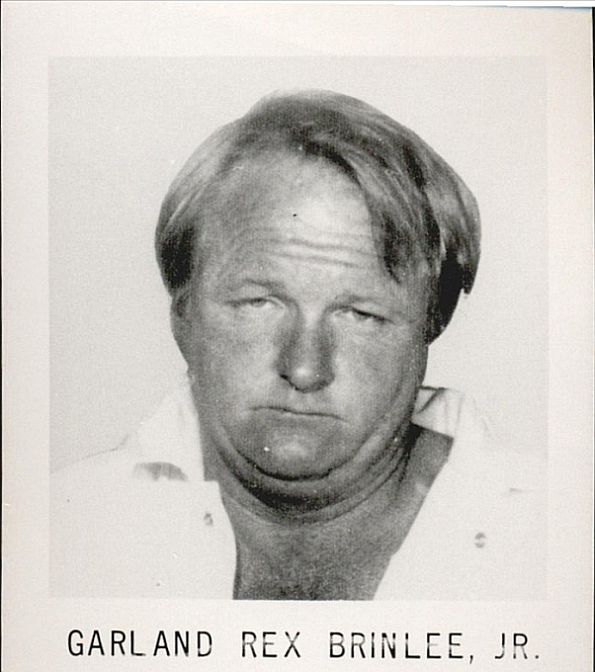
Mug Shot Monday! Bomb Slayer Rex Brinlee Jr., 1971

Home | Mug Shot Monday | Mug Shot Monday! Bomb Slayer Rex Brinlee Jr., 1971


This is Rex Brinlee Jr. He was a Tahlequah, Oklahoma plumber and operatorRex-Brinlee-bomb-slayer of a night club, called “The Library Club,” in 1971 when he was the chief suspect in the theft of a pick-up truck from a used car-lot. A witness in that case, Don Bolding, of Bristow, was set to testify against him.

On Feb. 2, Don’s wife, Fern, a 28 year-old kindergarten teacher, got into the family pick-up and turned the ignition switch which set off a massive bomb that killed her instantly and blew her body into the neighbor’s yard. The explosion was so enormous that one investigator characterized it as a “massive dose of overkill.”

Police quickly surmised Don was likely the intended target and their suspicion rested on Brinlee. He was later charged with murder, convicted and sentenced to life in prison.

During a 1973 prison riot at Oklahoma State Penitentiary, Brinlee was able to escape. The day before the FBI was to place him on its top 10 list, he was recaptured near Shreveport, LA. He escaped again three years later but was also recaptured.

During his 38 years in prison, Brinlee was a dynamic character and maintained his innocence. He died on Dec. 18, 2009.

Check out more of our Vintage Mug Shots.


Photo Source: FBI. [Photograph 2012.201.B0107.0463], Photograph, September 17, 1973; digital image, (http://gateway.okhistory.org/ark:/67531/metadc259376/ : accessed May 12, 2014), Oklahoma Historical Society, The Gateway to Oklahoma History, http://gateway.okhistory.org; crediting Oklahoma Historical Society, Oklahoma City, Oklahoma.

—###—


Mug Shot Monday: Bank Robber Coney Coffey,

Home | Mug Shot Monday | Mug Shot Monday: Bank Robber Coney Coffey,


.

Vintage Mug Shot

Today’s mug shot belongs to Tulsa bank robber Coney Coffey. Coffey robbed a bank in Tulsa in 1924 and was sentenced to 25 years in prison. While in prison, he contracted tuberculosis. He escaped twice in 1934 by tunneling underneath the tuberculosis wing of the Oklahoma State Penitentiary hospital with 7(?) other prisoners. During his second escape, four of those seven, including Coffey, kidnapped a couple to steal their automobile. When recaptured in Jan of 1935, they were charged with kidnapping.

When his photo appeared in an Oklahoma City newspaper, the caption read: $25.00 Reward: Will be paid for the arrest and delivery of this man to any authorized Officer of the Oklahoma State Penitentiary.

Coney Coffey, Tulsa bank robber

Coney Coffey, Tulsa bank robber

Photo Credits: [Photograph 2012.201.B0230.0693], Photograph, September 29, 1934; digital image, (http://gateway.okhistory.org/ark:/67531/metadc213997/ : accessed May 05, 2014), Oklahoma Historical Society, The Gateway to Oklahoma History, http://gateway.okhistory.org; crediting Oklahoma Historical Society, Oklahoma City, Oklahoma.

Check out more of our Vintage Mug Shots.

—###—


Johann Hoch: The Lady Killer, 50 Possible Victims, 1890-1905

Home | Feature Stories | Johann Hoch: The Lady Killer, 50 Possible Victims, 1890-1905


At the bottom of this article is a link to a 1905 newspaper story that is quite long and detailed, but was published before Hoch was executed in 1906.


Article: “Bigamist Blue Beard Johann Otto Hoch: 50 Possible Murdered Wives,” Celebrated Criminal Cases of America, Thomas A Duke, 1910.

Johann Hoch was born in Strasburg, Germany, in 1860. His father and two brothers were ministers in Strasburg, and Johann was educated for the ministry, but he abandoned the idea and came to the United States.
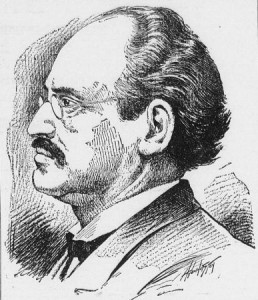
German-American Blue Beard Johann Hoch, suspected of murdering 50 wives.

German-American Blue Beard Johann Hoch, suspected of murdering 50 wives.

Under the name of John Schmidt, Hoch married a middle-aged woman named Caroline Streicher, in Philadelphia, on October 20, 1904, but eleven days later he disappeared, and on November 9 he registered at Mrs. Kate Bowers’ hotel, 674 East Sixty-Third Street, Chicago.

On November 16, he went to the Chicago City Bank to see Mr. Vail, the owner of a vacant cottage at 6225 Union Avenue, which Hoch desired to rent. Representing himself as holding a responsible position with Armour & Co., he succeeded in procuring the cottage in which he claimed he and his wife intended to reside.

On December 3, he published an advertisement in the Chicago Abend Post, a German paper, which read as follows:

“Matrimonial—German ; own home ; wishes acquaintance of widow without children; object, matrimony.  Address M 422, Abend Post.”

Marie Walcker, a hard-working woman about forty-six years of age, who had obtained a divorce from her first husband and was conducting a little candy store at 12 Willow street, saw this advertisement and requested her sister, Mrs. Bertha Sohn, to prepare and forward a letter which read as follows:

“Dear Sir:—In answer to your honorable advertisement I hereby inform you that I am a lady standing alone. I am forty-six years and have a small business, also a few hundred dollars.

“If you are in earnest I tell you I shall be. I may be seen at 12 Willow Street.

MARIE WALCKER.”

In response to the letter, Hoch called at the candy store on December 6, and during an extended conversation which followed he represented to Mrs. Walcker that his wife had been dead for two years; that he possessed $8,000, the cottage which he rented from Vail, and several vacant lots in the neighborhood of the cottage. He also claimed that his father, who lived in Germany, was 81 years of age and that when the old man died he would inherit $15,000.

It was soon agreed by the couple that they were intended for each other, and Hoch became a constant visitor at the store for the next four days, at the expiration of which time the couple decided to marry at once. The license was therefore procured and the marriage ceremony performed.

The “bride” sold her store for $75, which she gave to Hoch along with her entire savings, amounting to $350, which he claimed he needed to prepare his home for occupancy, as his money was tied up at that time.

Mrs. Walcker-Hoch had a widowed sister named Mrs. Fischer, whom Hoch met shortly after his latest marriage, and whom he learned had $893 deposited in a savings bank.

A week after the marriage, Mrs. Walcker-Hoch became very ill, and on December 20 Dr. John Reese was called in. The woman complained of excruciating pains in the abdominal regions ; she vomited freely ; had a violent thirst and a tingling sensation in the extremities, which she described as similar to ants crawling through her flesh. The doctor diagnosed the trouble as nephritis and cystitis (Bright’s disease and inflammation of the bladder).

Hoch sent for the sick woman’s sister, Mrs. Fischer, who frequently assisted about the house. She mailed her picture to her sick sister, which Hoch received, and he wrote a letter acknowledging the receipt of it, in which he stated that he intended to keep the picture himself and carry it on his breast.

Shortly afterward he accompanied Mrs. Fischer from the sick chamber to a car, and en route he told her that if he had met her four weeks sooner he would have married her. Finally Hoch and Mrs. Fischer appeared to be so friendly that the sick woman became jealous, and Mrs. Fischer left the house in a rage but she soon returned.

On January 12, 1905, Mrs. “Hoch” died, and Dr. Reese certified that death was due to nephritis and cystitis.

Mrs. Fischer was at the house at the time, and a few moments after the death occurred Hoch proposed marriage to her. She protested that the proposal was a trifle too sudden, although she accompanied him to Joliet three days after the funeral, where they were clandestinely “married.”

Hoch then suggested that the “honeymoon” be spent in Germany, reminding his “bride” of the advisability of visiting his “aged and wealthy father,” but he added that before they took the trip he would need $1,000 to straighten out his business affairs in Chicago. The “bride” volunteered to come to his assistance and she drew $750 from the bank and delivered it to Hoch.

They then proceeded to 372 Wells street, where the “bride” rented a flat and kept roomers previous to her marriage. At the door they were met by Mrs. Sauerbruch, who stated in an undertone that Mrs. Sohn, the sister who pre-pared the letter Mrs. Walcker sent to Hoch in answer to his advertisement, was in the rear of the house and had been denouncing Hoch as a murderer and swindler. The bigamist became greatly agitated and requested that he be left alone in the parlor while the two women went to the rear of the house to pacify Mrs. Sohn.

The women returned in a few moments but Hoch had disappeared. This move convinced the latest Mrs. Hoch that her sister’s suspicions were well founded, and Inspector of Police George Shippy was notified.

The body of Mrs. Walcker-Hoch was exhumed and a post-mortem examination held, which resulted in the discovery of 7.6 grains of arsenic in the stomach and 1% grains in the liver. As there was no arsenic in any of the medicines prescribed by Dr. Reese nor in the embalming fluid, the authorities became convinced, in view of Hoch’s conduct, that it was he who administered the poison. His picture was published in the papers and great publicity was given to the case.

On January 30, 1905, Mrs. Catherine Kimmerle, who con-ducted a boarding-house at 546 West Forty-seventh street, New York, notified the police that a man giving the name of Henry Bartells, but whose actions and appearance tallied with Hoch’s, was stopping at her place. Twenty minutes after he entered the house he volunteered to assist her in the kitchen by peeling potatoes, and the next day he proposed marriage, but the lady became frightened at his ardent manner of proposal.

The man was taken into custody, and after admitting that he was Hoch, claimed that he assumed the name of Bartells because of trouble he had with his sister-in-law regarding property.

When searched a fountain pen was found in his possession but there was no pen in the holder. A closer inspection revealed the fact that the reservoir contained fifty-eight grains of a powdered substance which the prisoner claimed was tooth powder, but when informed that the substance would be analyzed, he replied : “Well, it’s no use ; its arsenic which I bought with the intention of committing suicide.”

He insisted that he did not have the arsenic in Chicago and gave the location of a drug store in New York where he purchased the pen and arsenic. The police visited the store and found that fountain pens were not sold there and that no arsenic had been sold to Hoch.

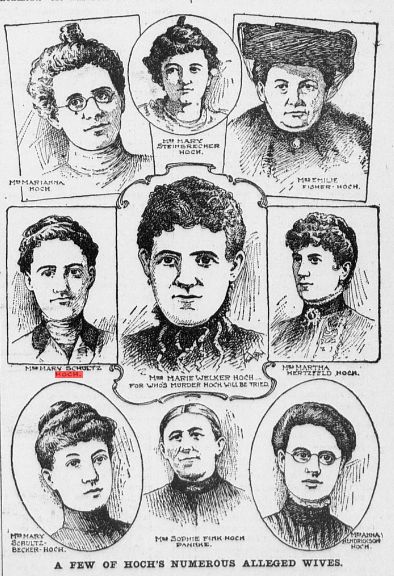
By the time the prisoner was returned to Chicago, Inspector Shippy had learned of the following women who were, among Hoch’s victims :
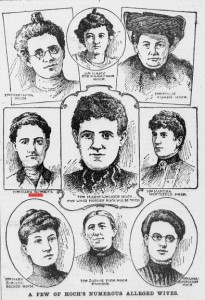
Just a few of Hoch's wives...and victims.

Just a few of Hoch’s wives…and victims.

Mrs. Martha Steinbucher; married to Hoch in 1895 and died four months later. When this lady was dying she declared that she had been poisoned, but it was thought that she was delirious when she made the statement and no credence was placed in it. Hoch sold her property for $4,000 and disappeared.

Mary Rankin married Hoch in November, 1895, in Chicago, and he disappeared with her money on the following day.

Martha Hertzfield married him in April, 1896, and four months later Hoch disappeared with $600 of her money.

Mary Hoch married her namesake in August, 1896, at Wheeling, W. Va., and died shortly afterward.

Barbara Brossert married him on September 22, 1896, in San Francisco, after a three days’ courtship. This lady was a widow living at 108 Langton Street. Hoch married her under the name of Schmitt and disappeared two days afterward with $1,465 of her money. As this was Mrs. Brossert’s life savings the loss so affected her that she died shortly afterward.

Hoch then took up lodgings at 30 Turk street, in the same city, and immediately attempted to creep into favor with the landlady, Mrs. H. Tannert. After a few hours’ acquaintance, he proposed marriage, but the lady refused the offer and Hoch left San Francisco.

Clara Bartel married Hoch in November, 1896, at Cincinnati, Ohio, and died three months later.

Julia Dose married this man in January, 1897, in Hamilton, Ohio, and on the day of her marriage Hoch disappeared with $700 of her money.

In April, 1898, he was arrested in Chicago for selling mortgaged furniture, and was sent to the house of correction for two years. After being liberated he began operations again as follows :

He married Anna Goehrke in November, 1901, and deserted her immediately.

Mrs. Mary Becker married Hoch on April 8, 1902, in St. Louis, and died in 1903.

Mrs. Anna Hendrickson married him on January 2, 1904, in Chicago, and eighteen days later the bridegroom disappeared with $500 of her money.

He married Lena Hoch in June, 1904, in Milwaukee, and she died three weeks later, leaving Hoch $1,500.

Then came the marriage to Caroline Streicker in Philadelphia and Mrs. Walcker and her sister, Mrs. Fischer, in Chicago, as previously related.

In addition to this list he had another wife in Germany.
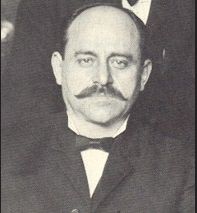
Johann Hoch before or during his trial.

Johann Hoch before or during his trial.

On his return to Chicago from New York, Hoch was interrogated at length by Inspector Shippy and then five of his former “wives” were admitted to the room for the purpose of identifying the prisoner. When they caught sight of Hoch, it required considerable effort on the part of the officials to quiet them, as they were collectively expressing their opinion of the prisoner in most vigorous terms.

On February 23, the coroner’s jury returned a verdict accusing Hoch of murdering Mrs. Walcker by means of arsenic poisoning. The case was then taken before the grand jury, where Hoch was indicted, and on May 5, 1905, he was placed on trial.

During the trial, Inspector Shippy testified that Hoch admitted to him that he had no love for any of his wives, and that when he advertised for them, he mentioned his preference for middle-aged women because it was easier to separate them from their money than younger women.

On May 19, Hoch was found guilty, and on June 3, the date for his execution was set for June 23.

He appealed to the Governor, who refused to interfere. On the day set for his execution, a Miss Cora Wilson, who conducted a furrier’s store at 66 Wabash Avenue, Chicago, came to the rescue by advancing sufficient money to make it possible for an appeal to be taken to the Supreme Court, and the Governor consented to a postponement of the execution.

Miss Wilson claimed that she had never seen Hoch, but that she desired that he be given every opportunity to prove his innocence.

After reviewing the case the Supreme Court sustained the lower court, and the execution was then set for August 25, 1905.

On August 24, he obtained another lease of life until the October session of the Supreme Court, but on December 16, this court again refused to interfere and the execution occurred on February 23, 1906.

More Reading:

Remarkable Career of Bluebeard Hoch,” The Pennsylvania Journal, Feb. 24, 1905

http://en.wikipedia.org/wiki/Johann_Otto_Hoch

—###—

HCD’s First True Crime Podcast via SwordandScale.com

Home | Uncategorized | HCD’s First True Crime Podcast via SwordandScale.com


True Crime podcast presenter, Mike Boudet, of SwordandScale.com is a big fan of HistoricalCrimeDetective.com and enthusiastically sought an interview with yours truly, HCD founder Jason L Morrow. He allowed me to choose one of my self-written stories for presentation and discussion on his podcast. The story I chose for what will be our first of many such installments, was “The Bizarre Tahlequah Coed Case.” To read that story, click here.

But even better, you can go to his beautifully designed website and listen to it yourself. Mike is a complete pro at piecing together a fascinating podcast. Sure, there are lots out there, but you can tell Mike has professional training and natural talent at putting together a podcast that is the same caliber as a nationwide radio program. It’s that good. Mike is that good. From his interviewing skills, his guidance through the storytelling, to his musical intros and seques, and his wrap up, Mike Boudet’s true crime podcast merits a large audience. He’s one of those talented individuals you watch for so you can later say, “I knew him when…”

True crime lovers will enjoy ALL of his podcasts. Instead of listening to the radio on your way to work, or tv while you are cooking dinner, subscribe to his podcast at itunes or catch them on his website.

“Sword and Scale is a true-crime podcast that covers the underworld of criminal activity and the demented minds that perform the most despicable and unthinkable actions.  We cover everything from high-profile trials to unsolved murders and missing person’s cases.”

To listen to our presentation of “The Bizarre Tahlequah Coed Case” click on the link below, episode 14, click on the purple colored arrow on that page, and fast forward to the 17:00 minute mark.

I hope you enjoy this story, and I know you will enjoy Mike’s True Crime Podcasts.

—###—


The Bully Gets A Bullet in his Brain

Home | Feature Stories | The Bully Gets A Bullet in his Brain


.

July 1, 1934
Jefferson & Jefferson County, Wisconsin

Earl Gentry was dead. It looked like he had been “taken for a ride” and polished off with typical gangland efficiency.

Not a soul mourned the passing of this self-styled gangster with the itching trigger finger, brass knuckles and concealed stiletto. He had won the sobriquet of “Jefferson County’s [Wisconsin] Public Enemy No. 1” and he gloried in his role of all-around tough guy. He was the same Earl Gentry who had gained nation-wide notoriety in 1925 in connection with the murder of pretty Madge Oberholtzer. Gentry had been the bodyguard and adviser to D. C. Stephenson, grand dragon of the Ku Klux Klan in Indiana, and had been charged with the murder together with his chief.

Click Here To Read the Rest of this Story

Source: “Who Murdered Earl Gentry, Man of a Thousand Enemies?” The Milwaukee Journal, The Green Sheet, Two Part Series Published on April 25 & 26, 1938.

.


The Mammoth Book of Murder: True Stories of Violent Death

Home | New Books | The Mammoth Book of Murder: True Stories of Violent Death


The Mammoth Book of Murder: True Stories of Violent Death

Become an email subscriber for a chance to win this book in our lottery on Friday.

This book contains 200 gripping accounts of homicide, criminal investigation, forensic science, criminology, and courtroom drama by veteran true crime writer Jim Fisher. The collection features murder-for-hire, arson murder, historic and celebrated murders, junk science, strange cause and manner of death cases, women who kill, the drug addled and the insane, serial murder, and more!


The Torture House, 1924

Home | Feature Stories | The Torture House, 1924


.

Originally Published: “Torture House,” by Detective Lieutenant William Oeltjen, as told to Frederic Lord, True Detective Mysteries, Feb., 1930.


The Torture House of Louisville

The Torture House of Louisville

Recently, while in my office in Louisville I was pondering on the dullness of life–in particular, of a detective’s life—when’ a question was put to me by a friend who had dropped in for a chat.

“Lieutenant, do you remember the Gates-Heaton case, here in Louisville?”

“Do I remember the Gates-Heaton case?” I replied. “I don’t suppose anyone who had anything to do with it will ever forget it!”

My friend’s query brought back the memory of that strange case—one of the weirdest I have ever known in all my years of police work. And, after a few remarks had been passed, I consented to tell him the story:

It was about 6:30 P.M. on a Saturday night, six years ago—March 8th, 1924, was the date, if I remember rightly—that we received the call at the Louisville Police Department Headquarters.

“A man has been shot!” the voice over the telephone shouted. “You’ll find him at Six-Thirty-Seven South Thirty-Fourth Street!”

Accompanied by several of my men I reached the scene in record time. We found the body on the second floor, in the bedroom. It was lying near a mattress—a circumstance odd in itself, because that mattress was lying on the floor. Surrounding the mattress were four steel staples driven into the floor. No one missed the picture it created, together with a number of surgical instruments that were in the room also.

Not much more than a glance showed us that the man was dead. There was a gaping hole in his neck, another near his heart. Several persons were in the room and, as is usually the case, they were incoherently babbling words about the killer. He had raced from the house, they said, when he made sure, on a doctor’s word in fact, that his victim was dead. On the killer’s wrists were handcuffs, his body was trembling, his face pallid.

Click Here To Read the Rest of this Story