True Crime Books by Jason Lucky Morrow

Welcome to HistoricalCrimeDetective.com [Est. 2013], where you will discover forgotten crimes and forgotten criminals lost to history. You will not find high profile cases that have been rehashed and retold ad infinitum to ad nauseam. This blog is the official website for true crime writer Jason Lucky Morrow, author of four books including the popular series: Famous Crimes the World Forgot, Volume I and Volume II. If you would like to send me a comment, Contact Me Here. - Please follow this historical true crime blog on FACEBOOK.

The Witch Craft Murder of Clothilde Marchand

Home | Rediscovered Crime News | The Witch Craft Murder of Clothilde Marchand


While researching newspaper coverage of other crimes, I came across trial coverage of the strange murder of Clothilde Marchand in 1930. What came out of that trial is a bizarre tale with the following ingredients: A Ouija board, witchcraft, an Indian faith healer, manipulation and coercion to kill, and a philandering sculptor who claimed it was necessary for him to “make love”  with his models out of “professional necessity.”

With those wackadoo components, I naturally looked into writing a feature story about this case. Unfortunately, others have already done it and they did a fine job of it.

This is one of those stories you can’t make up.

Below are links to two stories from contemporary writers who have written about this case.

The Ouija board murder: Tricking tribal healer Nancy Bowen to kill – David Krajicek, New York Daily News. I am familiar with his work on other crimes and you have to take the accuracy of his research with some skepticism. With that exception, his writing is entertaining.

Clothilde Marchand: done in by witchcraft, jealousy, and philandering husband – Elizabeth Licata, BuffaloSpree.com,

Google News Archive link to trial coverage of Lila Jimerson


Leon Turner and the Whitt brothers, 1950

Home | Rediscovered Crime News | Leon Turner and the Whitt brothers, 1950


On Jan. 1, 1950 ne’er do well brothers Malcolm and Windol Whitt, and Leon Turner broke out of the Attalla County Jail in Mississippi. The three  men were serving time for the attempted rape of a 15 year-old black girl named Verlena Harris.

Leon Turner had suffered the shame of being convicted for molesting a black girl and his drunken rage gave him the courage to get revenge seven days later. Grabbing their guns, the three men headed toward the dilapidated house of the girl’s step-father, Tom Harris. Leon burst through the door and ordered Tom to tell him where Verlena was. But the girl had heard the men coming and escaped out the back. Turner pushed Harris into the kitchen and shot him in the back with a .38 caliber pistol. Harris fell to the floor twisting in pain, but still alive.

Turner then went into the bedroom where he took out his shame and anger by shooting to death three young children, Frankie, 10, Mary, 8, and Ruby Nell, 4.

Meanwhile, Windol Whitt was trying to coax Verlena to come out from her hiding place underneath the house. Verlena had just made her way out from beneath the house when Turner fired his last two bullets at her. She played dead until the murderers had swaggered away, laughing at what they had just done. When they were gone, she painfully got to her feet and made her way to a neighbor’s house.

The next day, a 100 man posse was formed and tracking dogs from a nearby prison were brought in to find the men. Leading them was a prison trustee by the name of Hogjaw Mullen. Hogjaw was a confident, flamboyant man with the strength and courage to back it up.

Malcolm Whitt was caught that first day but he would not give up the route his brother and Turner had gone. Over the next two days, Hogjaw expertly commanded the bloodhounds who tracked the scent of killers to the house of Turner’s father. The scent grew stronger around the house, and then led to a barn, before trailing off to a potato house two miles away.

The eagerness of the baying dogs told Hogjaw that the killers were inside. With nothing to lose, Hogjaw pulled out a pistol [keep in mind he is a prisoner-trustee and he is armed] marched unprotected toward the shed where he knew armed men were hiding inside. Suddenly, he saw some movement inside and fired all six rounds of his gun into the shed. Terrified, Turner and Whitt came out of the shed and surrendered. Turner had taken a bullet near the spine. When the rest of the posse showed up, Hogjaw was standing guard over the men with an empty pistol.

Malcolm Whitt was sentenced to 10 years in prison for his part in the crime. Leon Turner and Windol Whitt each received a life sentenced. A thorough account of this crime is told in the book, One Night of Madness, by Stokes McMillan whose father was the editor of the local newspaper at the time. The reviews are quite good.

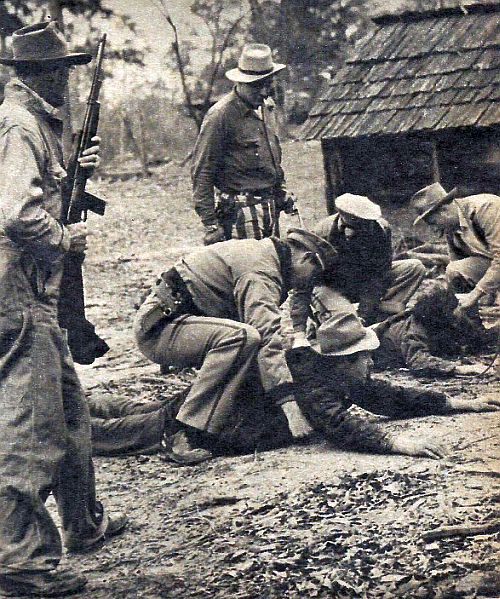
Crippled by a bullet, Leon Turner (foreground, with hat) and Windell White are handcuffed outside the shack where they hid.

Crippled by a bullet, Leon Turner (foreground, with hat) and Windol White are handcuffed outside the shack where they hid.

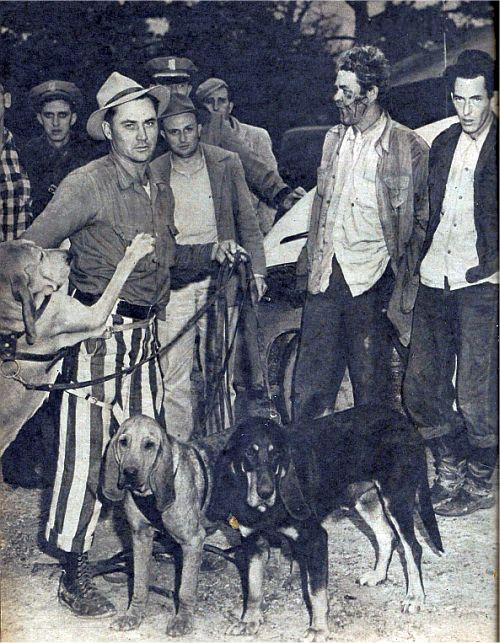
Hogjaw and his blood hounds after the capture of Windell White and Leon Turner.

Hogjaw and his blood hounds after the capture of Windol White and Leon Turner.

Source: “They Don’t Get Away,” Front Page Detective, May, 1950, pages 26, 27, 64-65.

—###—


The Wife Who Lost Her Head

Home | Feature Stories | The Wife Who Lost Her Head


This story has been removed and is available for reading in my book, “Famous Crimes the World Forgot, Volume I.”

Photos from this book are available for viewing here.


—###—


Hit & Run by Minor Movie Actress Kills 9-year-old Boy, 1954

Home | Short Feature Story | Hit & Run by Minor Movie Actress Kills 9-year-old Boy, 1954


.

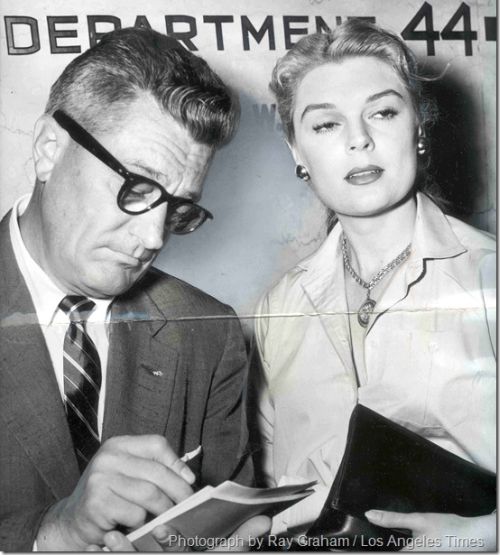
Lynn Baggett with lawyer, 1954. Photo by Ray Graham, Los Angeles Times

Lynn Baggett with lawyer, 1954. Photo by Ray Graham, Los Angeles Times

During the evening of July 7, a 1954 Nash Rambler station wagon driven by 28 year-old Lynn Baggett bore into the rear of a station wagon near Waring and Orlando Avenues in Los Angeles. The car she hit was filled with young boys returning from a day trip to a camp site. The force of the crash ejected nine year-old Joel Watnick who was killed when he impacted with the pavement. Another boy, five year-old Anthony Fell, was also seriously injured.

Baggett got out of her Rambler, examined the horrific scene, decided it was too much for her, got back in the small station wagon and took off. She drove several miles to a movie theater where she later said she went to calm herself. For the next 48 hours, police searched for the green Rambler and its driver. They found it in a San Fernando repair shop and arrested Baggett when she returned on July 9 to pick it up. Actor George Tobias identified the car as his and told police he had loaned it to Lynn Baggett.

Because of who she was, the arrest was reported in newspapers all across California. The 28 year-old former Texas beauty queen was a minor movie actress who mostly played background roles whenever a picture called for a beautiful girl in the background. By the time she was arrested, she had only had a few speaking parts. In spite of this, she was well known in Hollywood as the estranged wife of movie producer Sam Spiegel who would later go on to win three Academy Awards.

When she was arrested, she told police: “When I went back and saw the boy lying there, I knew he was dead. I didn’t know which way to turn. You don’t know what something like that does to you. I haven’t slept in 48 hours. I wish I’d been killed instead of the boy.”

Later when newspaper reporters came around to the police station, she sobbed out: “I’m sorry I can’t say anything now. I’m so confused. I wish I was dead!”

After her arrest and arraignment for manslaughter and hit and run, Baggett was released on a $5,000 bond.

Her trial began in mid-October of 1954 and lasted 10 days. On Oct. 27, a jury of 11 women and one man acquitted her on the manslaughter charge but found her guilty of felony hit and run. On Dec. 2, Superior Court Judge Mildren Lillie sentenced Baggett to 60 days in jail and three years probation.

“I am convinced of her attempt to evade responsibility of the law in leaving the scene of the accident,” Judge Lillie said. The judge further added that Miss Baggett was motivated by a feeling of irresponsibility rather than fear or panic in fleeing from the scene and had done “everything in her power to evade detection.”

“I still don’t feel I belong here, but in a way the judge did me a favor,” Baggett told a Hollywood gossip columnist during a jailhouse interview on New Year’s Eve. “This is the end of a cycle of bad luck for me. [Statement shows she doesn’t take responsibility for the accident –it was “bad luck” and not her fault.]

“I have been filled with anxiety because of my marital problems. When I get out I will divorce Sam, try to re-establish my personal life and try to work again. I’ve been in another jail of sorts the past three years.”

Lynn Baggett never worked again. She died in March, 1960 from a drug overdose in her Hollywood apartment. She was 34 years-old.

More Reading:

http://morethanyouneededtoknow.typepad.com/the_unsung_joe/2009/06/lynn-baggett.html

http://latimesblogs.latimes.com/thedailymirror/2010/09/movieland-mystery-photo-9.html

—###—


Innocent Man Freed After 15 Years in Missouri Prison & Asylum, 1932-1947

Home | Rediscovered Crime News | Innocent Man Freed After 15 Years in Missouri Prison & Asylum, 1932-1947


Posted from: “Full Pardon Asked For One Who Paid For another Man’s Crime,” The Sunday News and Tribune, Jefferson City, MO, Nov. 2, 1947
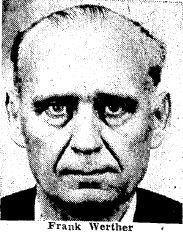
 

Frank-WertherAttorneys for Frank Werther, 47, who served nearly 15 years in the Missouri state penitentiary here and state mental hospitals after conviction of a crime he did not commit, are preparing an application for a full pardon which will shortly be placed before Gov. Phil M. Donnelly for consideration, it has been learned here.

The account of a miscarriage of justice in the Frank Werther case, in which an innocent man was kicked around for 15 long years, reads like something out of a fiction magazine.

On a cold, dark and rainy night early in the fall of 1932, the Frisco railway agent at Neosho, Missouri, sat hunched over his telegraph keys, pounding out train orders and relaying rnesisages for the operation of the many fast trains that thunder incessantly up and down that main line of a great railway.

It was the night trick for this wire operator, named Moore, and it was an especially busy night. His wife, to keep him company, had come to the station with him, and sat over by the glowing stove, listening silently to the clatter of the wires.

Suddenly the door connecting the office with the waiting room was pushed open, and a medium sized man, a complete stranger to Mr. and Mrs. Moore, strode into the room.

Calmly he walked over by the stove, but suddenly he pulled a mean-looking six-shooter, backed the agent and his wife into a corner and announced: “This is a stickup. Give me all the money in that cash drawer, and out of that safe.”

Takes Station Money

There was no help for it, and Moore, taking a good look at the stranger, raked the bills and change out of the drawer under the ticket window, walked over to the safe, reached in. and pulled out the money sack containing a fair amount of currency.

The stranger backed out, keeping them covered, rushed through the door, and was gone in the darkness. Mr. and Mrs. Moore, of course, getting over fright, immediately called the police and the sheriff’s office and, in a matter of minutes, the officers were at the depot.

But their quarry had fled. Careful search of the entire depot, and the railroad yards, produced no thug. No strangers could be found uptown, not in the restaurants, nor the pool halls. Methodically they’ started checking the rooming houses. In one, down on McCord Street, they found a suspicious-looking, suspicious-acting sort of character.

In response to their questions, he stammered and stuttered.

“Yes,” he’d just gotten in Neosho that night. “Yes,” his muddy shoes had Neosho mud on them. “No,” he hadn’t robbed the depot. “No,” he hadn’t stuck up anybody. “Yes,” he had some: money—and he did have; about’ $700—but it was mostly in postal, savings certificates.

Despite his protestations that he had just arrived in Neosho: that night, and was a laborer looking for work, he was lodged in the county jail. The next morning, Mr. and Mrs. Moore came down to the jail, and after studying the suspect for a while declared he was the man. “I’d remember that face anywhere,” said Mrs. Moore. Their identification was positive.

L. D. Rice, then the prosecuting attorney, now a prominent lawyer at Neosho, immediately filed charges against the: suspect, who said his name was Frank Werther, that he was 32 Years old, and that his home was at Winfield, Kans.

He employed three lawyers: Frank Lee, once a congressman from that district; Charles Prettyman, now a retired Neosho attorney; and Phil Graves, still, practicing in Neosho.

In the course of time, with Werther still in jail, his attorneys entered a plea of not guilty for him, and eventually secured a change of venue for his trial. It was set for hearing in Cassville, in that same judicial district, the county seat of Barry County.

Just before his trial his brothers came down from Kansas to see about it. Werther’s funds were exhausted, through lawyer fees, court costs and other expenses. They hired another lawyer. A R. Dunn, now Magistrate Judge in Newton County, to see what he could do. Dunn got into the case too late to do much good. The jury at Cassville found the man guilty of robbing the agent at the Frisco depot in Neosho at pistol point.

Dunn tried to get a new trial, but failed. The prosecuting attorney, elected by the people to see that justice was done by due course of law, felt that the man was guilty. He was supported in his belief by “Cap” Ruark, a special prosecutor who was helping him in that particular case.

Werther was sentenced to serve 10 years in the state penitentiary, following the jury’s conviction. He was received at Jefferson City [Missouri State Prison] on Dec. 5, 1932, prison records show.

Time marched on. Several months later, a special agent for the Kansas City Southern railway, in the line of investigating robberies from freight cars, came up on a hijacker in the railway yards at Harrison, Arkansas. In the gunfight that followed, the robber was critically wounded. Taken to the hospital

He lingered between life and death for several clays, gradually becoming worse. Finally, his condition grew so bad that he, himself, knew that he was going to die. The doctors had known it for some days.

Robber Admits Job

Lying on his iron hospital bed the robber thought back over his trail of crime, which had led him down through Nebraska, Kansas, Missouri and Oklahoma. Indeed, he had served time for some of his deeds. But, knowing the end was near, he called for the railroad’s special agent who had shot him.

“I want to tell you some things,” he said. “I robbed (so-and-so) over in Kansas. I held up a filling station at Joplin. I held up the Frisco depot in Neosho–”

“When was the Neosho job?” the officer inquired.

“One cold night in the early Fall,” he answered.

“Did you know another man was sentenced to the pen for that job?” the officer asked.

“No, I didn’t,” the dying man said. “But I did that job. Look in my grip over there under the dresser, and you’ll find the money sack that I took from that depot agent that night,” he said.

Sure enough, there was the money sack, with the words Frisco on it in big black type. And the details of the holdup, as he described them, were exactly as Moore and his wife had related them. No doubt about it—he did the job; but another man was serving time for it.

The officers of the county were contacted. They went to Moore and his wife, showed them the picture of the desperado who died in Arkansas, and they said he was the man. They completely repudiated their former identification of the man who was in the pen.

Then Attorney Dunn directed his attention to Jefferson City. He went up to the penitentiary, and uncovered a strange trail of events.

Werther, confined since December of ’32 for a crime he had not committed, had developed signs of increasing melancholy, and depression and finally his condition mentally had become so grave that he was transferred to the state hospital for the insane at Nevada, Mo. This occurred on May 8, 1933.

He remained at Nevada until June 25. 1934, for a year and a month, but became steadily worse, and was transferred to the asylum at Fulton. There he remained.

Attorney Dunn contacted his brothers in Kansas. They came out and canvassed the situation. The Governor and the parole board agreed to pardon the man. But his mental condition was still bad. Perhaps he was better off at Fulton than anywhere else—until, at least, his mind cleared up. So there he stayed.

Gradually, the beneficial results of the training, and care and understanding he received at Fulton, led to a slow return of the man’s normal sense. He was getting better.

On September 24, 1946, he was adjudged cured of any mental illness, and was remanded back to the penitentiary at Jefferson City.

Efforts were then set up in his behalf, but it was not until July 22 of this year (1947), almost 15 years from the time he entered the prison under a miscarriage of jus tice, that he was activated to parole.

Prison officials describe Frank Werther as a mild-mannered, inoffensive, laborer-type sort of person. He was, and is a protestant, and had a ninth-grade education.

Today, Frank Werther, it is reported has a good job, and is making good on it, at Wichita, Kan. His brothers still live down around Winfield.

Judge Dunn still interested in his behalf, advises that he is making plans to ask Governor Donnelly to issue Frank Werther a pardon, a full and complete restoration of citizenship for a man who was guilty only of being in a strange town, on a dark and lonely night, with muddy shoes encountered in tramping around looking for work, and with about $700 in his pockets.

“There was always a doubt in my mind about that case,” remarked Attorney Rice, recently, asked about the incident. “But the officers seemed to have the evidence, and it looked like he might have been the man who robbed the depot, although we never did find a gun on him, or in his room.”

Mr. Rice later joined in signing the application for pardon, as soon as he had learned of the confession made by the thug in Arkansas. And other lawyers in Neosho, including the district judge, also helped in the appeal for clemency.

Frank Werther, through a combination of circumstances had served about 15 years for a crime he did not commit, and had suffered more than ordinary tortures.

—###—


.

Skull in the Ashes, by Peter Kaufman

Home | New Books | Skull in the Ashes, by Peter Kaufman


.

Kaufman_comp_HiRes_REVSkull in the Ashes: Murder, a Gold Rush Manhunt, and the Birth of Circumstantial Evidence in America, by Peter Kaufman

On a February night in 1897, the general store in Walford, Iowa, burned down. The next morning, townspeople discovered a charred corpse in the ashes. Everyone knew that the store’s owner, Frank Novak, had been sleeping in the store as a safeguard against burglars. Now all that remained were a few of his personal items scattered under the body.

At first, it seemed to be a tragic accident mitigated just a bit by Novak’s foresight in buying generous life insurance policies to provide for his family. But soon an investigation by the ambitious new county attorney, M. J. Tobin, turned up evidence suggesting that the dead man might actually be Edward Murray, a hard-drinking local laborer. Relying upon newly developed forensic techniques, Tobin gradually built a case implicating Novak in Murray’s murder. But all he had was circumstantial evidence, and up to that time few murder convictions had been won on that basis in the United States.

Others besides Tobin were interested in the case, including several companies that had sold Novak life insurance policies. One agency hired detectives to track down every clue regarding the suspect’s whereabouts. Newspapers across the country ran sensational headlines with melodramatic coverage of the manhunt. Veteran detective Red Perrin’s determined trek over icy mountain paths and dangerous river rapids to the raw Yukon Territory town of Dawson City, which was booming with prospectors as the Klondike gold rush began, made for especially good copy.

Skull in the Ashes traces the actions of Novak, Tobin, and Perrin, showing how the Walford fire played a pivotal role in each man’s life. Along the way, author Peter Kaufman gives readers a fascinating glimpse into forensics, detective work, trial strategies, and prison life at the close of the nineteenth century. As much as it is a chilling tale of a cold-blooded murder and its aftermath, this is also the story of three ambitious young men and their struggle to succeed in a rapidly modernizing world.


The GE Mound Case by Jim Fisher

Home | New Books | The GE Mound Case by Jim Fisher


.

Before I decided to major in journalism and creative writing two decades ago, I wanted to be an archeologist. Having been on some digs, there’s just something so incredible about digging up an artifact in which the last person who touched it was 300 to 1,000s of years ago.

Well, I found a book that is a little bit of crime, a little bit of archeology, and a whole lot of government overreach. It’s written by my internet pal Jim Fisher who is a former FBI agent, criminal justice professor and author of…10 books now?? I think. Most of which are true crime. Check out his book and his blog  where he is always posting something interesting.

GEM image


Mug Shot: Child Killer Fred Stroble, 1949

Home | Mug Shot Monday, Rediscovered Crime News | Mug Shot: Child Killer Fred Stroble, 1949


.

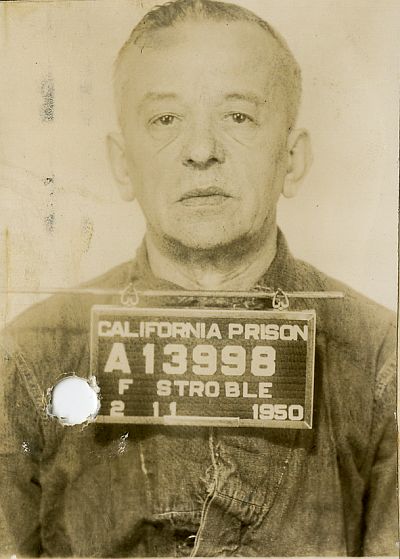
Fred Stroble Mug Shot

San Quentin Mug Shot of Fred Stroble. Photo Courtesy of California State Archives, San Quentin Prison files.

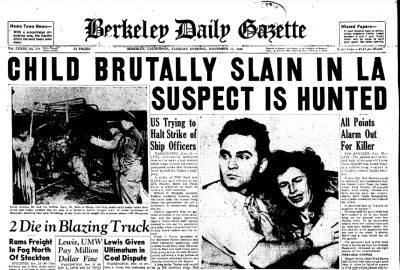
Story #1: Child Brutally Slain in LA, Suspect is Hunted

LOS ANGELES, CA, Nov. 15, 1949: The gashed and mutilated body of six year-old Linda Glucoft was found today in a rubbish heap, wrapped in a brightly colored Indian blanket.

Police Sgt. Bill Brennan said he definitely had established that the blanket came from the home where Fred Stroble, 67 year-old baker, lived nearby. Stroble has been missing since last night, shortly after Linda disappeared, and a police broadcast has ordered his arrest. It described him as “wanted on suspicion of murder.”

Brennan said the girl’s head had been bashed in by an axe found lying on the ground near her chubby form. In an incinerator nearby were her underclothes and an eight-inch butcher knife. Police said the knife apparently was not used in the crime. A whisky bottle and a wine bottle lay on the ground.

The gruesome find, a few steps from a church on busy La Cienega Boulevard, climaxed an all-night search of the neighborhood.

PREVIOUS CHARGE

Front page of The Berkely Daily Gazette, Nov. 15, 1949

Front page of The Berkely Daily Gazette, Nov. 15, 1949

Deputy Police Chief Thad Brown said Stroble had been sought since May 11, when he failed to answer

a child molestation charge and forfeited $500 ball. Brown said the baker was believed to have gone to Mexico at that time, and a bench warrant issued against him had never been served. The case involved a 10-year-old girl living in suburban Highland Park.

Investigators learned that Stroble returned from Mexico only a week ago. [This is not true. Stroble was at his daughter’s home, where he lived, the entire time, but police never checked his own residence. When his son-in-law threatened to turn him, he got drunk and molested the second girl].

Police said they delayed putting out an all points broadcast on Stroble for more than four hours after the crime was discovered because of variations in descriptions of the man.

NEAR MOVIE STUDIO

The La Cienega-Crescent Heights section is in a finger of corporate Los Angeles, on the southwest side, bordered by Culver City and Beverly Hills. It is not far from 20th Century-Fox Studio.

Det.-Sgt. R. T. Reid and Lloyd Baughn, in charge of the inquiry, said the man they seek lived in a house near where the body was found, but disappeared last night, taking his clothing. An all-points police bulletin set in motion a search for him throughout the West.

The officers said Linda Joyce and a granddaughter of the hunted man are almost constant playmates. But they were not together yesterday. Linda was playing alone because her friend had gone t o a birthday party.

“It’s horrible . . . unbelievable,” screamed Mrs. Lillian Glucoft, the girl’s mother and wife of Jules Glucoft, a commercial artist, when she learned of the gruesome find.

NEIGHBORHOOD SHOCKED

The little neighborhood of postwar stucco homes, on the edge of the Crescent Heights section — an established neighborhood of big Spanish-type homes with red tile roofs—was thrown into confusion by the brutal killing. Little knots of people gathered at street corners, outside a police cordon which kept all away from the backyard where the body was found, until crime laboratory experts had completed a minute examination.

Because of the absence of blood in an alley behind a six-foot fence, detectives believe she was killed in the yard. But they did not discount a theory that her slayer tossed her limp form over the fence as he fled.

Glucoft is 36, his wife, 33. They have an eight-year-old son, Richard. Glucoft came from Milwaukee, Wis., but has lived here about 20 years. His father, Joseph Glucoft, was a Milwaukee watchmaker who now lives here.

Of the killer, Glucoft said: ” It’s a crime that was allowed…to walk around a free man. I only hope he commits suicide—it would save a lot of notoriety we don’t want.”

MOTHER FAINTS

Mrs. Glucoft screamed out her horror, then fainted. She was placed under a physician’s care in an hysterical condition. Capt. Ray Pinker, head of the police crime laboratory, and his men took over the yard where the child’s body was found. They permitted no one but crime lab men to enter as they photographed and fingerprinted the yard, inch by inch, and all objects in the area.

It was in that vicinity that the murders of Nina Martin and her sister, Mae, occurred in 1924—a case that led to the conviction of Scott C. Stone, a night watchman.

Source: Associated Press via The Berkely Daily Gazette, Nov. 15, 1949, pages 1, 3.

Story #2: Fred Stroble Tells Story of Slaying

LOS ANGELES, CA, Nov. 18, 1949: Muttering “I don’t deserve to live,” pasty-faced Fred Stroble, 66 year-old baker, braced himself in a county jail cell today for swift grand jury action in the sex slaying of six-year-old Linda Joyce Glucofi.

Stroble, the grandfather of one of Linda’s favorite playmates, poured out his sordid story to District Attorney William Simpson as a 48-hour fugitive search throughout the week and into Mexico wound up yesterday on stool in a downtown Lobs Angeles bar — about five blocks front Central Police Station.

Simpson said Stroble, formally charged with murder, admitted that he strangled and bludgeoned the little girl to death when she resisted his improper advances. Arraignment is scheduled today in municipal court.

“I had been drinking all day —wine. I wouldn’t have done it if I wouldn’t been drunk,” Stroble was quoted.

Simpson said the ashen, gray-haired grandpa—who liked to buy kids ice cream and candy— then told of enticing Linda into a bedroom of the home where he lived with his daughter, her husband and their two children. The story:

“I was playing with her (Simpson said this involved an act of molestation, but not rape) when she started to scream. She was resisting me.

“This wasn’t the first time. I had played with her once before. “I strangled her first with my hands, then with a tie. She was quiet. I wrapped her up in the blanket and carried her out to the incinerator… I stabbed her with the ice pick, and then I slammed her with the flat aide of the axe six times on the head.

“Then I went back into the kitchen and got a (butcher) knife. I remembered a trick I learned while watching the bull fights in Mexico. I stabbed her in the back, just below the skull, between the shoulder blades. That makes death come easily and fast.

“The little girl did not suffer too much. She was dead within eight or ten minutes.”

That was about 6 p.m. Monday, Stroble said. Linda’s body was found the next morning and the search started.

Stroble told how he boarded an interurban train for Ocean Park and stayed in cheap hotels at the beach city for three nights.

He said he had thought about suicide, by jumping off the pier, but decided yesterday morning to return to Los Angeles and “give myself up. ”

He had just returned on a bus and gone into the bar for a glass of beer when a laundryman, Bill Miller, spotted him and told rookie traffic policeman, Arnold W. Carlson. Carlson confirmed the identification and Stroble submitted without protest.

Source: Associated Press via The Pampa Daily News, Pampa, TX, Nov. 18, 1949, pages 1, 5.

Story #3: Fred Stroble Found Guilty of Brutal Sex Slaying Of 6-year-old Girl

LOS ANGELES, CA, Jan. 19, 1949:, Fred Stroble was found guilty today of the brutal sex slaying of 6-year-old Linda Joyce Glucoft.

A Jury of 10 women and two men, which took the case yesterday, actually deliberated about three and one-half hours.

Thus, in only a little over two months, the state had captured, tried and convicted the 68,-year-old shifty-eyed baker who, in a signed statement, said he choked, stabbed,  hacked and bludgeoned the little girl last Nov. 14 when she resisted his fondling advances.

Stroble also pleaded innocent by reason of insanity, and will be tried immediately on the second plea. The jury’s verdict was guilty of first degree murder, without a recommendation of leniency. This carries an automatic penalty of death in the gas chamber, but under state law must be reviewed by the [state] Supreme Court.

Stroble was impassive as he was brought into court. He took the verdict calmly at first, but then sat down, put his head in his hands and burst into tears. Four bailiffs stood over the trembling slayer.

Superior Judge Charles W. Fricke, setting the sanity trial for 9:30 a.m. tomorrow, instructed the jurors not to discuss the case meantime. If Stroble is found to have been insane at the time of the killing, he would be sent to a mental institution. If found sane, the Supreme Court would then review the case before the death sentence could be imposed.

Weeping, Stroble clasped the hand of his attorney, public defender Al Mathews, and sobbed: “I loved her as my own child. I never thought of murder. I must have been crazy.

If I’d planned a murder I’d have done it in half a minute. I didn’t plan it, because I would have thought of my grandchildren.”

When a reporter asked Stoble if he was afraid to die, he said “I’ll do what God wants me to do.”

Source: Associated Press via The Daily Independent-Journal, San Rafael, CA, Jan. 19. 1950, page 2.

Execution and Epilogue

Fred Stroble was executed in the San Quentin gas chamber on Friday, July 25, 1952. Before he died, he expressed deep remorse for his crime.

It might seem hard to believe but by the time he was executed, most states did not have specific laws against child molestation and rape. According to Alison Arngrim, the woman who played Nellie Olsen in the TV drama, Little House on the Prairie, the punishment for child rape in California before 1950 was just 30 days in jail.

A more graphic account of Stroble’s crimes can be found here.


Check out more of our Vintage Mug Shots.
 
—–###—–

The 1963 Murder of Olympic Skier Sonja McCaskie by Thomas Lee Bean

Home | Mug Shot Monday | The 1963 Murder of Olympic Skier Sonja McCaskie by Thomas Lee Bean


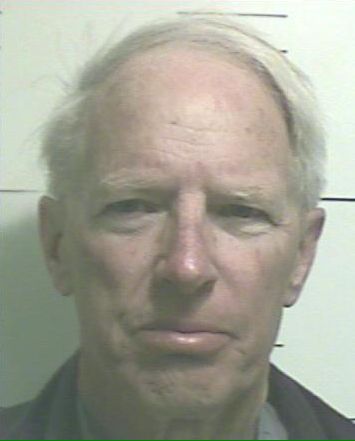
Posted below is a short but interesting documentary about the murder of Sonja McCaskie in 1963. She skied for the British team during the 1960 Olympics. Her killer, 18 year-old Thomas Lee Bean, was tried and sentenced to die in the Nevada gas chamber in 1963.  In 1972,  the United State Supreme Court overruled all pending death sentences and Bean’s death sentence was commuted to life in prison without the possibility of parole. Bean is still serving his sentence at a medium security prison in Carson City, Nevada. The 68 year-old inmate has been in prison for 50 years. The McCaskie murder has been characterized as the worst murder in Reno’s history.

“While Bean dismembered McCaskie, he played records on her stereo.”


Thomas Lee Bean as he appears in his most recent mug shot for the Nevada Department of Corrections

Thomas Lee Bean as he appears in his most recent mug shot for the Nevada Department of Corrections

Read More:

Reno Gazette Journal 2013:

Associated Press, April 15, 1963:

Associated Press, July 9, 1963:

—###—


Army Wife Acquitted for Murder of Horrible Husband in 1955

Home | Rediscovered Crime News | Army Wife Acquitted for Murder of Horrible Husband in 1955


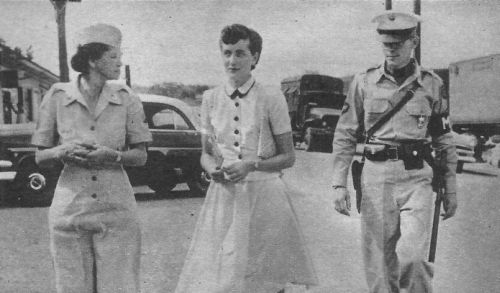
Romola Abidin endured eight years of married hell.

Romola Abidin endured eight years of married hell.

Wife Accused of Mate’s Murder Sobs Out Details

[Sendai, Japan, Aug. 6, 1955] — An attractive 26 year-old Army wife on trial for her life yesterday told an Army court-martial through shuddering sobs how the husband she Is accused of murdering bragged of his lurid sex life, beat her end threatened the lives of her children and herself.

Brunette Mrs. Romola Abidin, Queens, NY said the fatal shooting of her helicopter pilot husband, Robert, climaxed a night of beastiality and brutality during which he beat her with a belt and choked her at their home on “cherry Blossom Lane.”

She collapsed in tears as she described hew her husband ran toward the room of their three children shouting “I’m going to kill your kids now.”

“I grabbed a gun,” she sobbed “I said ‘Stop, Bob,’ “.4

Then she said, “something happened.”

The next she recalled, she told the packed and tense courtroom, her husband was on the floor pleading “Romola, get me to a hospital.”

He died a few minutes later of a bullet wound in the abdomen,

The Army prosecutor has charged her with premeditated murder, Conviction could carry the death penalty.

Source: United Press via The St. Petersburg Times, Aug. 6, 1955, page 3.

No Title Given

[August, 1955] In Japan, an army court martial listened and shuddered as Mrs. Romola Abidin, on trial for the murder of her pilot-husband, unfolded the story of her eight years of marriage.

Sometimes, she said, he made her and the children eat off the door to the kitchen oven because he couldn’t stand the sight of them. Once, on a Japanese beach, he looked at the kids and said, “I wish I had a cave where I could put them and let them starve to death.” Twice he tried to force her to have abortions.

On his last night he bragged of his love life. “There isn’t a man around who’s had as many women as I’ve had.” Then he told her how he’d seduced her best friend, as well as the wife of a colonel, a New York TV actress, numerous army nurses, and once, a Japanese airline hostess “on one of the plane’s seats, in front of a general.”

Then he told her, “You haven’t had a beating in a long time,” and started whacking her. He choked her, kicked her, flung her across the room. At breakfast he stabbed her with a fork, and threatened to have her killed.

Then, she said, he threatened to kill the kids and ran into the room where they slept. “I grabbed a gun,” she told the court, breaking into sobs, “and something terrible happened.” The something terrible, said the army, was murder. But the men who heard story said no, promptly announced a verdict of innocent.

Source: Front Page Detective, Nov. 1955, page 6.

Woman Who Killed Army Husband Freed

[Sendai, Japan, Aug. 7, 1955] — Mrs. Romala Abidin who shot and killed her officer husband was informed unofficially Monday she will collect his government insurance, his back pay and a special “gratuity” from the Army.

The 26 year-old mother of three whose stateside home is Bayside, NY, was found innocent Sunday of premeditated murder In the Cherry Blossom Lane shooting of her warrant officer husband, Robert, 29, a helicopter pilot.

‘Gratuity’

Army sources said she was expected to receive a $10,000 insurance policy, a special “gratuity” of about $2,000 awarded to dependents of soldiers who die “in line of duty,” and his back pay.

In addition she is entitled to social security benefits and a Veteran’s Administration pension, Army sources said the pensions probably would total about $250 monthly.

Mother Included

Attorneys for Mrs. Abidin said they did not know whether she would receive the entire $10,000 insurance because there was a possibility that Abidin’s mother, Mrs. James Abidin of Flushing, NY, was beneficiary to half the amount.

Although Abidin was killed at  home and did not technically die in line of duty, an Army legal source said it was Army policy to interpret the gratuity matter “as broadly as possible.”

A U.S. Army general court martial freed Mrs. Abidin after hearing that he forced her into sexual indecencies and threatened to kill their three children.

Source: United Press via The Dubuque Telegraph-Herald, Aug. 7, 1955, page 2.