
True Crime Books by Jason Lucky Morrow

Welcome to HistoricalCrimeDetective.com [Est. 2013], where you will discover forgotten crimes and forgotten criminals lost to history. You will not find high profile cases that have been rehashed and retold ad infinitum to ad nauseam. This blog is the official website for true crime writer Jason Lucky Morrow, author of four books including the popular series: Famous Crimes the World Forgot, Volume I and Volume II. If you would like to send me a comment, Contact Me Here. - Please follow this historical true crime blog on FACEBOOK.

Cop Killer, 1937, Michigan State Policeman Richards F. Hammond

Home | Rediscovered Crime News | Cop Killer, 1937, Michigan State Policeman Richards F. Hammond


Part 1

[MONROE, Michigan,  Jan. 20, 1937]—The bullet-pierced body of Michigan State Policeman Richards F. Hammond was found handcuffed to a mail box on a lonely country road today, five hours after he was abducted by a former convict he had arrested.slain-trooper
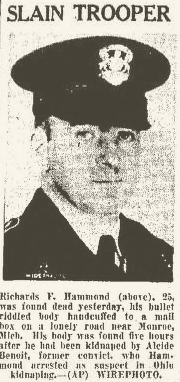
A posse of more than 200 officers from Indiana, Ohio, and Michigan searched wooded areas for Alcide (Frenchy) Benoit; alias, Joe La Rue, who was paroled from the Michigan state reformatory at Ionia a year ago.

Airplanes piloted by Detroit police and Indiana state police joined the search and Michigan state police issued radio appeals for farmers to arm themselves and search their out buildings for the fugitives

Had Halted Pair

Hammond, a husky, six-foot troopers with a fellow officer, Sam Sineni, halted two men while blockading the highway at Monroe shortly before last midnight in search of two gunmen who abducted Fred Williams, a used car salesman, in Detroit, and left him tied to a tree in Toledo. Hammond took Benoit in the state patrol car while Sineni entered a car operated by the second suspect, John Smith, alias Mike Delberto, formerly of Flint, and also a former convict.

En route to the state police barracks at Erie, Mich., Benoit suddenly overpowered Trooper Hammond •and sped away with him in the motor car.

A Running Gunfight

Trooper Sineni pursued the fugitive patrol car for 10 miles, exchanging shots with Benoit until the pursuing car was ditched.

Two Monroe county deputy sheriffs, Joe Dansard and Robert Navarre, came upon the hunted car near Lulu, Mich., and again a gunfight ensued with Benoit finally abandoning the patrol car. He escaped on foot into nearby woods. In the bloodstained car was the uniform coat of Trooper Hammond. It was saturated with blood.

At 5 a.m. officers patrolling roads in the area came upon the body of the missing trooper. Hammond had been shot through the head. His body was slumped against a rural mail box and his wrists were shackled with his own handcuffs to a steal post.

Capt. Lawrence A. Lyon of the Michigan state police, who is directing the search, Identified Benoit as the man sought. He said Trooper Sineni brought Smith to the Erie barracks after the gun battle and then joined the search for the former convict.

Killer Is Parolee

State police Identification bureau records show that Benoit wes sentenced to the state reformatory at Ionia after conviction in Detroit of carrying concealed weapons and of receiving stolen property. Benoit was released on parole Jan. 2, 1936. Smith also served a sentence in the reformatory.

Captain Lyon said the motor car in which Benoit and Smith were arrested last night was stolen from Williams, the Detroit used car salesman, in Toledo last night. Hammond, whose home was in Hanover, Mich., had been a member of the state police for 18 months.

Source: AP via The Miami Daily-News Record, (Oklahoma), Jan. 20, 1937, Pages 1,2

Part 2

[Monroe. Mich.. Jan. 21, 1937] – Alcide (Frenchy) Benoit, youthful paroled convict captured after a 20-hour manhunt, told today how he killed Michigan state policeman Richards P. Hammond and then handcuffed the officer’s body to a rural mailbox.Alcide-Benoit2
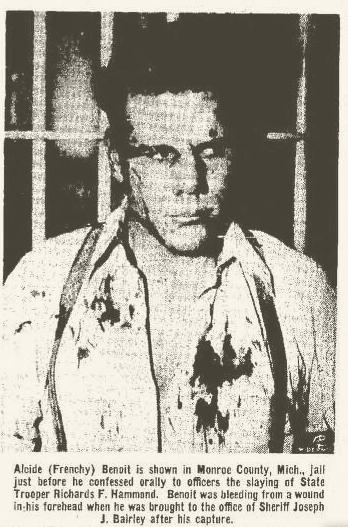
County Prosecutor Francis Ready announced the confession of the 24 year-old black-haired gunman shortly after Benoit’s desperate game of hide-and-seek over sleet-covered country areas with officers or three states and the federal government ended In Monroe—a short distance from the spot where he abducted Trooper Hammond of midnight Tuesday.

Hammond and Trooper Sam Sinei halted a stolen car occupied by Benoit and John Lee Smith, 23, alias Delbert, and decided to take the pair to headquarters for questioning In connection with the abduction of Fred Williams, a Detroit used car salesman who was left tied to a tree at Toledo early Tuesday night.

“I got into the patrol car with the officer (Hammond),” Benoit orally confessed to Prosecutor Francis Ready, State Police Captain Lawrence A. Lyon and Sheriff Joseph J. Ready. “Sinei and Smith followed in the seized automobile.

“As the car started, I jammed the gun into the officer’s rib and told him to slow down,” Benoit said.

“Instead, Hammond started to go faster so I slugged him over the eye with the butt of my pistol and told him to turn onto a side road.

“The other officer (Sineni) behind came up close. I turned around and fired three shot. When I started shooting Hammond said he was going crash the car and I told him if he did, I’d kill him sure.

“Then the other car went into the ditch and I stopped. I was going to take my partner (Smith) away, from the other cop, but a truck blocked the way, so I made Hammond drive down lonely roads until we came to where I left him.”

This was five miles southeast of Erie, Mich., about ten miles from the place where Benoit abandoned the blood-stained patrol car and escaped into the woods.

“I made Hammond stop,” Benoit was quoted as confessing. “Then got out and put one of the handcuffs on his wrists. When I tried to get him out of the car he put up a fight and we rolled over on the ground. I could see he was getting the best of me. Then I fired during the scuffle and he got limp. I cuffed his hands around the poet lot the mail box.”

Benoit, bleeding profusely from cuts on his head insisted to officers, however, that he did not realize, he had shot Trooper Hammond until the officers’ body went limp and he succeeded in shackling him to the post.

After leaving the body, Benoit said, the wireless in the police car brought realization that a highway blockade had been set-up which he could not hope to penetrate. He said he heard orders sending all available Michigan officers, into the area, with reinforcements from Ohio and Indiana.

After brief burst of gunfire from county and state officers, Benoit said, he abandoned the patrol car and ran on foot across a field. Later he took refuge in a barn to escape freezing rain, Benoit said, and remained until darkness fell last night. Then, Benoit walked into a farm house near Federman, Mich., and at gunpoint forced Paul Balog, 55, and his son, Steve, 16, to drive him in their light truck.

Another member of the Balog family raised an alarm and four state troopers participated in the capture after Benoit at the wheel of the truck, had narrowly escaped cruising police cars by turning into alleys.

Arraignment

Benoit faced arraignment today. If convicted of first degree murder in the state courts, he faces a mandatory life sentence, the maximum penalty In Michigan.Alcide-Benoit
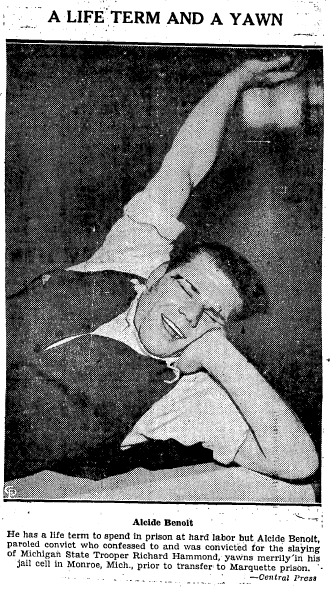
Benoit was captured by four state troopers at the intersection of Michigan state highway 50 and Telegraph Road, about three miles from Monroe.

Harry Nelson and Trooper Russell Moore on duty on Telegraph Road, saw the Balog truck going northeast on Telegraph Road at the edge of Monroe. They forced Benoit to turn onto a side road and there the troopers fired a shot into the hood of the truck, Benoit stopped the truck and got out—his hands in the air as two other officers arrived.

“You’ve got me, coppers!” he shouted. “Yes, I’m the guy,”

Anna Balog, 13-year old daughter of the Monroe farmer, was credited with giving state police the tip that led to Benoit’s capture.

The girl, ignoring her mother’s protests, got out in a driving rainstorm over a soggy road to the farmhouse of a neighbor, Irvin Karns to notify him that a stranger had appeared at the farm house about 6:45 p.m. He made the Balogs believe at first they were going to help him out his car out of the ditch.

“When they drove away,” Anna said, “I grabbed a lantern and started up the road to the Karns’ place.

“I was scared.” Steve Balog, telling of the capture, said: “The state police seemed to be all around the car. They pulled him out and, boy was I glad!”

Source: AP via The Daily Mail, (Hagerstown, MD), Jan. 21, 1937, Pages 1, 2

Note: Alcide “Frenchy” Benoit pleaded guilty to first degree murder and was sentenced to life in prison at Marquette State Prison in Michigan.


Two Opium Dens Busted in 1901 Raids

Home | Rediscovered Crime News | Two Opium Dens Busted in 1901 Raids


“The two visitors were so far on their way to dreamland that they did not pay any attention to the entrance of the officer.” – My favorite quote for this story.

Opium Den Raided

[Burlington, Iowa, Sept. 12, 1901]—Two sallow-complexioned Chinamen and one wreck of white humanity lined up at the police station bar yesterday to answer to charges of conducting and resorting to an opium den. M. E. Blake ay- , peered for the defendants and entered, a plea of guilty for both. They were fined and released, but Judge Gillespie promised both a much more severe punishment should either be caught a second time.

Besides the two prisoners, their pipes, lamps, scales and dope were also taken to the court room. They were all the genuine article and before the trial was over the police court room smelled like a typical Chinese laundry. [Okay, they got a little bit racist there.]

The Celestial goes by the name of Fong Sing and runs the laundry at the corner of Valley and Third streets. In the rear of the place a room is fitted up with Minks and curtains, small lamps and an abundant supply of thick, black opium. For some time the police patrolmen have had their eye on the place, but no raid was made until about midnight on the night before last.

It is understood that besides the one man caught in the place, two well-known women are also regular customers of the den [prostitutes?],but there is no positive proof, or at least the officers have not at this time enough evidence to convict the women, so they were not arrested. The place will, however, be closely watched hereafter and the next raid will, no doubt, have more serious results.

Source: The Waterloo Daily Courier, Sept. 12, 1901, page 1

OPIUM DEN RAIDED

(Officers of Rochester, Montana determined to Break Up Chinese Joint).

[Rochester. Mont. July 12, 1901]—Deputy Sheriff J. R. Stark of Twin Bridges at 3 o’clock this morning raided an opium den at this place (Rochester) conducted by Lee Lou.

The complaint was sworn to by another Chinamen, and when Officer Stark, armed with a warrant, broke down the door of the cabin he found, beside the proprietor, two persons inside taking a smoke. The two visitors were so far on their way to dreamland that they did not pay any attention to the entrance of the officer.

The persons found Inside were Jim Jacobs, an itinerant musician [why am I not surprised they found a nomadic musician?], and Maude Owens, a woman of the half-world of Rochester. All three were placed under arrest and will be taken to Twin Bridges for trial today. In the cabin was also found all of the accessories for smoking, and the outfit was also seized and will be used as evidence at the trial.

The Joint has been in operation about three weeks and during that time has been closely watched by the officers. It was intended to raid the place July 8 but the conditions were not favorable. The raid today was successful and the officers do not doubt but that a conviction will be secured.

Source: The Anaconda Standard, July 13, 1901, page 1

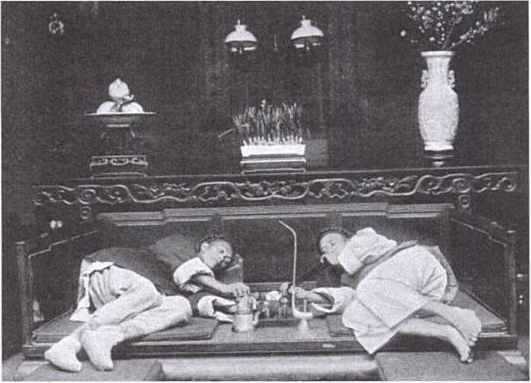
Two garden variety, turn of the century opium users in China.

Two garden variety, turn of the century opium users in China.


Rented Husband Loses Lawsuit for His Share

Home | Rediscovered Crime News | Rented Husband Loses Lawsuit for His Share


Okay, this may not be a crime story per se, but there was no way I was NOT going to post this from our: “We couldn’t make this up department.” The only crime committed here is stupidity.

[LOS ANGELES. May 1, 1941]- In blasé, nonchalant tones, Samuel Brummel, 56-year-old insurance salesman, testified Thursday that his wife rented him out to another woman for a year for S10,000, promising him half of the money. Brummel, a dark, cigar-chewing little man, told the story as trial of his suit to divorce Mrs. Lillian Brummel, 55, and to collect his half of the “fee.”

The other woman is Mrs. Norma Peppin, middle-aged county employee, who married Brummel in 1938 but obtained an annulment on grounds that the first wife’s Mexican divorce was illegal.

Following Brummel to the stand, Mrs. Lillian Brummel denied making any such deal with Mrs. Peppin.

Following Brummel to the; stand, Mrs. Lillian Brummel denied making any deaf with Mrs. Peppin. She said Mrs. Peppin volunteered, before the Mexican divorce, to give her the $10,000 as compensation “for the harm done me,” by Mrs. Peppin’s failing in love with Brummel.

In commenting on discrepancy in the testimony, Superior Judge Starry F. Sewell issued a subpoena to bring Mrs. Peppin into court.

Brummel, asking for $5,000 from his first wife as part of the community property, was questioned by her attorney, John A. Cronin, regarding his claim.

“Where did this money come from?” Cronin asked.

“It was a business deal,” Brummel replied.

“You testify in a deposition that your wife had an agreement where she was loaning you out for S10.000?”

“Yes.” said Brummel, “She told me that.”

“What did you say to the arrangement?”

“I said all right.”

Deposition Read

The deposition then was read into the court record and in it Brummel elaborated on the so-called business deal:

“In the summer of 1937, I came home one day and my wife told me she had a good surprise for me—that this woman was inheriting a large estate that might amount to $80,000” read Brummel’s deposition.

“My wife said she had arranged everything for $10,000; that she would go ahead and get a divorce: that I would not stay with her for a year, but that I was to come back to her after that. In other words, she was just loaning me to her.”

Brummel detailed how his wife promised to give him half the money after he divorced the second Mrs. Brummel.

Asked if he continued to see his first wife while he was married to the second, Brummel said: “Oh, yes, we saw each other right along.”

Another Reason

The first Mrs. Brummel testified later that she received the $10,000 bu that it was given by the second wife for a reason other than that which Brummel. 56, related.

“She came to me in 1937 and said: ‘I am going to make a confession and tell you something that will surprise you.'” Mrs. Lillian Brummel, 55, told the court.

“She said ‘I’ve done the worst thing I could do to a dear friend and so I want to do for you  now what I would expect someone else to do for me under the same circumstances. I am in love with Mr. Brummel. It is just one of those things and I can’t help it but I am going to compensate you. I fell heir to quite a sum of money and I am giving you $10.000.'”

Source: AP via The San Antonio Express, May 2, 1941, Pg. 1

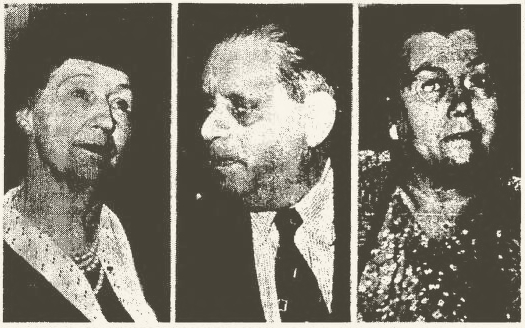
From L-R, Lillian Brummel, Samuel "For Rent" Brummel, and Norma Peppin

From L-R, Lillian Brummel, Samuel “Too Hot” Brummel, and Norma Peppin

Follow-Up Story, June 4, 1941

[LOS ANGELES, June 3, 1941] Plump little Samuel Brummel, who claims his wife rented him to another woman for $10,000, today was denied his claim to half the ”rental fee.”

Acting Superior Judge Harry Sewell granted a divorce to the Insurance man’s wife, Mrs. Lillian Brummel and ruled that the 510,000 which Brummel claimed was community, property belongs entirely to the wife.

“The astounding claim made by the husband that in effect he was rented by his wife to another woman for $10,000 and that therefore is entitled to a sham of the proceeds defeats Itself upon the very threshold of the litigation”, Judge Sewell commented.

“To be such a claim upon an alleged state of facts which are in themselves contrary to public policy; to good morals and to common decency would deprive him of the aid of any court of equity and the court would be impelled to leave this parties exactly as it finds them.”

In his testimony, Brummel said Mrs. Norma Peppin, a county employee, came to his wife and said she had fallen in love with him and wanted to “borrow— Mr. Brummel for a year and would pay $10,000 for the loan of Mrs. Brummel’s husband.

The little insurance agent said that when his wife told him of the proposal she promised that if he agreed to be loaned out as proposed by Mrs. Peppin, he could have half of the $10.000 fee.

Brummel related he agreed and Mrs. Brummel obtained a Mexican divorce, following which he married Mrs. Peppin in 1938.

Last year, however, the second, Mrs. Brummel obtained an annulment of her marriage to Brummel on grounds that the Mexican divorce obtained by his first wife was illegal.

It was Brummel, reunited by court order to his first wife, who started the divorce action and Mrs. Lillian Brummel filed a cross complaint charging cruelty.

In his complaint, Brummel listed the $10,000 paid for his rental by Mrs. Peppin as community property and asked for his half-share as had been agreed upon when he consented to marry Mrs. Peppin.

Still pending in court is a civil suit filed by Brummel against Mrs. Lillian Brummel in which he seeks control of the entire $10,000.

Source: UP via The Arizona Independent Republic, June 4, 1941, page 37.

—###—


The Amazing Crime Spree of a 14 year-old boy

Home | Rediscovered Crime News | The Amazing Crime Spree of a 14 year-old boy


I almost feel sorry for the police. This kid is like the “James Bond” of juvenile delinquents.

[November 18, 1949] A thin, wiry, 14 year-old boy who has led officers of three states on a merry chase for seven crime-packed weeks was captured today at his Texarkana home.

The boy, small for his age, launched his crime wave seven weeks ago by stealing a raccoon from the Texarkana Zoo.

Since then, officers say he has:

  1. Stolen a long string of automobiles, motorcycles and even a motor-scooter.
  2. Burglarized an ex-police commissioner’s home of $580.
  3. Escaped from officers three times. Once was a thrilling getaway from a 50-man posse when he jumped from a car handcuffed.

Tipped that the boy was back in Texarkana after escapades in Houston, Arkansas and Louisiana, detectives and policeman from Texas and Arkansas found him hiding in a closet of his home here and he surrendered without resistance. Texarkana Detective Homer Goff said the boy was “as far back in that closet as a person could get.”

Here is the boy’s crime career as outlined by officers:

He was caught and released after he had stolen the raccoon. Then, he stole two motorcycles here (Texarkana).

He was apprehended after stealing the first motorcycle but broke away from the officer who had him in custody.

On the second motorcycle, he rode to South Texas. He wrecked it and stole a motor scooter in Houston.

He visited the Houston home of his stepfather but ended the visit abruptly by stealing $58 from the home and his stepfather’s car.

He drove the car to Texarkana and abandoned it.

Then he went on to Nashville, Ark., and burglarized the home of an ex-police commissioner of $580. He also stole a couple of cars in Nashville. He went on to a town near Shreveport and stole another car.

He drove that car to Houston and parked in front of the home of an aunt. He went in the house and went to sleep. The aunt called police to come and get him, but he awakened and heard them coming. He jumped through a window and hid in the woods till they were gone.

They made the mistake of leaving the stolen car in front of the house. The boy promptly got in it and drove away.

He was next spotted in the woods near Addicks, Texas, in Harris County. A 50-man posse called for him to come out, but he didn’t. They waded into the woods and caught him. Officers in the group handcuffed him and placed him I their car and headed for Addicks.

En route, the boy opened the back door of the car with his toes and leaped out. This time, the posse didn’t catch him.

The next word of him was the telephoned tip to police here last night that he was in town. It resulted in his arrest.

Texarkana officers say they’ll turn him over to Nashville, Ark., authorities today.

[Note: Why do I get the feeling the story doesn’t end here?]

Source: AP via The Pampa Daily News, (Texas), Nov. 18, 1949, Pg. 1.

 —###—


Denver’s Capitol Hill Thug Kills 3 Women

Home | Feature Stories | Denver’s Capitol Hill Thug Kills 3 Women


This story has been removed and is now a part of my award-winning book, Famous Crimes the World Forgot: Ten Vintage True Crime Stories Rescued from Obscurity, Volume I.

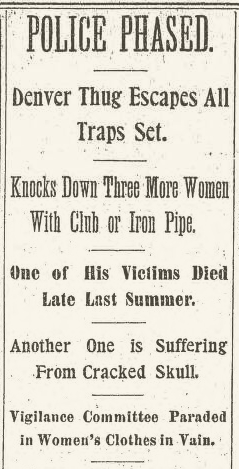
Feb24-1901-Boston-Globe-Headline

Boston Globe Headline, Feb. 24, 1901

 —###—


The Confessions of Serial-Killer “Texas Jim”

Home | Feature Stories | The Confessions of Serial-Killer “Texas Jim”


This story has been moved here:


—###—


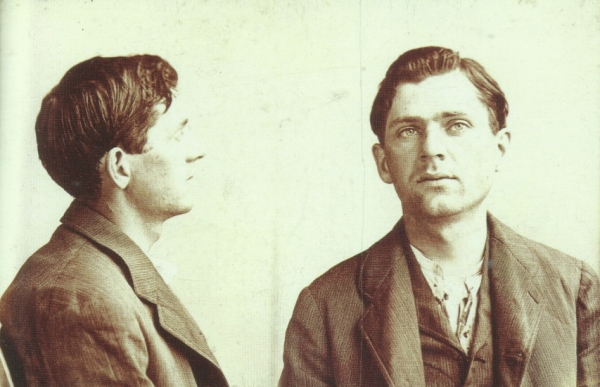
Mug Shot: President McKinley Assassin Leon Czologz, 1901

Home | Mug Shot Monday | Mug Shot: President McKinley Assassin Leon Czologz, 1901


Leon-Czologz

President William McKinley’s assassin, Leon Czologz. Click to enlarge in new window.

Forgotten President, Forgotten Assassin

In the 1890s, Leon Czologz joined the growing American anarchist movement because of what he perceived as a great injustice to the common man by the wealthy who exploited the poor to enrich themselves. He blamed government for this inequality and after reading about the assassination of Italian King Umberto I by anarchist Gaetano Bresci in 1900, Czologz decided to take matters into his own hands by killing President William McKinley.

On Sept. 6th, 1901, Czologz caught up with President McKinley at the Pan-American Exposition in Buffalo, New York and with a $4.50 revolver shot at him twice, mortally wounding the president in the abdomen with one bullet. As the crowd pounced on Czologz, President McKinley is reported to have said, “Go easy on him boys, he could not have known.”

McKinley died eight days later from an infection.

Czologz was indicted 10 days later but refused to assist his defense attorneys in his own trial which began on Sept. 23th, just 17 days after he shot the president. He was found guilty the next day and two days later, the jury fixed his punishment as death.

Leon Czologz was executed in the electric chair (a fairly new means of execution at the time) at New York’s Auburn Prison on Oct. 29th, 1901, just 54 days after he shot the president.

As he was strapped into the chair, Czologz told those in attendance, “I killed the President because he was the enemy of the good people – the good working people. I am not sorry for my crime.” However, his last words before the guards flipped the switch were ones of regret, “ I am only sorry I could not get to see my father.”

 Get the Latest Updates from HistoricalCrimeDetective.com by following us on FACEBOOK.

—###—


Father Poisons Family, Oklahoma, 1934

Home | Rediscovered Crime News | Father Poisons Family, Oklahoma, 1934


After my last post (The Andrea Yates Epidemic of 1901) I remembered reading this filicide story (a parent who kills their children) and decided to post it because it has subtle differences to it compared to the mothers in the 1901 story. The father’s excuses and story in this post seem a little “hinky.” Isn’t it always odd how the parent “tries” to commit suicide afterwards and they always seem to fail?

Chester Barrett of Sapulpa
Charged With Murder After
He Is Said to Have Made Confession.
“Family Starving,”
HIS EXCUSE FOR ACT
“I Couldn’t Bear It Any Longer,”
He Is Quoted as Saying
Five Others in Family Made Ill

[Sapulpa, Oklahoma, May 5, 1934] A father who said he “could not bear to see my family starve” was held without bond here tonight on a murder charge after three of his small children had died from poison he allegedly administered.

Sebe Christian, Creek County Attorney, said the father, Chester Barrett, 32 years old, signed a full confession after several hours questioning today. A murder charge was filed immediately. The father’s excuse for the act, which not only killed the three little girls, but endangered the lives of his wife and four of his five other children, was that he was ill and had no money.

“I have been sick for months and can’t work,” Christian quoted Barrett as saying.

Had No Money

“I hadn’t any money and my family was starving. I couldn’t bear it any longer.” The dead are Betty Jo, 6; Mary Kathryn, 3, and Wanda Marie, 2.

Mrs. Barrett and Cora Lucille, 12 Duane, 10; Mildred, 8, and Dorothy, 5, were made seriously ill, but doctors said they would recover. Barrett also took some of the poison, which was administered last night, but recovered sufficiently to be taken to the courthouse today.

He did not give any of the poison to his 7-months-old baby.

“I could not do that,” Christian said Barrett declared. “I hoped someone would find the baby and take care of her. I didn’t want her to die, too.”

The statement related, Christian said, that Barrett tried to give his family poison Monday night [April 30th, 1934], but it failed to take effect. It was administered in milk on that occasion. “Barrett said he wanted to try again Wednesday night, but lost his nerve.” Christian added.

Questioned Before Officers

Sheriff Willis Strange, Deputy Lee Snider and Police Chief J.O. Edwards sat with Christian while Barrett was questioned.

The authorities were unaware of the tragedy in the shabby little dwelling on the out skirts of Sapulpa until late last night. Barrett, staggering from the effects of the poison he took, then went to the home of a neighbor, Mrs. Clara Hugo, and told her his family was ill, apparently from food poisoning.

Mrs.Hugo called Dr. P.K.Lewis, county physician, and he hastily summoned additional medical aid.

It was too late to save the three little girls, but the others were given effective emergency treatment.

Three of the Barrett children recovered recently from attacks of measles, and Barrett said he told the family he was giving them quinine to ward off fevers. He purchased the poison on the pretext he wished to kill rats.

Editors Note: Chester Barrett was executed in Oklahoma’s electric chair on September 20, 1935.

Source: Associated Press via The Joplin Globe, May 5, 1934

—###—


The Andrea Yates Epidemic of 1901

Home | Rediscovered Crime News | The Andrea Yates Epidemic of 1901


As sad as this story is, in the course of my research for other vintage crimes I come across many similar accounts of parents murdering their children (known as filicide) due to depression, religious fervor, or other reasons. In most of these cases, poverty drives their depression. With just some light searching done of newspaper archives for 1901, I found 4 different cases.

Rosa Wurzer, Pt. 1: Crazed by Poverty, Mother Kills Her Six Babes

(Uniontown, WA, Saturday, Feb. 23, 1901) Six children were murdered by their crazed mother at Uniontown, Wash., the crime being unusual in the method employed. Mrs. Rosa Wurzer, a widow, threw her six children, two boys and four girls into a well thirty feet deep and with but two feet of water at the bottom.

Then she jumped into the well herself and ‘held the little ones’ heads under the water until all were drowned.

Neighbors found Mrs. Wurzer in the well with her six murdered children, and putting a rope around her body, drew her out. She is violently insane and is restrained with difficulty.

Mrs. Wurzer’s husband died one year ago leaving her in destitute circumstances. She has been supported by the county which allowed her $15 a month and by the charity of her neighbors. Brooding over her circumstances drove her crazy and she was determined to kill her children and herself, but the shallowness of the water in the well prevented her attempt to end her own life.

Rosa Wurzer, Pt. 2: Murderess of Six Children Makes Escape

(Uniontown, Wash., Sunday, Feb. 25, 1901) Mrs. Wurzer, the insane murderess escaped the vigilance of guards Sunday night and went to the home of Peter Jacobs and broke a window, frightening the inmates considerably and then visited the residence of Mr. Koester.

All had retired but Mrs. Koester who was sitting at a table writing a letter. Upon hearing a knock at the door Mrs. Koester asked who was there. The reply came “Please let me in I want to toll yon something.” Mrs. Koester unlocked the door and the insane visitor clad only in her night drops, seized her with both hands. Mrs. Koester screamed and ran to the room where her husband was asleep. He sprang from the bed, caught the crazy intruder and called his brother. Together they led the poor woman back to her home.

She escaped from her watchers by climbing out through the window.

Coroner Mitchell and Deputy Sheriff Hamilton arrived at the scene of the Wurzer tragedy at 8 a. m. The coroner’s verdict was that the children came to their death at the hands of the mother.

Upon preparing them for burial, fingermarks were found on the throats of all, indicating that they had been strangled before being thrown into the well. The ruddy color of the skin and the absence of the flow of water from the mouths during the preparation for laying out would seem to indicate that they were dead before being cast into the water. The necks of all except one were broken. Mary, aged 6, has a deep gash in the top of the head and a two inch cut over the left ear. In addition Rosa [not the mother] has a broken shoulder and Anna a broken thigh and arm. Besides these there are numerous bruises, probably caused by the thirty foot drop into the well.

Last evening the unfortunate little one lay in six coffins in the sitting room of what was their home.

I couldn’t find any follow-up stories on a trial/punishment for Wurzer but she may have been sent to an insane asylum.

Inflamed by Religious Frenzy, A Maddened Pittsburgh Woman Throws Children Into River

(Pittsburgh, PA, Tuesday, Feb. 20, 1901) Mrs. Maggie Deithorn, aged 26 years, walked out on the Twenty-second street bridge early today with her two children, aged two and four years, and when in the cantor of the structure quickly picked up the little ones and threw them into the Monongahela  River. Before she could follow, she was arrested. Boats put out at once and rescued one of the children, but the other was drowned. The woman was evidently demented. She told the police that the act was an inspiration from heaven.

She has been under religious excitement for several weeks and has been almost constantly praying. The boy, who was rescued, was taken to the South Side hospital. It is thought he will die from exposure. The body of the girl was recovered.

/—–/

Mother Murders Children with Morphine

(St. Louis, Michigan, Monday, May 20, 1901) Mrs. Elmer Quimby, wife of a farmer living five miles south, gave her two children, a boy of 7 and a girl of 9, two large doses and both children died early today. Mrs. Quimby took 18 grams herself but it acted as an emetic [causes vomiting]. She will recover. Family trouble is the alleged cause.

/—–/

Mother Throws Her Little Ones Into a Well and Leaps in Herself

WELL LITERALLY FILLED WITH BODIES OF DEAD

Woman Had Only Recently Been Released From an Insane Asylum as Cured, But It Is Evident Insanity Returned.

(Cleveland, Ohio, Friday, Sept. 27, 1901) At Little York, 15 miles from here [Cleveland], Mrs. Perry Curtis, wife of a farmer, today drowned her three small children in a well and then committed suicide by jumping in the well. Following are the names and ages of the dead:

  • MRS. PERRY CURTIS, 38 years.
  • ROSA CURTIS, 2 years.
  • ANNIE CURTIS, 6 years.
  • HAROLD SCUDDER, 9 years.

The latter was Mrs. Curtis’s stepson. Mrs. Curtis was released from Massillon Insane Asylum recently as cured. Eugene Roberts, a neighbor, discovered the insane mother’s crime when he attempted to draw some water from the well and to his horror found It literally filled with dead bodies.

Get the Latest Story Updates from HistoricalCrimeDetective.com by following us on FACEBOOK.

 —###—


The Story of a ‘Gangster Queen,’ 1931

Home | Rediscovered Crime News | The Story of a ‘Gangster Queen,’ 1931


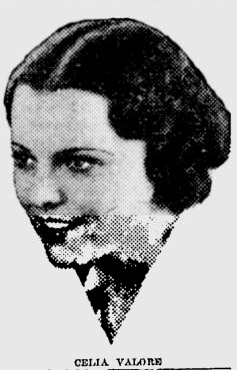
The following story is the “confession” Cecile Valore made to Cleveland authorities before she was sentenced to prison for her part in a murder. At the bottom is link a to Google News Archive page of a Sunday Edition Full Page Story about Cecile and her husband’s gang and their crimes.


Mrs. Cecile Valore Tells Sheriff that Her Husband Killed Dr. Alfred P. Scully at Cleveland Last March —Half Dozen Other Murders Cleared up by her Confession — Her Husband in Ohio Penitentiary Serving Life Term.

Cecile Valore "Ganster Queen?"

Cecile Valore “Ganster Queen?”

(CLEVELAND, OHIO Feb. 18,1931) Caught flat footed by the confession of Mrs. Cecile Valore that her husband, Ross, murdered Dr. Alfred P. Scully here last March, police and deputy sheriffs made desperate but futile efforts’ today to round up a half dozen men implicated by the woman in the Scully and other crimes.

Mrs. Valore said her husband had slain six men.

“I don’t believe she told that,” Valore said last night at Columbus where he is serving a life term for the murder of R. Miller Wilkison, Princeton student, at a Shaker ‘Heights party last fall. “If she did say it, she lied.”

Mrs. Valore made her confession public to officials and newspapers men late yesterday. It developed that she had made the same Confession to County Prosecutor Ray T. Miller a week ago.

Miller said today that it was “unfortunate she made it public at this time.”

Mrs. Valore confessed to Sheriff John Sulzmann and Criminal Court Judge Walter McMahon. The judge said that detective inspector Cornelius Cody also had known the facts for several days.

She accused her husband of the following crimes:

  • Murder of Dr. Scully [on March 3, 1930]: She said that Valore and a relative went to Scully’s office and that the doctor was slain when he resisted robbery.
  • Killing in the county jail of Anthony Colletto who was being held on charge of murder for the killing of his wife. The coroner said lie hanged himself although his attorneys insisted it was a murder.
  • Slaying of a guard at Mansfield. Another man was convicted and died in the electric chair.
  • Killing of a man in the robbery of the Blue Pig Inn here. The killing was attributed to policemen.
  • Killing of another man, in a crime the details of which she had forgotten.
  • Bombing of the homes of two Loraiu county attorneys who failed to get Valore out of trouble after accepting a fee.

The woman pleaded guilty last week to a charge of general homicide in connection with the Windsor killing.

McMahon had deferred sentence to give her a chance to tell what she knew about other crimes.

Dr. Alfred Scully

Dr. Alfred Scully

“Honest, I never took part planning a crime,’ she cried to Sulzmann, McMahon and newspaperman.

“Everything I ever did was done because I was afraid of Ross and what his people might do to my mother.”

She admitted that she was in the auto when Valore and the Ball brothers, Mike and Angelo, went to the Wilkison residence.

The woman was alternately tearful and defiant.

She sat on a woman’s bed in the women’s ward of the county jail while she told her story.

“It all proves that humanitarianism pays,” Sulzmann exulted. “That little girl said to me, ‘Sheriff you have been like a father to me and I want to confess to you,’ so we sent for the judge.” ‘

Officials decline to be quoted but they indicated they did not accept her story at full value. Six squads policemen, however, were detailed to hunt for Joe Valore, brother of Ross [her husband] who she said “knew a lot about the Scully murder.” Police were eager to question him about it.

Source: United Press

A full newspaper page follow up story to this case can be found here. Please note that to navigate this page, place your mouse on the content, left click once, and then move it where you want to go. There are also Zoom In and Zoom Out icons at the top that are labeled – and +.

Here is another link to the same story but with different pictures.

—###—