
True Crime Books by Jason Lucky Morrow

Welcome to HistoricalCrimeDetective.com [Est. 2013], where you will discover forgotten crimes and forgotten criminals lost to history. You will not find high profile cases that have been rehashed and retold ad infinitum to ad nauseam. This blog is the official website for true crime writer Jason Lucky Morrow, author of four books including the popular series: Famous Crimes the World Forgot, Volume I and Volume II. If you would like to send me a comment, Contact Me Here. - Please follow this historical true crime blog on FACEBOOK.

Blame it on the Teacher, 1964

Home | Rediscovered Crime News | Blame it on the Teacher, 1964


Summary: Student with poor grades murders one woman, injures two others including his English Tutor.

Story 1: “Tucson Youth Goes Wild, Kills Woman,” by Dominic Crolla, Tucson Daily Citizen, May 16, 1964 pages 1 and 6.

A bitter argument over his poor marks in English triggered a wild rampage early today by an enraged 16-year-old Tucson High School student which ended in the death of a woman and beatings of two other persons.

The youth, Peter B. Damskey, 3663 N. Cactus Blvd. [Tucson, Arizona], was taken into custody by sheriff’s deputies at his home where they found him peacefully asleep about a half hour after the bloody melee.

Lying near his home were the victims—the dead woman, Mrs. Margaret Agnes Eckstrom, about 50, with a butcher knife protruding from the right side of her neck; her unconscious husband, Carl, a painting contractor, and Miss Barrie Ryan, 28, a University of Arizona English instructor.

Damskey, who has been turned over to juvenile authorities, was being tutored privately in English by Miss Ryan. Both she and Carl Eckstrom are in satisfactory condition at Tucson Medical Center. Miss Ryan suffered bruises on the face and Eckstrom is being treated for facial and head cuts.

According to Sheriff Weldon V. Burr, the youth also tried to set fire to Miss Ryan’s house, at 2707 Clay Alley. Burr said the youth’s father, George B. Damskey, owner of Damskey’s Cigar Store, 131 N. Stone Ave., had told him his son had been a patient for two years at the Tucson Child Guidance Clinic.

The Eckstroms’ home is at 3625 Clay Alley. They are neighbors of the Damskeys and Miss Ryan. And they became involved when they saw the Ryan house on fire.

Sheriff’s Deputies Kenneth Chronister and Reggie Russell and Capt. James McDonald were told the Eckstroms found Miss Ryan lying outside the house unconscious.

While Mrs. Eckstrom ran back to her home to call for an ambulance and the sheriff, her husband attempted to put the fire out.

Damskey was interrogated for some two hours after being taken into custody, at which time, according to Burr, he gave this account of what had happened.

He said he had gone over to see his tutor at about 1:30 a.m. to discuss his English marks with her. She ordered him out, but he wouldn’t leave. A struggle developed, during which he shoved her and punched her with his fists.

She ran out of the door screaming, but he tackled her, tried to stifle her screams for help, and then punched her four or five more times on the face. Burr said that Damskey had stated that he then took a “stick,” later changing the description to a “club.” and then beat her unconscious.

After that, the sheriff said, the boy tried to set fire to the house by turning on the gas in the oven, and shoving a silken scarf or paper inside.

The gas ignited from the pilot,” said Deputy Russell. He managed to set fire to the drapes, some piano music and his English lesson papers.

The youth said that when Carl Eckstrom arrived he said: “You’re a Boy Scout, get this fire out.” And they both turned a garden hose on the flames and put the fire out.

Once the fire was under control, Eckstrom grabbed Damskey by the shoulders and shook him several times. The youth, whose father told Burr he had taken karate lessons, broke loose and punched Carl Eckstrom to the ground, knocking him unconscious with a blow across the face with a glass coffee pot.

The youth then went to the Eckstrom home which was locked. Mrs. Eckstrom was inside, trying to call for help as Damskey, using his elbow, smashed a glass panel in the kitchen door and gained entry to the house.

Mrs. Eckstrom grabbed a butcher knife and ran out of the front of the door. Damskey ran after her. Shortly before he caught up with her, she turned and faced him, the knife held high in her right hand, the blade pointing downward.

Damskey told Burr he feinted and she plunged down with the knife, missing him. He said he grabbed her wrist, forced her to the ground, and then twisted her wrist, her hand still holding the knife, back toward her neck.

“I twisted her wrist and drove the knife into her neck once, maybe twice,” he told the sheriff.

Burr said later there were two “good” fingerprints on the knife, but they had not yet been identified.

Damskey told the sheriff he had not handled the knife at all. According to Burr, the youth then went back to his home, got into his pajamas, hung his bloodied clothes in a closet, and then went to bed, apparently putting out of his mind completely the savage attacks.

The youth, described as about 5 feet 5 inches, slender but having heavy hands, told the sheriff’s deputies he went “mad” while arguing with Miss Ryan.

The youth’s report that Miss Ryan was awake when he went to her home conflicted with her statement that she was awakened by Damskey.

Damskey told deputies his son wanted to major in sciences, but poor marks in English apparently were holding him back. That was why he started taking lessons from Miss Ryan.

“In trying to determine his ‘likes and dislikes’ we learned that he was quite a student of the Nazis and the Third Reich. He apparently had studied the Second World War very closely, concentrating on battles the Nazis had won and lost,” Burr said.

It was through this close interest in the Nazis that sheriff’s deputies were able to extract the whole story from him. Burr said he was impressed when Cronister started speaking to him in German and demonstrated knowledge of the German’s and their battles.

Paul Charters, assistant chief probation officer here, said he had no knowledge “of any referral” on the youth before. He added that Damskey will be given psychiatric and psychological tests Monday, “although the boy has had these tests before.”

Three Years Later…

Story 2: Judge Rules Damskey Fit for Sentencing, Tucson Daily Citizen, Dec. 12, 1967, page 12.

Superior Court Judge Robert 0. Roylston ruled today that confessed teen-age slayer Peter B. Damskey is mentally fit to be sentenced for the May 16, 1969, butcher-knife murder of Mrs. Margaret Eckstrom, 50. Roylston set sentencing for 9 a.m. Dec. 22, at which time a bearing will be held concerning the nature and length of sentence.

Damskey, 19, could receive 10 years to life in prison, but his attorneys are expected to ask that he be granted probation on the condition that he go to a private mental institution.

Roylston ruled Damskey legally sane after listening to the testimony of Drs. Robert Cutts and Gabriel Cata. Both recommended that the youth be confined to a mental hospital. Cutts said Damskey is “crafty.” The doctor added: “He presents a good facade, but, in my opinion, Peter is still a sick boy.”

Cata testified that the defendant “intellectually” knows the difference between “right and wrong.” He said that “emotions” could interfere with Damskey s judgment, however.

Cata said that during an interview, Damskey talked about “going to school next year . . . which is quite unrealistic.”

The youth pleaded guilty to Mrs. Eckstrom’s murder and was committed to the Arizona State Hospital in Phoenix. He was recently released as being in “a state of complete remission.”

Story 3: Young Slayer Dies of Coronary Illness, Tucson Daily Citizen, Oct. 23, 1974

Peter B. Damskey, who was serving a 25 year-to-life sentence for the 1964 butcher-knife slaying here of a 50-year-old woman neighbor in an incident that began with an argument over poor grades, has died at the Safford Prison Farm.

State Department of Corrections spokesmen said Damskey, who was 16 at the time of the killing, died of coronary insufficiency and coronary arterial sclerosis. He also suffered from Hodgkin’s disease.

Damskey, who was 26, pleaded guilty to second-degree murder in the May 16, 1964, stabbing death of the neighbor, Mrs. Margaret Eckstrom.

A Tucson High School student at the time of the slaying, Damskey was arrested by sheriff’s deputies following a bitter argument over his poor grades in English.

The argument left Mrs. Eckstrom dead — felled by a butcher knife wound to the neck — and her husband, Carl, and another neighbor, Miss Barrie Ryan, a University of Arizona English Instructor, severely beaten. Miss Ryan had been tutoring Damskey in -English.

Formal sentencing was delayed while he was confined to the Arizona State Hospital for about three years after the slaying. In 1967, Damskey was declared sane, sentenced and transferred to the Arizona State Prison.

Three years ago, Pima County Superior Court Judge Robert 0. Roylstun ordered that the original 25-year-to-life term be predated to the’ day in 1964 he confessed to the murder of Mrs. Eckstrom.

The re-sentencing voided the 1967 sentencing date, and would have made him eligible for parole earlier.  In an interview last year, Damskey said he expected to be paroled in 1979 or 1980.

Before his transfer from the Arizona State Prison at Florence to the Safford facility, Damskey was active in prison sports and worked as a activity coordinator.

—-###—-


Mug Shot Monday! Lloyd Sampsell,
Famous California Criminal, 1920s-1952,

Home | Mug Shot Monday | Mug Shot Monday! Lloyd Sampsell,
Famous California Criminal, 1920s-1952,


 Lloyd-Sampsell-Yacht-Bandit

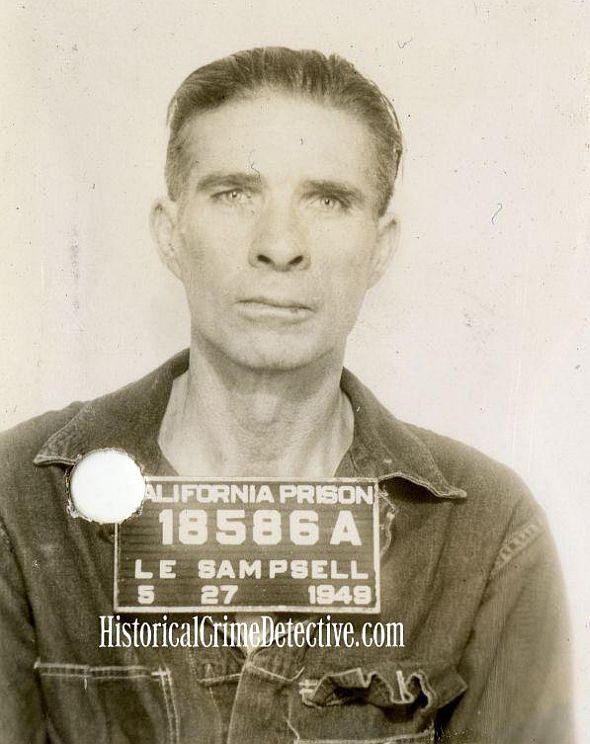
I am really proud [because of its rarity] of today’s mugshot of Lloyd Sampsell, a career bank robber whose amazing escapades spanned three decades. This is the only mugshot of him to known exist on the internet, outside of an FBI wanted circular.

From the early 1920s to 1952 Lloyd Sampsell was one of the most famous criminals in California. During the 20s, he and partner Ethan McNab robbed banks up and down the West Coast and used a yacht to make their escape and to travel from one city to the next, robbing banks along the way. This unique method of travel earned Sampsell and McNab the nickname “The Yacht Bandits,” which would follow them the rest of their lives.

He was arrested and convicted of bank robbery in 1929 and served 18 years in prison. His first stint was at Folsom where he was recognized by other inmates and prison staff as highly intelligent and was labeled an intellectual, by prison standards. Some books credit him with “running” Folsom Prison after he ingratiated himself with the warden.

During World War II, he was moved to a less secure prison farm where his power and influence grew to the point that the warden would let him take “French leave” from the camp. This meant that on Friday afternoon, he would go to his girlfriend’s apartment, and then return on Sunday night or Monday morning. When the press found out about this, the warden lost his job.

He was released in 1947 and went back to robbing banks. During the 1948 robbery of the Seacrest Finance Company, he shot and killed a clerk and wounded a policeman. This earned him a spot on the FBI’s Most Wanted List. It was his first murder and after he was captured and tried in 1949, he was sentenced to die in the gas chamber at San Quentin. While in prison, Sampsell connected with the most famous prisoner in the United States, author Caryl Chessman, and wrote brilliant legal briefs that earned him several stays of execution as his case was argued.

Eventually, he lost his battle and was executed on April 25, 1952. In an interview before he died, he pointed to what he was most proud of when it came to his legacy. “They say I’ve lived a wasted life,” he told a reporter. “But look, here’s something I’ve never told anyone. I’ve got a son. He’s six-foot-three and 170 lbs. He’s married, got two kids. He’s in the service overseas now. So I’ve left something good. You can’t say my life was wasted.”

Below is an article published the day before he was executed.

“Yacht Bandit Plea Denied by High Court,” Berkeley Daily Gazette, April 24, 1952, page two.

The State Supreme Court in San Francisco today denied the last-chance appeal of bank robber Lloyd Sampsell, scheduled to die tomorrow in San Quentin’s lethal gas chamber for a San Diego hold-up murder.

Sampsell, notorious Berkeley “Yacht Bandit” of the 1920’s, has been in the State penitentiary’s death row for three years for slaying, of Arthur W. Smith, a by­stander, during the holdup of the Seaboard  Finance Company in 1948.

He was originally scheduled to die in the gas chamber on July 21, 1950, but was granted a stay of execution on July 19 by the US District Court of Appeals.

His appeal was finally denied by the US Supreme Court on Jan. 28, 1952, and his execution was rescheduled for April 25. The tall, gaunt killer, once listed among the FBI’s “10 most wanted men,” was arrested in Phoenix, AZ, March 25, 1949, less than 24 hours after pulling his last job—the $8700 robbery of the Bank of America in Los Angeles.

Sampsell won notoriety in the late 1920’s when he and his partner,” Ethan Allen McNabb, cruised the Pacific Coast from Vancouver to Los Angeles in the luxurious yacht “Sovereign,” pulling robberies in port cities, and then putting to sea to escape capture. Their crimes included a $17,000 Berkeley bank robbery.

They were finally arrested in San Francisco in 1929 and Sampsell served 18 years in Folsom Prison for his part in the crimes. McNabb was sentenced to San Quentin where he was later hanged for killing a fellow convict.

Sampsell, who has spent more than half his lifetime behind bars and was known to have bragged that he stole more than $200,000 during his career of crime.

Check out more of our Vintage Mug Shots.

—###—


Sword & Scale True Crime Podcast, Episode 21

Home | Uncategorized | Sword & Scale True Crime Podcast, Episode 21


.
Sword-Scale-21

I’m proud to be a regular contributor to Sword and Scale True Crime Podcast where in this week’s episode Mike Boudet and I review the most incredible historical true crime story you’ve never heard about. This podcast presentation was born from a story I wrote and posted on the HCD blog last October called: Mr. Secret Agent Man: The 3X Killer of Queens, NY.

As Mike writes: One of the first documented cases of a narcissistic killer engaging the media to taunt police, the tale of 3X captured the imagination of the nation. However after the killing stopped abruptly, this story was all but forgotten… until now. With similarities to the Zodiac Killer case, this is a story you have to hear.

You can listen to the podcast of this amazing criminal here: http://swordandscale.com/sword-and-scale-episode-21/Click on the purple arrow to start the Audio MP3 player and fast forward to the 7 minute and 30 second mark.

If you’d like to read the story and view related photographs, follow this link: http://www.historicalcrimedetective.com/mr-secret-agent-man-the-3x-killer-of-queens/

—###—


The Knight Falls: The Murder of Mrs. Langfeldt, 1896, San Francisco

Home | Short Feature Story | The Knight Falls: The Murder of Mrs. Langfeldt, 1896, San Francisco


There is a great link to an 1896 article from The San Francisco Call about the case at the end of the article.

San Francisco, 1896

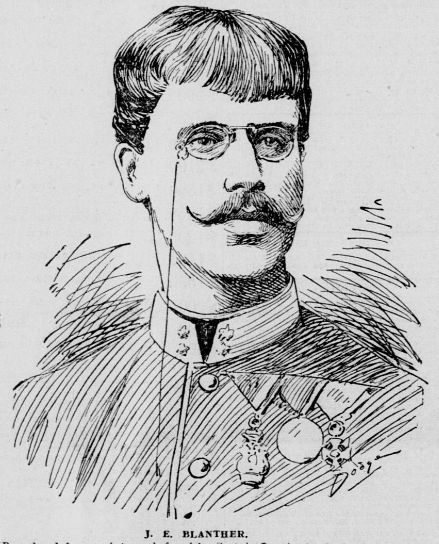
Joseph Blanther was born in Rankerburg Steirmart, Austria, in 1859. When nineteen years of age he was made a Lieutenant in the Austrian army, and a few months later, on December 12, 1878, was knighted and decorated by Emperor Franz Josef for distinguished services in battle.

Because of some peculiar transaction he retired from the army and left his native land. He arrived in San Francisco on February 2, 1896, and took up lodgings at the residence of Mr. Hogan, at 222 Haight Street. He was a liberal spender among the fair-weather friends he chanced to meet, and delighted to maintain a show of wealth.

He had been living at the Hogan residence only a short while when he borrowed $15 from Miss Hogan, at the same time obtaining $9.70 from a Mrs. Gilbert, who lived in the same house. For security he gave both ladies worthless checks on the Columbia Bank.

About this time he met Mr. C. H. Tebbs, a newspaper artist. Blanther, who had done some writing for Harper’s, and the Argonaut, and Tebbs, became quite friendly, and Blanther borrowed Tebbs’ camera. When the artist asked him to return it, Blanther made so many excuses that the Harry Morse Detective Agency was finally employed to recover it. Captain Cullenden was assigned to the case, and obtained a confession from Blanther to the effect that he had pawned the camera to a broker on Kearney Street, where it was subsequently recovered.

As Blanther claimed that he was actually starving and was forced to raise the money, Tebbs declined to prosecute him.

In 1896 an aged and decrepit old lady named Mrs. Philipini Langfeldt occupied a room at the residence of Dr. Kleineburg, at 1225 Geary Street. She, like Blanther, also loved to create the impression that she possessed much wealth, and almost constantly wore five very valuable rings set with diamonds and pearls.

Blanther remained at the Hogan home but a short time, and after a brief trip to Portland took up his residence at the home of the widow of Detective James Handley, at 828 Geary Street, four blocks from the Langfeldt home.

Lt. Joseph Blanther, former Austrian army officer and knight.

Lt. Joseph Blanther, former Austrian army officer, knight and notorious moocher.

He learned of the “wealthy” old Langfeldt lady and obtained an introduction. Notwithstanding the great differences in their ages, he paid her marked attention and made a great display of his decorations, never missing an opportunity to tell of his hairbreadth escapes on the bloody battlefield, and incidentally to refer to the honors bestowed upon him by the Emperor.

On Friday, May 15, 1896, Mrs. Langfeldt told Mrs. Kleineburg that she expected Mr. Blanther to call that evening.

While no one saw Blanther enter the house, different members of the household heard some man laughing and talking with Mrs. Langfeldt in her apartments. This person arrived about 9 p. m., and Dr. Kleineburg heard him leave at 11:10 p.m.

At 9 a. m. on the following morning a domestic servant in the house named Susie Miller took a cup of coffee to Mrs. Langfeldt’s room, but as she received no response to her knocks at the door she notified Dr. Kleineburg.

Officer Thomas Atchison was called and he broke in the door. In the middle of the floor was the body of the old lady, her head almost severed from the body, evidently by a razor. As might be imagined, everything near the body was saturated with blood.

Captain of Detectives Lees was called and he found drops of blood in remote corners of the room, which convinced him that the assassin had probably cut one of his hands in cutting the old lady’s throat. The five rings which she wore were stripped from her fingers, and the apartments were rifled. Suspicion at once fell on Blanther.

Mrs. Handley, his landlady, was visited, and she stated that Blanther arrived home on the preceding evening at 11:20, ten minutes after Dr. Kleineburg heard Mrs. Langfeldt’s visitor leave. She stated that he went to the bathroom, and while she heard him leave the house on the following morning at 6 o’clock, an unusually early hour, he did not sleep in his bed during the night.

J. E. Lynch, a roomer in the same house, stated that he saw Blanther leave the bathroom about 11:30 on the preceding night, just as he entered it, and noticing crimsoned water in the bottom and on the sides of the basin he concluded that Blanther had a “nose bleed” or had cut his hand.

Architect George Dodge came forward and made a statement substantially as follows:

“I became acquainted with Blanther when he resided at Mr. Hogan’s home on Haight Street. I saw him on Friday evening, the night of the murder, and he was despondent. He informed me that he had just pawned his overcoat, and if he did not get some money somewhere he would commit suicide.

“When he left me at 8:15 p. m. he told me that he was going to visit a friend on Geary Street.

“On the following morning he appeared at my office at 9 o’clock, an unusually early hour, and pretended to be in high spirits. He seldom wore gloves, but on this morning he wore a maroon colored glove on his left hand, even while rolling a cigarette.

“Many weeks ago Blanther told me that while at the racetrack one day he met a lady named Mrs. Genevieve Marks, who resided with a Mrs. King, at 427 O’Farrell Street. He said that this lady had valuable diamonds upon which she desired to borrow some money, and he asked me if I could procure a loan on them. I replied that I thought I could, but that I would require a written authorization from Mrs. Marks.

“On Saturday morning he delivered two unset diamonds to me with the following note:

‘Mr. J. Blanther: I hereby authorize you to borrow money on collateral security given to you by me, consisting of diamonds.   — GENEVIEVE MARKS.’

“After reading the letter of authorization I felt reassured and returned it to Blanther. I then went with Blanther to a money lender named Henry Lacey, who loaned me $100 on the stones.

“Blanther did not enter Lacey’s office, but remained outside. As I had business in Alameda, and as Blanther told me that he was going to Oakland, thence to San Jose to meet Mrs. Marks, we rode across the bay together.

“As he pulled out several cigars during the morning I playfully opened his coat and looking at the pocket where the cigars were kept, I laughingly said : ‘You must have beat the slot machines.’ When I opened his coat I noticed a razor in the pocket with the cigars. I now recall that Blanther did not appreciate my little joke.

“He left the local train at Seventh and Broadway streets, and said he would see me the next evening.”

Mrs. Marks made a statement substantially as follows :

“It is true that I know Blanther, and he called at my home many times. I have several diamonds, and Blanther annoyed me with the interest he took in them and the questions he asked regarding their value.

“The man became obnoxious to me, so I suggested to him that it would be better if he ceased to call, and I notified Mrs. King, my landlady, that thereafter I was not at home if Mr. Blanther called.

“I have not seen him for weeks, and yesterday, the day I was alleged to have made an appointment for a meeting at San Jose, I was sick in bed at home.

“I never asked Blanther to hypothecate any diamonds for me nor did he ever have any of my jewelry in his possession.”

Mrs. King, when questioned, corroborated Mrs. Marks’ statement.

Henry Lacey, the money lender, was interrogated, and he produced the diamonds received by him from Mr. Dodge.

Mrs. Kleineburg identified them as being exactly the same as those in Mrs. Langfeldt’s rings.

Francis Korbel, the Austrian Consul, was called in to examine Blanther’s medals, decorations and papers, and he stated that they were undoubtedly genuine and added that Blanther was not only an officer in the Austrian army, but a Knight in several imperial orders.

Captain Lees had positive information that Blanther boarded train No. 19, bound for Los Angeles, which left Sixteenth Street, Oakland, at 5:30 p. m., on the day the body was found. Blanther purchased a ticket to Martinez on the train, but when he reached Port Costa he purchased a ticket to Los Angeles, and continued his journey on the same train. He attracted general attention because of the fact that he wore maroon colored gloves at all times, even when eating his meals.

Captain Lees telegraphed to the Los Angeles authorities to apprehend him at the train, but through some misunderstanding the officer arrived ten minutes too late.

It was subsequently learned that Blanther procured the ticket under the name of Forbes.

Captain Lees then decided to flood the country with circulars containing a picture of Blanther, but only two pictures of the fugitive could be found. One was taken in his military regalia when he was scarcely a man, and while the other picture, which was unmounted, had been a good likeness, it had faded so that it was useless for copying purposes. It was turned over to Theodore Kytka, the handwriting expert, who observed that it was printed on solio paper. As this kind of paper had only been in use for this purpose for two years, it was easy to conclude that the picture had been taken within that time. Because of the modeling of the shadows on the face, Kytka concluded that it was printed in some well-equipped gallery. He obtained Captain Lees’ consent to communicate with the police departments and the Pinkerton agencies throughout America, who were requested to visit all photograph galleries and ascertain if Blanther or “Forbes” had within the last two years sat for a picture, and if so to procure the negative.

The Pinkerton agency located the negative in Brand’s gallery in Chicago, and it was forwarded to Kytka, who removed the retouching, to make the picture look as natural as possible.

A good picture and description of the fugitive was then sent to the Chicago Detective, a paper of wide circulation, with instructions to publish the same.

On March 2, 1898, the county assessor came into the sheriff’s office in a little town in Texas and saw Blanther’s picture, taken from the Chicago Detective, pasted on the wall.

He said: “Hello, who is this?” The sheriff gave him the desired information. The assessor then said: “Well, if that ain’t the picture of Archibald Forbes our schoolmaster over at Koppearl, I am very much mistaken.”

The more he studied the picture the more convinced he became. Finally he persuaded the sheriff to accompany him to the school.

After interrogating “Forbes” the sheriff decided to take him into custody. As he did so the schoolmaster attempted to draw a pistol, but he was overpowered and placed in the jail at Meridian, Texas, pending a further examination, which proved conclusively that he was Blanther.

Detective Ed. Gibson was sent after him, but Blanther had probably been prepared for nearly two years for such an occasion, as he had cyanide of potassium concealed under the band of his hat, and the jailers found him dead in his cell.

From the book: “Celebrated Criminal Cases of America,” by Thomas Samuel Duke, The James H. Barry Company, 1910.


Read More: The San Francisco Call, May 19, 1896

—-###—-


Mug Shot Monday! Roy Gardner, 1884-1940

Home | Mug Shot Monday | Mug Shot Monday! Roy Gardner, 1884-1940


Roy Gardner, Bank Robber, Escape Artist

Roy Gardner, Bank Robber, Escape Artist, Author


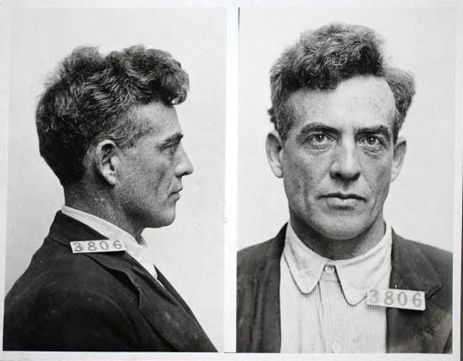
Roy G. Gardner (January 5, 1884 – January 10, 1940) was once America’s most celebrated outlaw and escaped convict during the Roaring Twenties.

During his criminal career, he stole over $350,000 in cash and securities. He also had a $5,000 reward placed on his head three times in less than a year during his sensational career. He was the most dangerous inmate in the history of Atlanta Prison and he was dubbed by the newspapers across the West Coast as the “Smiling Bandit”, the “Mail Train Bandit”, and the “King of the Escape Artists.” He was one of the most notorious offenders within the Federal Bureau of Prison system, one of the most notorious inmates at Alcatraz and one of the most ruthless criminals in American history.

Gardner is said to be the most hunted man in Pacific Coast history. While legend has it that he was the first to escape the McNeil Island Federal Penitentiary, this has been confirmed to be not true. The first escapes from McNeil Island occurred before Gardner was even born, and, by the time of his imprisonment, several dozen inmates had made their escapes. McNeil Island, in fact, was the only Federal Penitentiary never to have a wall and was never considered a maximum security facility.

Gardner was the “Most Wanted” gangster of 1921.

He is now largely forgotten for his daring acts. No longer the household name that he was in 1921, he never lived as an outlaw on the Western frontier, was never a Depression Era gangster, and was never in a gang, all things that may contribute to him being largely forgotten in modern times. He was a lone wolf and his reputation and notoriety made him a touchstone of his time.

Gardner published his autobiography, “Hellcatraz”, a sensational book that contains not only descriptions of his interesting life but also such familiar names as Al Capone. He attended crime lectures, and he and Louis Sonney made one of the first re-enactments on a short film called, “You Can’t Beat the Rap”. The ex-convict landed a job as a film salesman and an exposition barker. A 1939 movie called “I Stole A Billion” was based on his life. The movie was a failure.

On the evening of January 10, 1940, Gardner wrote four notes at his hotel room in San Francisco, one of which was attached to the door warning: “Do not open door. Poison gas. Call police.” He sealed the door from the inside, then killed himself by dropping cyanide into a glass of acid and inhaling the poison fumes.

Source: Wikipedia, Creative Commons

Check out more of our Vintage Mug Shots.

Read More:

http://en.wikipedia.org/wiki/Roy_Gardner_%28bank_robber%29

http://www.legendsofamerica.com/az-treasures9.html

—###—


Feature Story Comes to Life

Home | Rediscovered Crime News | Feature Story Comes to Life


This is amazing and I wanted to share it with everyone. Its one of the great things that happen when you have a blog like this one. Back in March, I posted a story from the October, 1930 issue of True Detective Mysteries that I titled, “The Baby Snatcher.” It was the story about an incident in 1924 where an older, middle-aged Philadelphia woman, Mary De Marco, fooled her Italian husband into thinking she was pregnant, and then kidnapped a baby to make good on her lie. The baby she kidnapped was Corrine Modell. Detectives were able to track down the woman with the help of a street-wise prostitute who sincerely wanted to help and did so without accepting the combined reward of $3,000.

Well, that baby is now 90, and we were contacted by her daughter. Five years ago, for mother’s day, one of her children contacted a local TV station who did a story on the case.

Here’s the video

Read more about this interesting story here: http://www.historicalcrimedetective.com/the-baby-snatcher-1924/


Pistol Packin’ Mama

Home | Feature Stories | Pistol Packin’ Mama


Originally Titled: “Fiendish Plot of the Pistol Packin’ Mama,” by Jack Harrell, Front Page Detective, March, 1944.

Note: This full-length feature story lacks clarity in some passages, but if you power through, it all comes together in the end.

Wyoming, July, 1934

LIKE MANY ANOTHER successful city businessman, Sewell Combs—”Charlie” to his friends—hankered for life in the country. Fortunately he lived where his desire to be in the open could be indulged, in Casper, Wyo.

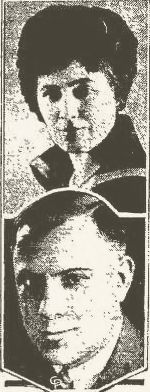
Hazel & Sewell "Charlie" Combs of Casper, Wyoming

Hazel & Sewell “Charlie” Combs of Casper, Wyoming

Some 50-odd miles south of that central Wyoming city he owned a ranch to which he retreated when he could free himself of the demands of a prosperous law practice. Life out there, he felt, not only was good for his soul but greatly benefited his physical condition. His lungs still showed traces of tuberculosis he had contracted in the Midwest years earlier, although the vitalizing, dry climate of the West had all but eradicated the disease.

Combs and his wife arrived at the ranch house early in the evening of July 10. Bill Satterlee, a tall, powerfully built young man, ambled toward the lawyer’s sedan from one of the outbuildings, waving a cheery greeting. Bill’s two young nieces ran shrilling from the house where Grandma Satterlee stood smiling in the doorway, wiping her hands upon her apron.

These were the only inhabitants of the ranch in the absence of the owner. Bill was the caretaker, and his mother and his brother’s children lived with him. There would have been room for no more. The ranch house was small, having only a combination kitchen-living room and two bedchambers.

Consequently Joe Ludwitz, a handyman whom Combs frequently employed in Casper, and who had ridden out in the back of the sedan to help with the haying on the ranch, had to sleep in a small cabin on the creek, perhaps a mile from the main buildings.

It was some time after 11 P.M. when Combs and his wife retired to their bedroom. Grandma Satterlee already was in bed in the other chamber with the children, and Bill had made up his bunk on a cot in the main room of the ranch house.

The breeze which rustled the plain curtains at the windows and scented the bedroom with the odor of sage was dry and hot. The lawyer paced across the floor twice, then spoke casually.

“I believe I’ll drive down and get a cold bottle of beer from the creek,” he said. “I’d like to see Joe a minute, anyway.”

His wife looked at him, a peculiar foreboding in her eyes. “Charlie,” she murmured, “please don’t . . .”

“Now, Hazel,” he interrupted, “don’t worry. I’ll watch myself. Just one bottle, no more.”

Click Here To Read The Rest of the Story


We have a lot of other full-length feature stories here that you can download and read later.


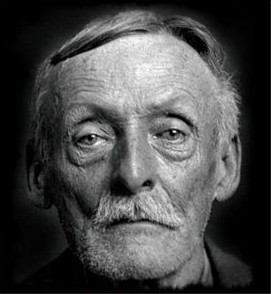
Albert Fish Photo Gallery

Home | Uncategorized | Albert Fish Photo Gallery


This page is currently being updated. Please check back again soon.

Albert-Fish


—###—


Mug Shot Monday! Armando Cossentino, 1962

Home | Mug Shot Monday | Mug Shot Monday! Armando Cossentino, 1962


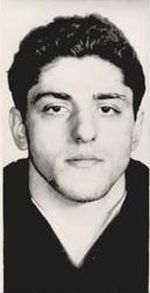
Armando Cossentino

Armando Cossentino

In 1962, Queens County, New Yorker Armando Cossentino, 19, and his 36 year-old lover, Jean Difede, murdered her physician husband, Dr. Joseph Difede in order to collect on his $72,000 life insurance policy. They were arrested not long after and went on trial early that summer. Armando was sentenced to die in the electric chair while Jean, a mother of 2, got 20 years. When the sentence was announced, she screamed out, “If I have to spend 20 years in jail I’d rather be dead!”


His death sentence was commuted to life in prison in the 1970 by Governor Rockefeller. He was paroled sometime in the 1990s.

A little more information can be found here:
http://ow.ly/xjy3M and here, http://ow.ly/xjyCw

Check out more of our Vintage Mug Shots.

—###—


For No Good Reason

Home | Feature Stories | For No Good Reason


On the morning of April 1, 1935, at 3:55 o’clock, Patrick Murray, a subway conductor on the Brooklyn-Manhattan Transit lines, arrived home from his night’s work. As soon as he entered the hallway of the two-story frame dwelling on Marine Avenue, Brooklyn, he noticed something unusual—the light in the hallway had not been extinguished.

It is customary in most homes to leave a light burning at night when someone is still out. But Murray’s landlady, sixty-eight-year-old Nora Kelly, who lived on the ground floor with her dog Brownie, had to count every penny. She had no source of income other than the thirty dollars a month she received as rent from the Murrays, so she always turned out that hall light when she retired for the night. Murray, long a night worker accustomed to finding his way around in the dark, was surprised.

“The old woman would have ‘a fit if she saw the light burning in the morning,” he remarked to himself as he switched it off. Then he climbed the stairs to his own apartment, which he occupied with his wife, Helen, and their four-year-old daughter, Eleanor.

Murray was undressing for bed when he became conscious of a second unusual circumstance. Mrs. Kelly’s dog, a cross-bred collie, was howling mournfully in the back yard. This puzzled the conductor much more than the light. He knew it was the landlady’s habit, every night, at ten o’clock, to unleash Brownie from his kennel in the yard and take him into the cellar. Murray decided that Mrs. Kelly had gone visiting and failed to come home. That would explain both the light and the fact that the dog had not been taken in for the night. Surely if she were home she would long since have heard Brownie’s barking.

“I never knew her to neglect him like this before,” he muttered. “It’s a strange thing indeed for a woman like Mrs. Kelly.”

Several more howls proved too much for him. He pulled on his trousers and a sweater, procured a pocket flashlight, and then tip-toed downstairs. The dog’s cries thinned out to a whimper as he approached. Murray noticed that the seven-foot length of rope which leashed Brownie to the kennel had become frayed from his incessant leaping efforts to get loose. He was quivering and panting with impatience as Murray untied him. This, too, struck the man as unusual, for the dog showed neither relief nor gratitude but only a desperate urgency, as though he were needed somewhere and must get there.

He pulled Murray around to the front door, his claws digging frantically into the gravel walk.

Click Here To Read the Rest of the Story

.