
True Crime Books by Jason Lucky Morrow

Welcome to HistoricalCrimeDetective.com [Est. 2013], where you will discover forgotten crimes and forgotten criminals lost to history. You will not find high profile cases that have been rehashed and retold ad infinitum to ad nauseam. This blog is the official website for true crime writer Jason Lucky Morrow, author of four books including the popular series: Famous Crimes the World Forgot, Volume I and Volume II. If you would like to send me a comment, Contact Me Here. - Please follow this historical true crime blog on FACEBOOK.

Mug Shot Monday! Anton Woode, 1892

Home | Mug Shot Monday | Mug Shot Monday! Anton Woode, 1892


Additional information  for this article was provided by John Johnson.
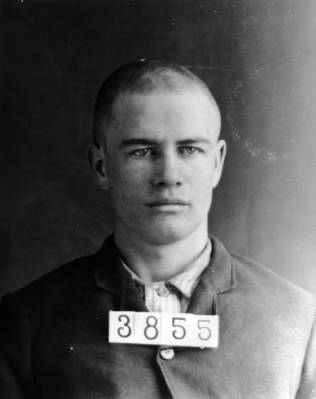
 

Anton Wood, 11 year-old psychopath almost hanged for murder, age in photo 12. (Maybe? I have doubts I can’t prove.)

In November of 1892, young Joseph Smith was hunting with Anton Woode, 11, on the Woode family ranch near Denver when he was shot in the back and killed by Woode. When Anton was arrested, he immediately confessed and told authorities he shot Smith because he envied the boy’s gold watch and chain.

Woode’s first trial ended in a hung jury when the jury couldn’t come to a unanimous decision on the boy’s sanity.

During his second trial, however, he was found guilty of second-degree murder on March 24, 1893 and sentenced to 25 years to life in prison, or just 25 years, (the newspaper accounts differ). His insanity defense was supported by testimony from a doctor who concluded that because Anton drank coffee, as a boy, it likely lowered his “mental constitution,” leading to his “insanity.”

The following article details Anton Woode’s reaction over hearing the guilty verdict.

DENVER, COLO, special: Anton Woode, the 11-year-old murderer of Joseph Smith, was convicted of murder in the second degree. The Jury was out sixteen hours and little Anton came near being sent to the gallows. The stubbornness of one juryman saved him. When the verdict was read in court, Anton wept. He thought the verdict meant hanging for him, and he expressed his regret for not murdering Smith’s two companions that were with him on the day that Smith was killed.

Little Anton looked viciously at Alexander Pecker, the principal witness against him, and said: “If I had plugged that [obscenity] nobody would know nothing about the thing at all.” The lad was then taken to the sheriff’s office, and the first thing that attracted his attention was the rogues’ gallery. He called the sheriff over, and, pointing to the photographs of the dead body of a desperado dangling from a telegraph pole, said: “I suppose that’s what you going to do with me? Well, I’ll fool you.”

The sheriff assured the lad that he would be only confined in jail. This satisfied him. The idea of getting enough to eat and having no work to do tickled him.

“In the West,” The Farmer’s Leader, Canton, South Dakota, March 31, 1893, page two.

He may have been wrong about having no work to do. Another source reported that Woode was sentenced to 25 years of hard labor.

On January 23, 1900, Woode and three other convicts escaped from the Colorado State Penitentiary Canon City after one of the men, Thomas Reynolds, stabbed to death a captain of the guards. The four men split up into two groups, and Woode and his accomplice, Kid Wallace, were captured two days later. Reynolds was captured one day after Wallace and Woode. When a posse was leading Reynolds back to the prison, an angry mob followed and snatched Reynolds when he was just outside prison walls.

Reynolds, who knew what was coming, told his captors: “If they start to make trouble for me up there, just put a bullet through me. I don’t want to be hanged.”

Nobody put a bullet through him and the mob lynched him instead. The fourth man in the escape, Bill Wagoner, was rumored to have been lynched but this went unconfirmed by newspapers from that era.
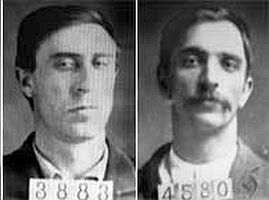
 

Reynolds-WagonerThomas Reynolds & C.E. Wagoner

Special Thanks to John Johnson of Colorado.

—###—


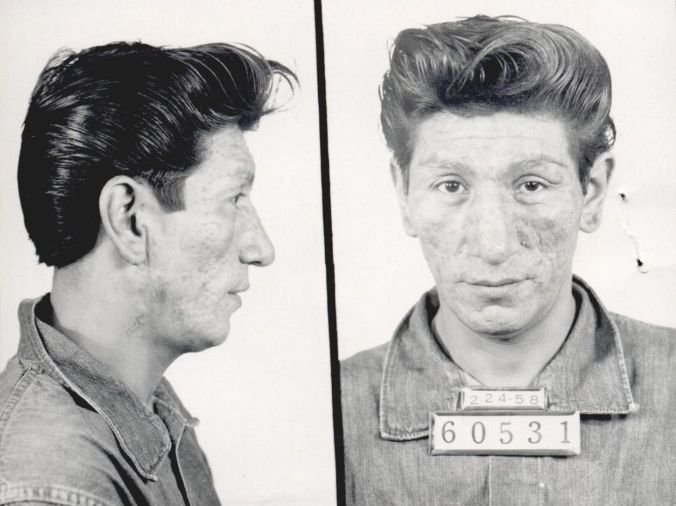
Mug Shot Monday: Nathan Jerry Ellis, 1956-1986

Home | Mug Shot Monday | Mug Shot Monday: Nathan Jerry Ellis, 1956-1986


Nathan-Jerry-Ellis

This unfortunate face belongs to Nathan Jerry Ellis, killer and rapist.

In 1956, Ellis and another man were convicted for the murder of Victor Quick in Custer County, Oklahoma. He was sentenced to life in prison for first degree murder. He appealed, received a new trial, and was re-sentenced to serve sixty-years for manslaughter. In a era of long prison sentences and early paroles, sixty years in his case actually meant eleven years. He was paroled in 1967 but was back in prison two months later for violating the terms of his release. While he was out, he racked up several minor alcohol offenses and also tried to molest a fifteen-year-old girl.

He was given a second chance for parole in March 1974. This time, he was able to stay out of prison for two years but was returned again for parole violation after he was convicted of a simple assault charge and other minor offenses.

Ellis got another chance for parole in 1979. During his parole hearing, which was called to consider Ellis’s request to attend to his ailing mother, the forty-nine-year-old was cautioned about drinking. Ellis responded with a promise that this was the last time they would ever see him and stated: “I feel 21 years is sufficient time to do on this crime.”

The parole board agreed and he was released.

On July 12, 1985, Ellis broke his promise to the parole board when he was arrested for driving under the influence. He was not sent back to prison and instead, the fifty-six-year-old was arrested the following May for first-degree rape. In that case, he duped a mentally-handicapped woman into going to a motel with him where he raped her with a sexual-aid device. A jury found him guilty and recommended a sentence of 300 years.

The photo above appears to be from his 1958 retrial.

Photo Credit: [Photograph 2012.201.B0357.0256], Photograph, March 24, 1971; (http://gateway.okhistory.org/ark:/67531/metadc215226/ : accessed January 05, 2015), Oklahoma Historical Society, The Gateway to Oklahoma History, http://gateway.okhistory.org; crediting Oklahoma Historical Society, Oklahoma City, Oklahoma.

—###—


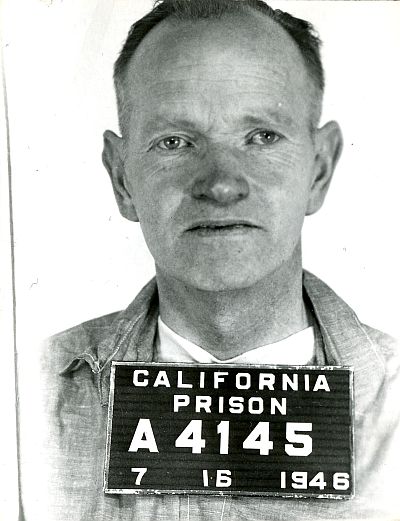
Mug Shot Monday! Arthur Eggers, 1946

Home | Mug Shot Monday | Mug Shot Monday! Arthur Eggers, 1946


Arthur Eggers, Courtesy of California State Archives

Arthur Eggers, Courtesy of California State Archives

Today’s mug shot is taken from “Famous Crimes the World Forgot.” This is Arthur Eggers. In 1946, he was a cuckold who got tired of his younger, dominant wife running around on him. He was coming home late one night when he caught sight of his wife’s lover leaving the house. When he went inside, he found her naked in bed enjoying the afterglow – or whatever you call it. Arthur then grabbed his gun and was going to chase after the man but his wife got in the way and the two fought. During the struggle, the gun “accidentally” went off. He then cut off his wife’s head and hands and dumped her body out in the San Bernardino Mountains near Los Angeles. Although they found the torso, her head has never been located and no one is really sure what happened to it.

The complete story of how he did it, how he tried to get away with it, his wacky behavior, the trial, and his final outcome, are all in the ebook.

If you are inclined to look at gruesome pictures, a photo of his wife’s torso can be found on Google Image Search: Keywords = “Dorothy Eggers.” It’s not a pretty sight and this is my caution/warning.

—-###—-


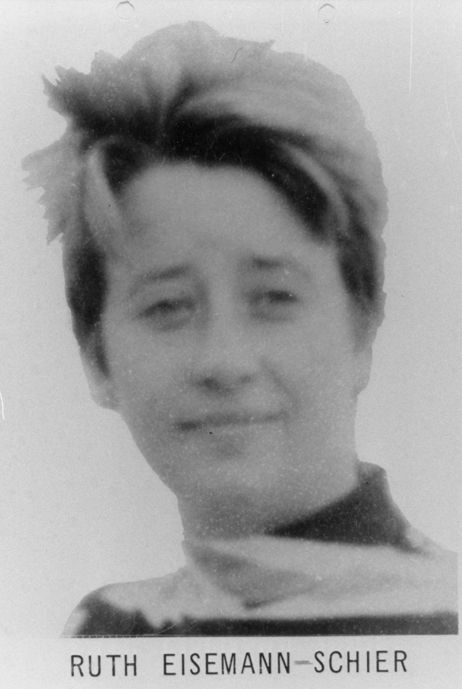
Mug Shot Monday! Ruth Eisemann-Schier, 1968

Home | Mug Shot Monday | Mug Shot Monday! Ruth Eisemann-Schier, 1968


On December 28, 1968, Ruth Eisemann-Schier became the first woman to claim a spot on the notorious FBI Most Wanted list when she and her then boyfriend, Gary Stephen Krist, kidnapped the daughter of a millionaire and demanded a $500,000 ransom. RuthEismannSchier

The 26-year-old and her boyfriend buried Barbara Mackle outside of Atlanta in a coffin with ventilation tubes and a little food. Mackle was found buried in the shallow grave 80 hours later, unharmed. Krist was arrested on December 20, 1968 for the Mackle kidnapping, while Schier, who had separated from Krist after a botched initial attempt to collect the ransom, escaped. She was later apprehended in Norman, Oklahoma, on March 5, 1969, 79 days after the kidnapping, where she was pretending to be a 19 year-old college student at the University of Oklahoma.

She pleaded guilty and was sentenced to seven years in prison. Schier served four years of her sentence and was paroled on condition of deportation to her native Honduras.

While Schier was in prison, Gene Miller, in collaboration with Mackle, wrote about the crime in their book 83 Hours Till Dawn, which later became a movie by the same name. Schier’s case was one of many covered in the 2002 book Mistresses of Mayhem: the Book of Women Criminals.

Ruth till lives in Honduras. She has a Facebook page which was last updated on May 14, 2013, by the time of this post.

Gary Krist served ten years, received a pardon so he could become a doctor, lost his license, and was arrested in 2006 for trying smuggle aliens and cocaine into the country on a private boat he had chartered.

Barbara-Mackle

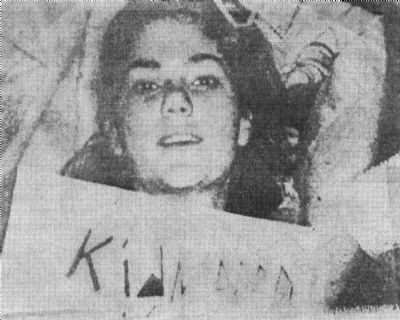
Barbara Mackle “proof of life” photo taken when she was kidnapped.


—-###—-


Serial Killer ‘Texas Jim’ Baker, Part Two

Home | Feature Stories | Serial Killer ‘Texas Jim’ Baker, Part Two


.

Click Here to Read Part OneOr Click Here to Read All in One with Bibliography

The Investigation

After Baker left, the two men loosened their ropes and discovered Gaw’s body while searching for a telephone to call police. Detectives and lab supervisors were able to piece together that Gaw’s killer must be a former employee because he knew where to find the cash box and where the poison was secured. For some reason, the killer did not take Gaw’s money, nor did he remove the valuable platinum bars the lab stored which were worth thousands of dollars. They were also able to quickly deduce that Gaw was killed with poison, which was odd since Mayhew and McCauley said the killer had a gun. Detectives wondered why did he use poison instead of a gun.

After the two drivers described the man that robbed him, lab supervisors were able to narrow that down to three men, one of whom was Jim Baker. An employee photograph of Baker was used to make a positive identification with the truck drivers.

When police searched Jim Baker’s room that morning, they were horrified to learn what kind of man they were dealing with.

“Convinced by their discoveries in Baker’s room that they are dealing with a psychopathic case—the police began the nationwide distribution of circulars containing Baker’s photograph and description, as well as a warning that he is a dangerous man known to be armed with a dirk and a pistol,” the New York Times reported the day after the murder. Like most newspapers during for that era, the Times maintained a certain decorum for their readers. Some of the more delicate topics of humanity were off-limits, and if they couldn’t be avoided, they used code-words the general public understood. What the Times didn’t tell their readers was that in addition to being a psychopath, Jim Baker was a sexual sadist. A 1937 detective magazine had no such problems reporting on what police found in his apartment.

“Vials of deadly acids stood in rows on a shelf. A large bottle, falsely labeled, contained cyanide of potassium. There were ingredients for manufacturing prussic acid, one of the most virulent of poisons. Several notebooks in Baker’s handwriting gave details about the effects of various toxins. Other jottings dealt with abnormal sex psychology, the emphasis being on sadism and flagellation rather than on homosexuality. Indeed, the youth’s passion for women manifestly was second only to interest in poisons. Prints of nude girls lined the walls, and a sketch book was filled with obscene drawings by himself. He had hoarded scores of letters from women, with many lascivious passages being underlined in red.”

Police claimed they discovered enough potassium cyanide in his room to kill 100,000 people. It was a discovery that seemed to negate Baker’s claim that he had to return to the laboratory to steal more poison—unless he was planning mass murder on a level that would have been history making. It was just the kind of thing a narcissistic psychopath seeking infamy might plan.

Read more »


Mug Shot Monday! HCD Video

Home | Mug Shot Monday | Mug Shot Monday! HCD Video


:

Music:  “Nobody’s Fault but Mine” – Blind Willie Johnson, 1897-1945.

I thought this recording, which was done around 1927, would go great with 10 vintage mug shots of prisoners from McNeil Island Federal Penitentiary taken between 1899 to 1911. I put this together over the weekend. The lyrics are posted below.


Nobody’s fault but mine,
Nobody’s fault but mine
If I don’t read it my soul be lost

I have a bible in my home,
I have a bible in my home
If I don’t read it my soul be lost

Mmm, father he taught me how to read,
Father he taught me how to read
If I don’t read it my soul be lost, nobody’s fault but mine

Ah, Lord, Lord, nobody’s fault but mine
If I don’t read it my soul be lost

Ah, I have a bible of my own,
I have a bible of my own
If I don’t read it my soul be lost

Oh, mother she taught me how to read,
Mother she taught me how to read
If I don’t read it my soul be lost, nobody’s fault but mine

Ah, Lord, Lord, nobody’s fault but mine
If I don’t read it my soul be lost

And sister she taught me how to read,
Sister she taught me how to read
If I don’t read it my soul be lost, nobody’s fault but mine

Ah, mmm, Lord, Lord, nobody’s fault but mine
If I don’t read it my soul’d be lost, mmm

Blind Willie Johnson on Wikipedia

—-###—-


Serial Killer “Texas Jim” Baker, Part One

Home | Feature Stories | Serial Killer “Texas Jim” Baker, Part One


This is part one of a two part story that is 9,500 words long.  A all-in-one post is available here.


Author’s Note: “Texas Jim” Baker was a serial killer who used poison and pistols to murder nine men around the world between 1924 and 1929. After he was captured in February, 1930, for the murder of a chemical laboratory employee, Baker bragged about these murders “with lip-smacking gusto” during several confessions to investigators and newspaper reporters. He thrived on the attention he received and often embellished his life story and the murders by describing them with overtly gruesome details meant to shock his listeners into thinking he was a special kind of monster. By doing so, Baker also hoped to increase his celebrity criminal status and gain more attention for himself. Several months after he was sentenced for one of his murders, International Features Syndicate paid him to write his autobiography. The story they published was filled with lies, half-truths, self-pity and Baker’s trademark overstated joy he felt while poisoning his victims. Through my research of New York newspapers, and five true crime magazine articles published after his trial, I believe I have separated fact from fiction as well as anyone could. Below, Baker’s “autobiography” is followed by facts gleaned from the investigation and his incarceration as reported by New York newspapers.

Wednesday, February 19, 1930

The Detroit detectives scrutinized the young man in front of them and didn’t know whether to believe him or not. If the story he told them was true, then twenty-four-year-old[1] James Baker was one of the worst mass murderers[2] they’d ever seen. He seemed arrogant, almost as if he was bragging about his confession to poisoning eight men around the world. They were used to liars in their line of work, but if “Texas Jim” Baker was a liar, he was one of the biggest. However, the liars they knew avoided specifics. They lacked details. All the made-up stories prisoners told were meant to get them out of trouble, not sent to the electric chair.

The confession Baker told them was rich in detail.

His claim to killing seven other men was news to them but they were sure they had the right man for the 1928 poison slaying of Henry Gaw, an employee at the Guggenheim Metallurgical Research Laboratory in New York City on the morning of December 28. His photograph, description, and tattoos on his right forearm matched the James Baker that New York City police were hunting the last fourteen months. However, since Texas Jim hadn’t killed anyone in Michigan that they knew about, this homicidal maniac was New York’s problem, not theirs. And as soon as he could be extradited, they would have to deal with him.

 Cropped-Jim-Baker-on-Train

Texas Jim Baker, 1930

Read more »


Mug Shot Monday! Opium Smuggler Wesley Sischo, 1918 and 1935

Home | Mug Shot Monday | Mug Shot Monday! Opium Smuggler Wesley Sischo, 1918 and 1935


:

Wesley-L-Sischo Opium Smuggler, 1918 & 1935

Wesley Sicho’s 1918 Federal Mug Shot

Wesley Leroy Sischo was a former maritime customs agent who decided it was more profitable to work on the other side of the law. During World War I, he began working with a Seattle Chinese gang to smuggle opium into Washington State.

As the captain of a small coastal vessel, it was his job to sail out and pick up floating packages of opium that were dropped a few miles offshore by ships arriving from Asia. He would then bring the drugs the rest of the way to shore and load them into trucks.

In early 1918, he was caught trying to smuggle opium into Port Townsend, Washington. Instead of charging him with narcotics smuggling, the federal prosecutor in his case charged him with failure to declare on his customs claims document that he had opium on board. Sicho was convicted and sentenced to two years in federal prison.

However, and this is where the story gets interesting, Sischo appealed his conviction with the legal argument that he was not required to declare the opium since it was an illegal substance. The Ninth Circuit Court of Appeals agreed and overturned his conviction.

Outraged, the federal prosecutor took the case to the United States Supreme Court which reversed the lower court ruling by 1923. Sischo managed to stay out of prison another two years but eventually began serving out his sentence at McNeil Island prison in 1925 and was released in 1926 or 1927. If he had done his time when originally sentenced, with good behavior he would have been released in 1919.

But that wasn’t the last time the federal court system would deal with Wesley Leroy Sischo. When he got out of prison he returned to his old ways. Here’s where the story gets interesting again.

A Port of Seattle customs agent by the name of Melvin Hanks went undercover as a “corrupt agent” working for a Chinese gang led by a man named Chin Wah. Chin Wah was buying opium in Hong Kong for $2 a tin, and selling it on the West Coast for $100 a tin. That same tin when smuggled to Chicago was worth $150 a tin.

Before he went “corrupt,” Hanks was costing the Chinese gang a lot of money when he initiated new protocols that made it more difficult to smuggle opium into Seattle. Agent Hanks disrupted this practice by having Coast Guard vessels meet ships arriving from Asia offshore and escort them into port. This made it more difficult for them to drop their opium loads in the ocean for pick-up by the coastal vessels.

Tired of losing money, Chin Wah made several bribe offers to Melvin Hanks for a cut of the profits if he could get keep the Coast Guard vessels away from his ships that were transporting opium. Finally, Hanks agreed and became a double agent. To show his loyalty, Hanks was even initiated into the gang by swearing a blood oath to be loyal to Chin Wah.

For the first several shipments that made it ashore, Hanks “earned” pay offs ranging from $1,800 to $2,000 with the promise of $6,000 in the future. Until then, his main task was to arrange with the Coast Guard for their ships to hang back. However, in order to learn who was bringing in the opium to shore, Hanks needed to work his way up in the gang. Rumors circulated that a mysterious man named “Sea Ghost” was the gang’s top smuggler.

To find out more, Hanks accused Chin Wah of holding out on him. Chin Wah responded by calling together a clandestine meeting with the agenda of arranging higher payoffs for their man in the inside. As a result of that meeting, Hanks was able to learn the names of more gang members and associates. He also traveled to St. Louis, Detroit, and Chicago where he personally delivered opium to local Chinese gang leaders.

His trip to the Midwest was very profitable and Chin Wah held a large banquet in Hanks honor. At that banquet, the double agent got to meet the “Sea Ghost.” It was Wesley Sischo.

A short time later, Hanks and his team of customs agent sprang their trap during a large delivery that took place on the Seattle docks. Thirteen people from Seattle to Detroit were arrested, including Chin Wah and Wesley Sischo.

Chin Wah was later sentenced to eleven years in prison and fined $15,000. Sischo was sentenced to six years in prison and fined $10,000. He was paroled after serving nearly four years.

Thirty-eight years later, Melvin Hanks’ memoir was published and is available on Amazon. NARC: The Adventures of Federal Agent.


—-###—-


Dying for Survival on the SS William Brown, Atlantic Ocean, 1841

Home | Short Feature Story | Dying for Survival on the SS William Brown, Atlantic Ocean, 1841


This story was the inspiration for several movies, and there is a book about this tragedy called The Wreck of the William Brown. There are links to further reading at the end of the story.

Story by Thomas Duke, 1910
Celebrated Criminal Cases of America
Part III: Cases East of The Pacific Coast

On March 13, 1841, the American ship William Brown left Liverpool for Philadelphia. In addition to a large cargo, the vessel carried sixty-five passengers and a crew of seventeen men.

At 10 p. m. on Monday, April 19, when two hundred and fifty miles from Cape Race, Newfoundland, the vessel struck an iceberg and began to fill so rapidly that it was evident she would soon go down.

The “long boat” and “jolly boat” were then cleared away and lowered. The captain, second mate, seven of the crew and one passenger entered the jolly boat, and the first mate, thirty-two passengers and the remainder of the crew entered the long boat.

Thirty-one passengers were left on the ship, and they all begged the captain and mate to take them into the lifeboats, but the first mate replied: “Poor souls, you’re only going down a short time before we do.”

One hour later the ship went to the bottom and the thirty-one passengers perished.

The two lifeboats remained together during the night, but at daybreak the captain decided to take his boat in another direction, but before leaving the long boat he instructed all on board to obey the first mate’s orders.

The first mate then informed the captain that his boat was leaking badly, and that it would soon be necessary to cast lots to determine who should be thrown overboard.

The captain replied: “Let that be the last resort.”

During Tuesday [April 20, 1841] the rain came down in torrents. The long boat was in constant danger of being struck by floating ice. The sea grew heavier and the passengers, many of whom were attired in their nightclothes, suffered intensely from the cold weather.

The men took turns at rowing and baling out the boat, while the terror-stricken women huddled together in an effort to keep warm.

At 10 o’clock Tuesday night the men were completely exhausted from exposure, exertion and lack of nourishment. Finally the mate, who observed that the boat was slowly filling with water, cried out in despair: “This work won’t do. Help me, God! Men, go to work, the boat is sinking.”

The women passengers became hysterical and many were down on their knees offering up prayers.

The first mate then said: “Men, you must go to work or we shall all perish.”

They “went to work” and threw fourteen passengers overboard, but the crew was not molested.

The first four men to be thrown overboard were named Riley, Duffy, Charles Conlin and Frank Askin. The latter’s two sisters were in the boat, and they pleaded for their brother’s life, but all in vain.

The next two to go overboard were Askin’s sisters, but the evidence is conflicting as to whether they were thrown overboard or whether their sacrifice was an act of self-devotion to their brother. It was admitted that when Sailor Holmes seized their brother, the sisters expressed a wish to follow him.

Askin struggled violently, and the fact that the boat was not upset in the struggle was used against Holmes afterward to prove the improbability of its capsizing.

The “work” continued until fourteen men were forced into a watery grave. Many asked for and were granted time to offer up a prayer before being cast into the sea.

On Wednesday morning the weather cleared up and the ship Crescent was sighted by the occupants of the long boat. The shipwrecked people were rescued and brought to Philadelphia.

After six days of indescribable suffering, the captain and his party were picked up by a French fishing boat.

When some of the passengers finally reached their destination of Philadelphia, they filed a complaint with the District Attorney. Sailor Alexander Holmes was the only crewman to be found in the city, so he was the only one charged. He was accused of murdering Frank Askin. A grand jury refused to indict him on that charge, so it was reduced to manslaughter. Holmes was prosecuted under an act of April 30, 1790, which provided:

“Any seaman who shall commit manslaughter upon the high seas, on conviction shall be imprisoned not exceeding three years and a fine not exceeding one thousand dollars.” Holmes was charged with the unlawful, but not malicious, killing of Askin.

During the trial, it was proven that he was the last man to leave the wrecked ship, and, when he entered the long boat, he found a widowed mother crying for her sick daughter, Isabelle, who had been inadvertently left on the doomed ship. Holmes immediately climbed up the ship’s side and, at great peril to his life, ran astern, located the sick girl, and placing her over his shoulder climbed down the ship’s side and restored her to her mother.

With the exception of a shirt and trousers, he gave all of his clothing to the women in the boat and uttered words of encouragement to the remainder of the passengers and crew.

It was proven that the first mate lost courage and turned the command of the boat over to Holmes, who immediately changed the course, thus enabling him to sight the ship Crescent.

Holmes’ defense was that the homicide was necessary for self-protection and for the protection of the lives that were spared.

The prosecution claimed that the circumstances did not justify the action taken; that many of the persons thrown overboard struggled violently and, as the boat did not capsize then, there was little chance of it occurring under any of the other conditions then existing.

The court ruled that: “Extreme peril is not enough to justify a sacrifice such as this was, nor would even the certainty of death be enough, if death were yet prospective. It must be instant.

“The sailor is bound to undergo whatever hazard is necessary to preserve the boat and passengers, even to the extent of sacrificing his life.

“While it is admitted that sailor and sailor may lawfully struggle with each other for the plank which can save but one, we think that, if the passenger is on the plank, even ‘the law of necessity’ justifies not the sailor who takes it from him.”

The jury deliberated sixteen hours and then returned a verdict of guilty with a recommendation for mercy.

The defendant was sentenced to six months in the Eastern Pennsylvania Penitentiary and a fine of $20, but the penalty was subsequently remitted.

Further Reading:

http://williambrownshipwreck.blogspot.com/

http://en.wikipedia.org/wiki/William_Brown_%28ship%29


—###—


Mug Shot Monday! John Elgin Johnson, 1953

Home | Mug Shot Monday | Mug Shot Monday! John Elgin Johnson, 1953


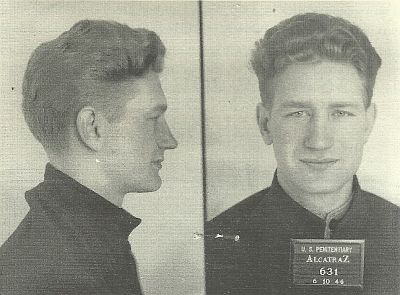
Alctraz Prisoner John Elgin Johnson, 1919-1953.

Alcatraz Inmate John Elgin Johnson, 1919-1953.

John Elgin Johnson, 1919 to 1953, was a career criminal who ended up in the federal prison system for robbing banks. After a failed escape attempt from Fort Leavenworth that left one guard severely injured, Johnson was sent to Alcatraz in 1944. He served nine years there and was released in 1953. During his time in Alcatraz, he underwent a religious conversion that, although sincere, did not stick.

After he was released, he was suspected of murdering a new friend he had made after he had gotten out. The FBI began hunting him and caught up with him while he was in a telephone booth inside a movie theater in Baltimore, Maryland.

According to an interesting story written by the FBI, here is what happened next:

“Inside the booth, Johnson, his criminal cunning ever alert, sensed his impending apprehension. Two shots rang out from the booth. One bullet crashed into the abdomen of agent J. Brady Murphy. Another tore into the hip of Murphy’s fellow agent. All four agents opened fire on the phone booth; and, though mortally wounded, Agent Murphy emptied his revolver at the figure of the desperate man behind the glass and wood partition. Fifteen times the agents fired, and 15 deadly slugs ripped into the booth. Johnson toppled toward the floor, but his head, crashing through the broken glass of the door, held him partly erect. Before he stopped moving forever, he tried vainly once or twice to lift his head.”

When the shootout occurred, Johnson was on the phone with Los Angeles Mirror reporter, Sidney Hughes.

The entire story of John Elgin Johnson’s life can be found, here, on the FBI’s website.


—-###—-